
Pinellas County · Florida CAC-1822618
Residential Heat Pump Repair in St. Pete Beach, Florida
Blume Mechanical Service repairs residential heat pumps in St. Pete Beach, a barrier island city just off the St. Petersburg mainland in Pinellas County. This page covers what shapes a heat pump repair here: salt air, the heating side and its defrost cycle, and flood water. Blume Mechanical Service is a Class A licensed Florida air conditioning contractor, license CAC-1822618.
The City of St. Pete Beach says it has a permanent population of about 10,000 residents. It also calls the city a popular winter residence for people from other parts of the United States, Canada and Europe. Winter is when a heat pump pulls heat from the outside air to warm the house. If you arrive for the season, try the heating mode soon after you arrive rather than on the first cold morning. The outdoor unit spends the whole year in island air, in both modes, and that is where most of this page focuses.
One machine that heats and cools
A heat pump is not a separate heater bolted onto an air conditioner. Guidance published on the U.S. Department of Energy's Building Science Education site says heat pumps use electricity to move heat instead of using electricity to generate heat. In the colder months the system pulls heat from the outside air and pumps it indoors. In the warmer months it works in reverse, taking heat from the house and expelling it outdoors.
So a system that cools well all summer has not yet shown you how it heats. Run it in Heat mode for a while before the first cold night.
Heat pumps may also have auxiliary heat. The same guidance describes it as electric resistance strip heat used as a supplement, and calls that mode costly and inefficient. If the thermostat shows auxiliary heat most of the time, it says to have an HVAC professional check the unit. Our guide to auxiliary heat explains what that display means.
Signs the guidance lists
It names a sudden rise in electricity use on your bill as the most common and apparent sign of trouble. It also lists these:
- the heat pump does not run at all, or cycles off and on often;
- the room never reaches the thermostat setting;
- the house stays humid;
- there is loud noise from the unit or the ducts;
- auxiliary heat shows on the thermostat constantly;
- there are strange smells from the unit or ducts;
- the indoor or outdoor coil is frozen;
- there is mold near or around the heat pump.
For any of these, it advises contacting a qualified HVAC professional.
Cool mornings, frost and the defrost cycle
NOAA's 1991 to 2020 normals for its St. Petersburg airport station put the January normal low at 55.3°F and the January normal high at 69.0°F. December's normal low is 58.7°F and February's is 57.9°F. January has the lowest normal low of any month at that station. The station is in St. Petersburg, not on the island, and these are averages, so single nights can run colder.
The Building Science Education guidance says that when outdoor coils drop below 32°F, condensation freezes on them, forming frost. The heat pump then runs a defrost cycle, switching to cooling mode so warm refrigerant melts the ice. Refrigerant is the working fluid inside the coils and copper lines.
During defrost the fans might stop or slow, and auxiliary heat could come on to keep the temperature stable. Defrost typically takes 5 to 15 minutes. Melted water drips at the outdoor unit, and the guidance warns not to let it pool and refreeze on a walkway.
What is not normal is a unit stuck in defrost or covered in ice. The guidance says to consult an HVAC professional when that happens. Our page on heat pump defrost mode walks through the cycle in more detail.
Salt air on an island outdoor unit
The city describes St. Pete Beach as a barrier island community just off the Pinellas County mainland of Saint Petersburg. A heat pump's outdoor unit sits in that island air in both seasons.
A 2026 literature review for the European Commission's Clean energy for EU islands programme gives a simple test. It says heat pumps within one kilometre of the sea, or where the sea is visible from the site, could be considered at risk of salt damage. Use that test on your own address.
What salt attacks
The review names the parts most at risk:
- The coil. Corroded coils can lead to poor heat exchange and refrigerant leaks.
- The housing and fan guard. Once they corrode, the more fragile parts inside get more salt spray.
- Electrical components. Corrosion there can lead to the unit malfunctioning.
It reports evidence from some EU islands that coastal units can start to corrode in as little as 18 months. In some cases they failed completely within a few years.
What changes the risk
The review says the real risk depends on the site. Prevailing winds can raise salt exposure. A unit facing the sea gets more than one facing inland and shielded by the building. Nearby buildings, trees or other structures can reduce exposure. Higher humidity speeds up the effect of salt, and rainfall helps rinse salt deposits off.
For maintenance, it recommends rinsing the outdoor unit and its coils with fresh water at least every few months. It says to use a low-pressure hose and never a pressure washer, because pressure can damage the fins. It also recommends regular checks of the housing for scratches or coating damage, and of fasteners and brackets. Ask your technician to show you what a safe rinse looks like on your unit. Our guide to coastal coil protection covers coatings and coil choices.
Flood water and where the unit sits
The city's own flood page says hurricanes often cause extensive flooding, but summer thundershowers can bring the same conditions. It also warns that flood waters can be charged by downed power lines. If your outdoor unit sits on a ground pad, it is the part of the system nearest that water.
The Building America Solution Center, a Department of Energy resource built with Pacific Northwest National Laboratory, says floodwaters are likely to completely destroy the electrical components of outdoor HVAC equipment. It recommends raising outdoor equipment at least 1 foot above the base flood elevation. It also says the equipment should be secured to the building or its stand so it resists movement.
In St. Pete Beach, the city says FEMA rules govern all building in the city. If you do not know how high your unit sits compared with your flood elevation, the city lists the elevation certificates surveyors have submitted. You can request a copy of the certificate via email.
If water has reached the outdoor unit, leave the system off and call a licensed contractor. Do not try to restart it to see whether it still runs. For storm preparation, see our hurricane-season HVAC prep guide.
Safe checks before you call
These three checks need no tools and no open panels. Stop at anything that feels unsafe.
- Thermostat settings. The Building Science Education guidance recommends Heat mode in winter and Cool mode in summer, rather than Auto. It says Auto can heat on cool summer nights or cool on sunny winter days. It also suggests starting with the fan on Auto, because continuous indoor fan operation can harm heat pump performance.
- The filter. The same guidance says a dirty filter strains the system. For ducted systems it suggests washing or replacing filters about every 90 days, following the manufacturer. The EU islands review suggests checking more often near the coast, because humidity and salt spray can clog filters faster. See our guide to HVAC air filters.
- Around the outdoor unit and the vents. Clear leaves, palm fronds and anything stored against the outdoor unit, and keep supply vents and return grilles open. The guidance says to keep outdoor units clear of obstructions all year and not to cover a heat pump in winter.
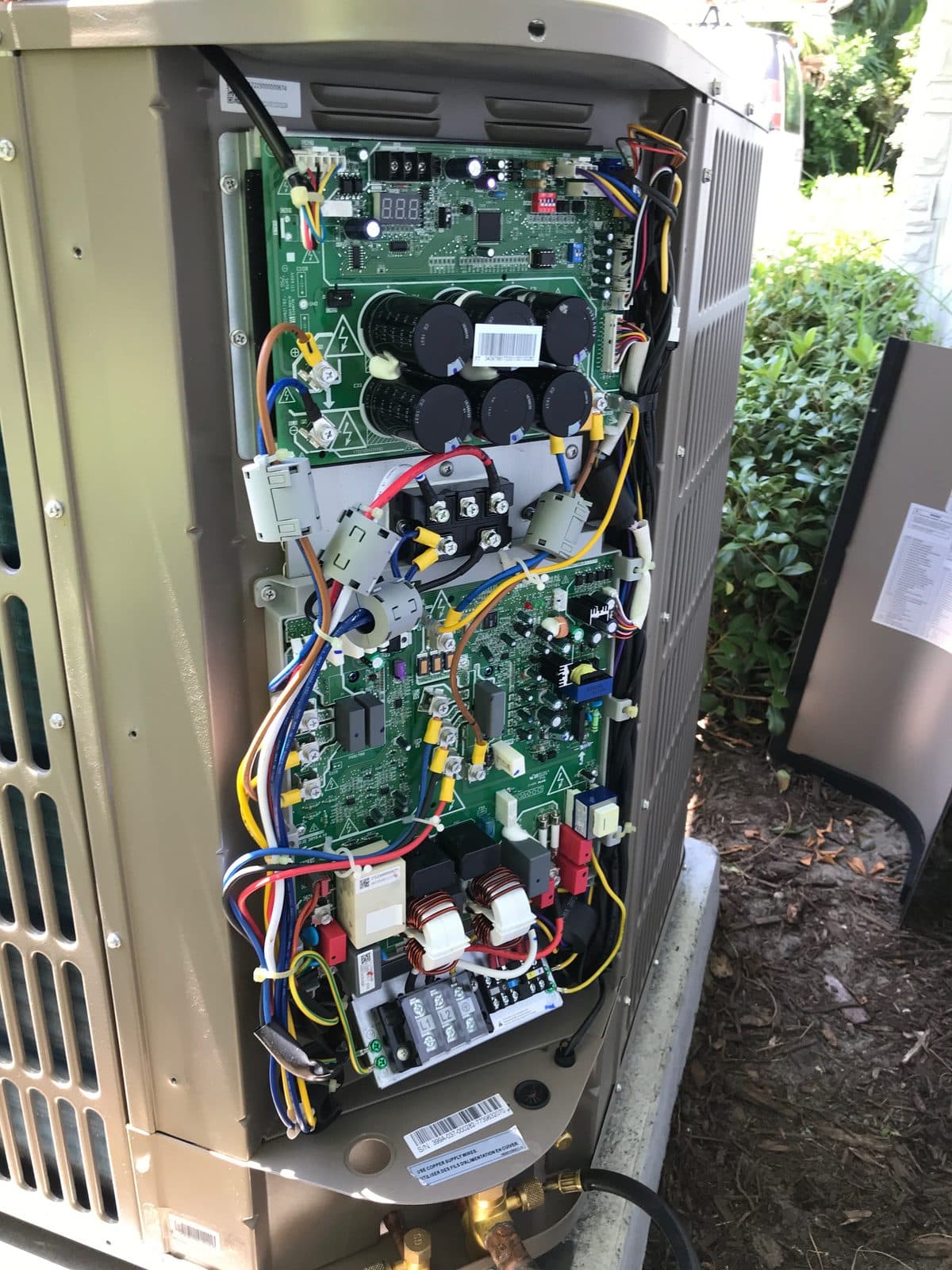
If a breaker for the system has tripped, leave it off and call a licensed contractor. Do not open the outdoor unit's panels, touch electrical parts or add refrigerant. Those jobs belong to a licensed contractor.
What a repair visit should cover
The Building Science Education guidance lists what a heat pump service technician should be able to do:
- check that the system is properly charged with refrigerant, and look for leaks;
- verify adequate airflow;
- clean the outdoor and indoor coils;
- clean the condensate drain pan and check it for clogs;
- inspect the electric terminals;
- seal duct leaks;
- check that the refrigerant lines are insulated and protected from UV;
- confirm the thermostat settings;
- check that supplemental heat comes on only when necessary.
Refrigerant work is regulated. The EPA says technicians who maintain, service, repair or dispose of equipment that could release ozone-depleting refrigerants must be certified. Blume's technicians are EPA Section 608 certified technicians. Our page on EPA Section 608 refrigerant rules explains the certification.
Repair or replace
The same guidance says air source heat pumps typically last about 15 years, depending on the type and how well they are maintained. On a salt-exposed island unit, the coil and housing condition belong in that decision. Blume gives a written, upfront price before any work starts and shows repair and replacement side by side. Blume does not sell equipment a building does not need. When replacement is the answer, the new system is sized with an ACCA Manual J load calculation and Manual S equipment selection. See when to replace a heat pump.
If a replacement needs a city permit, the city's building department says owner signatures are required on all permits, residential and commercial. Its permit desk is at permits@stpetebeach.org or 727-367-2735.
Frequently asked
Do I need to call a pro for this?
Maybe. A wrong thermostat mode, a dirty filter or leaves packed around the outdoor unit you can fix with the checks above. Call a licensed contractor if the outdoor unit stays iced, auxiliary heat runs constantly, a breaker has tripped or flood water reached the unit. Refrigerant and electrical work belong with a licensed contractor only.
The fan on my outdoor unit stopped and there is frost on the coil. Is it broken?
Probably not. The Building Science Education guidance says the heat pump runs a defrost cycle that melts frost off the coils, and fans might stop or slow while it runs. Defrost typically takes 5 to 15 minutes. If the unit stays stuck in defrost or covered in ice, it says to consult an HVAC professional.
Why does my thermostat keep showing auxiliary heat?
Auxiliary heat is electric resistance strip heat that supplements the heat pump. It can come on briefly during defrost. The guidance calls it costly and inefficient, and says frequent use is a reason to have an HVAC professional check that the unit works properly.
My outdoor unit faces the Gulf. What does salt do to it?
The EU islands review says units within one kilometre of the sea, or where the sea is visible, could be at risk of salt damage. Salt can corrode the coil, the housing and fan guard, and the electrical parts. The review recommends regular low-pressure freshwater rinsing and checks of the housing for coating damage. Ask your technician how often your unit needs it.
How do I reach Blume in St. Pete Beach?
Call 727-330-9131. A person answers the 24/7 dispatch line. Blume offers 24/7 emergency HVAC service, with same-day response available based on location and technician availability. The office is at 2840 West Bay Drive #114 in Belleair Bluffs, and Pinellas County is part of Blume's core service area. See our St. Pete Beach service page for other services.
Drain line care and maintenance plans
If the drain line is why you are here, these pages cover what we offer for it:
- DrainGuard condensate drain protection plan
- AC maintenance plans
- Clogged AC drain line: causes and what to do
- AC capacitor replacement, installed by a licensed technician
Homeowner guides
Heat pump trouble in St. Pete Beach? Talk to a Blume technician.
References: City of St. Pete Beach, Community (no date printed) · City of St. Pete Beach, Flooding & Property (no date printed) · City of St. Pete Beach, Flood Information for St. Pete Beach (no date printed) · City of St. Pete Beach, Permits, Applications, Forms (no date printed) · NOAA National Centers for Environmental Information, 1991-2020 U.S. Climate Normals, monthly, station USW00092806 St. Petersburg AP (read November 13, 2026) · Consortium for Energy Efficiency, You Installed an Air Source Heat Pump. Now What? (U.S. Department of Energy Building Science Education, January 2024) · Clean energy for EU islands Secretariat, Literature Review on Salt Exposure Risks and Mitigation Measures for Heat Pumps and Solar Photovoltaics in Coastal Environments (July 2026) · Building America Solution Center (U.S. DOE / PNNL), Outdoor HVAC Equipment Elevated and Secured for Resistance to Floods, Earthquakes, and High Winds (September 2022) · U.S. EPA, Section 608 Technician Certification (March 2026)
Also in St. Pete Beach: AC repair in St Pete Beach · AC maintenance in St. Pete Beach · Heating repair in St. Pete Beach
Residential Heat Pump Repair nearby: Heat pump repair in Clearwater · Heat pump repair in Dunedin · Heat pump repair in Largo · Heat pump repair in Palm Harbor