
Pinellas County · Florida CAC-1822618
Residential Heat Pump Repair in Dunedin, Florida
Blume Mechanical Service repairs residential heat pumps across Dunedin and Pinellas County, from the older bungalows near downtown to the homes out toward Honeymoon Island. We diagnose the actual failure in both heating and cooling, account for the salt exposure this coastal town sees, and pull the Pinellas permit. Florida license CAC-1822618.
Dunedin is a small coastal town on the Gulf side of north Pinellas, just north of Clearwater and connected by causeway to Honeymoon Island. Much of its housing is older — modest bungalows and mid-century homes near the historic downtown and along the waterfront — and the town sits close enough to open salt water that outdoor equipment feels it. A heat pump's outdoor unit lives in that coastal air year-round, in both heating and cooling seasons, and in an older Dunedin home the equipment and the aging duct system have to be judged together.
A heat pump heats and cools with the same machine
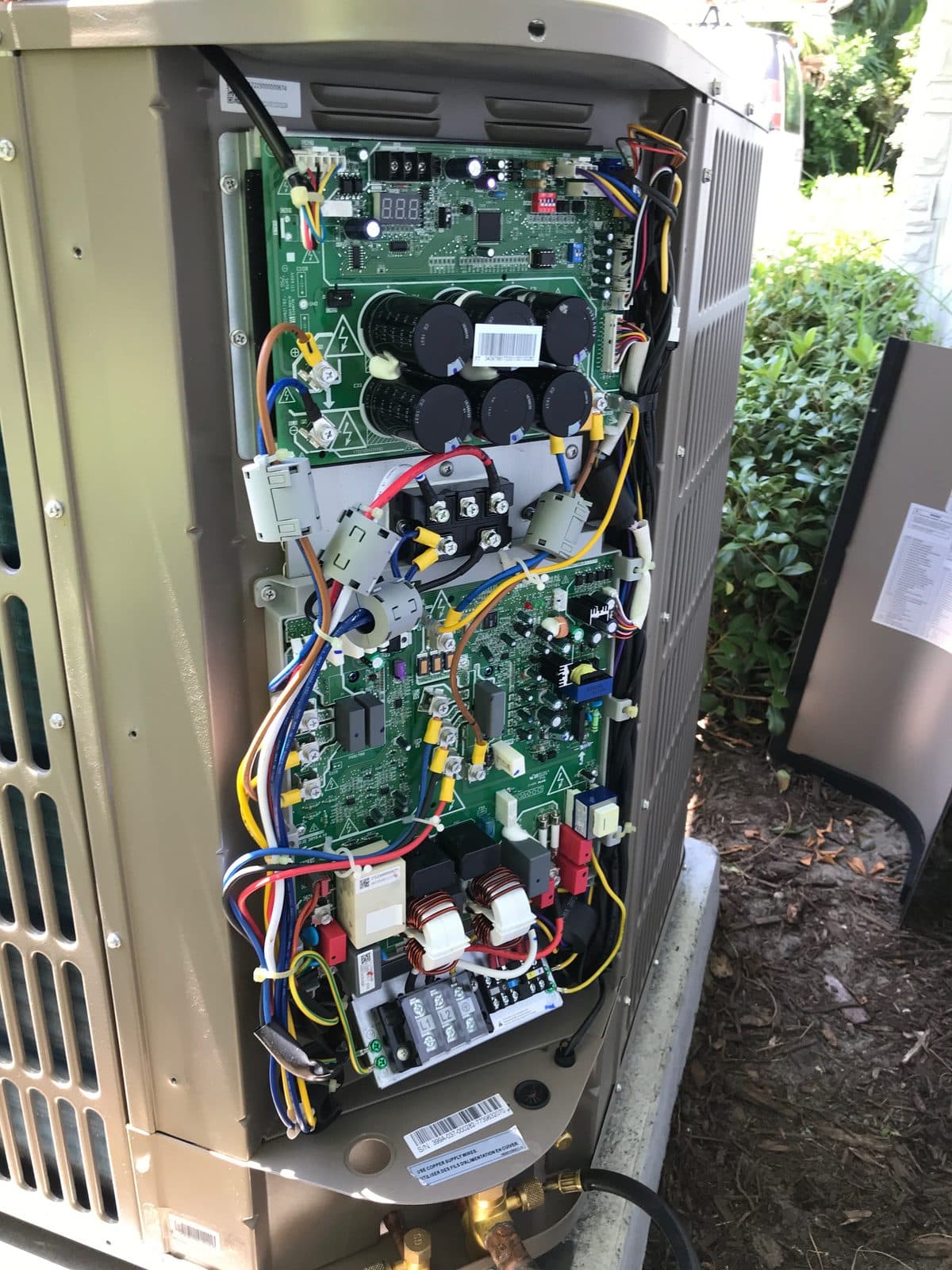
A heat pump is the same refrigeration machine as an air conditioner with one extra part — a reversing valve that lets it run in both directions. In summer it moves heat out of the house like an AC; in winter it reverses and pulls heat from the outdoor air to warm the house without burning fuel. For a mild coastal climate like Dunedin's, where the system spends most of its life cooling and only occasionally heating, a heat pump fits well.
Because it does two jobs, a heat pump has more ways to fail than a cooling-only system, and the failures are not interchangeable. When a Dunedin homeowner says the system 'is not heating,' the cause is usually a stuck reversing valve, a low refrigerant charge from a leak that weakens heating first, a failed defrost control that lets the outdoor coil ice over, or dead auxiliary heat strips. When they say it 'is not cooling,' it is more often a weak capacitor, a pitted contactor, a low charge, or restricted airflow.
Our job is to tell these apart before touching a part. The reversing valve is one of the most expensive single components to replace, and it is the last thing anyone should swap on a hunch. We measure the charge, verify the valve responds, and check the defrost and auxiliary circuits, then repair what the evidence actually points to rather than what the thermostat complaint superficially suggests.
Coastal salt exposure near Honeymoon Island
Dunedin sits close to the Gulf, and homes near the waterfront and out toward the Honeymoon Island causeway see meaningful salt exposure. Salt-laden air is corrosive to the aluminum fins and copper tubing of a heat pump's outdoor coil, and to the fan and electrical connections. It is not always the open-barrier-island severity of a beachfront unit, but for waterfront and near-water Dunedin homes it is real, and a coastal outdoor unit ages faster than an identical one placed a few miles inland.
This matters more on a heat pump than a cooling-only unit because the outdoor coil does double duty: it rejects heat in cooling, absorbs heat in heating, and frosts and defrosts. A corroded coil is compromised in every role. On a salt-exposed Dunedin unit we begin seeing oxidation on the aluminum fins within the first few years; by mid-life the fin deterioration is measurable, with fins bridged or eaten back; late in life the usable coil face is reduced, head pressure runs chronically high, and the efficiency the system was sold with is gone.
We call an outdoor coil finished on three conditions: visible perforation or an active leak at the coil, substantial loss of fin area that keeps head pressure elevated even with a correct charge, or corrosion severe enough that a coil replacement approaches the cost of replacing the whole system. Factory-applied protective coil coatings genuinely extend coastal service life and are worth specifying on a waterfront Dunedin installation, and rinsing the outdoor coil with fresh water on a routine schedule helps more here than it would inland.
Older bungalows: small mechanical spaces and aging ducts
Dunedin's older housing — the bungalows and mid-century homes near downtown and along the water — carries the pattern common to small older Florida towns. Air handlers are often tucked into tight closets or converted spaces. Ductwork was installed decades ago, retrofitted more than once, and runs through hot attics with degraded insulation and returns that are frequently too small for the airflow a modern heat pump wants.
A heat pump can only deliver what the duct system carries, and in an older Dunedin home the ducts are often the reason a good system underperforms. The complaint the homeowner feels is not 'duct leakage' — it is a room that never gets comfortable, weak airflow at the far register, a system that runs and runs, or a house that will not dehumidify. We see the equipment blamed for what is really a duct problem more often than almost anything else.
So on an older Dunedin home we do not diagnose the heat pump in isolation. We check static pressure across the air handler, look at return sizing, and inspect accessible duct runs before condemning a compressor or a coil. A heat pump forced to push air through a restrictive, leaky duct system runs hotter, works harder, and fails younger. Repairing the machine without addressing the ducts just resets the clock on the same complaint.
The defrost cycle and the rare Dunedin cold snap
North Pinellas rarely gets cold, but a few mornings each winter the temperature drops low enough that a heat pump's outdoor coil frosts over. This is normal. When the outdoor coil is absorbing heat from cold, damp coastal air, moisture condenses and freezes on it; left alone, that frost insulates the coil and kills heating. Every heat pump handles this with a defrost cycle — it briefly reverses to send warm refrigerant out and melt the frost, then switches back. A heat pump 'steaming' on a cool Dunedin morning, or a whoosh as it changes modes, is the system working correctly.
What is not correct is a coil that stays iced solid. A failed defrost sensor or control board leaves the coil glazed over, and heating output collapses. Homeowners describe this as the system 'blowing cold when it should be warm.' The same complaint can also be a stuck reversing valve or a low refrigerant charge, which drops heating capacity first. These look identical from inside the house and are different repairs.
Because Dunedin winters are mild, most homes lean on the heat pump itself and only occasionally on the auxiliary electric heat strips. When a hard freeze does arrive and a system will not keep up, we check whether the aux heat is actually firing, because a dead heat strip is often the difference between a comfortable house and a cold one on the coldest morning of the year — and it is easy to miss precisely because it is asked to work so seldom.
Humidity, short cycling, and a damp house at setpoint
A heat pump cooling a Dunedin home does two jobs: it lowers temperature and removes moisture. In a humid coastal climate the moisture half matters, and it is the half a house notices when it is missing — the thermostat reads 74 and the rooms still feel clammy. A heat pump only dehumidifies while it runs, so a system that short-cycles — satisfying the thermostat in a few minutes and shutting off — leaves the house cool and damp.
In older Dunedin homes this shows up two ways and neither is fixed by adding refrigerant. An oversized system, chosen by rule of thumb rather than a load calculation, cools the air fast and shuts off before drying the house. Or leaky attic ductwork pulls humid coastal air into the system, so the equipment fights moisture the ducts keep importing. We prove the machine first — charge, airflow, whether the indoor coil gets cold enough to pull water out of the air — then look at what feeds it. A rise in temperature or humidity between the return grille in the room and the air arriving at the coil is a clear tell the ducts are adding load before the equipment sees it.
Only after refrigeration, airflow, the coil, and the ducts are clean, and the system still short-cycles, does oversizing become the credible answer. That is a selection decision confirmed by a Manual J load calculation rather than by floor area alone. Condensate is part of this too: the indoor coil sheds water in cooling and the outdoor coil sheds water during defrost, and a blocked drain line in a small older home produces overflowing pans and stained ceilings quickly. We treat the drain path as part of the system, not an afterthought.
Refrigerant, permits, and honest repair-or-replace
A heat pump does not consume refrigerant, so a system that is low has a leak, and the honest repair finds the leak rather than topping off the charge. Refrigerant work is regulated — only EPA Section 608-certified technicians may open a sealed circuit, recover refrigerant, and recharge a system. Under the federal AIM Act the country is phasing down high-GWP refrigerants, and new residential heat pumps have moved from R-410A to lower-GWP refrigerants such as R-454B. Existing R-410A systems remain legal to operate and service, and refrigerant is still available for them.
Equipment change-outs in Dunedin require a mechanical permit, issued either by the City of Dunedin or unincorporated Pinellas County depending on the address. Confirm the requirement for your specific address before work begins, because an unpermitted change-out becomes your problem at resale or an insurance four-point inspection, not the installer's.
The repair-or-replace call rarely turns on refrigerant alone. It turns on the equipment's age and condition, whether the failure is a cheap component or the compressor or a corroded coil, and — on a coastal unit especially — how far the salt has gone. A heat pump that holds its charge, has a sound coil, and lost a capacitor or a contactor does not need replacing because it uses R-410A. But on a waterfront Dunedin unit, the coil is often what actually ends the system's life, not the compressor, and replacing a compressor behind a badly corroded coil is money spent on the wrong component. If a company condemns a Dunedin system on age or refrigerant type alone with nothing measured behind it, that is not a diagnosis.
Frequently asked
My outdoor unit near the water is corroding. Can it still be repaired?
It depends on how far the corrosion has gone. Dunedin's coastal salt air oxidizes the aluminum fins and copper of an outdoor coil, along with the fan and electrical connections. Early oxidation and pitted contactors are repairable. But when corrosion perforates the coil, causes an active leak, or eats away enough fin area that head pressure stays high even with a correct charge, the coil is finished regardless of what we do to the charge. On the coast the coil often ends the system's life before the compressor does, so we look hard at it before recommending an expensive component repair.
My heat pump blows cold air when I set it to heat. What is wrong?
On a heat pump that has several possible causes and they are different repairs. The reversing valve may be stuck in cooling. The refrigerant charge may be low from a leak, which weakens heating first. The defrost control may have failed and iced the outdoor coil. Or the auxiliary heat strips that back up the system on a cold morning may be dead — easy to miss in Dunedin because they run so seldom. We measure the charge, test the reversing valve, and check the defrost and aux circuits before replacing anything, because the reversing valve is expensive and the wrong guess is costly.
My heat pump was steaming outside on a cold morning. Is it broken?
Almost certainly not. On a cold, damp Dunedin morning a heat pump's outdoor coil frosts, and the system runs a defrost cycle — it briefly reverses to send warm refrigerant out and melt the frost, which produces steam and sometimes a whooshing sound as it changes modes. That is normal and it protects heating output. What is not normal is a coil that stays iced solid and never clears, which points to a failed defrost sensor or control board and needs service.
Do I need a permit to replace a heat pump in Dunedin?
Generally yes. Equipment change-outs require a mechanical permit, issued by the City of Dunedin or unincorporated Pinellas County depending on the address. Confirm the requirement for your specific address before work begins. An unpermitted change-out becomes your problem at resale or an insurance four-point inspection, not the installer's — Florida insurers commonly flag equipment whose installation date does not match a permit record, and from there a carrier may require the permit be pulled retroactively, exclude the system from coverage, or decline the policy, any of which can hold up a closing.
Do you work on both homes and commercial buildings?
Both. A good share of our work is commercial mechanical service, which is where our documentation and diagnostic discipline comes from. A warranty denial on commercial equipment is expensive, so we learned to prove failures with measurements rather than guess. Dunedin homeowners get the same process on a smaller system: the failure is measured, the cause is identified, and on a coastal unit the condition of the outdoor coil is weighed honestly into whether a repair or a replacement is the right call.
Homeowner guides
Heat pump trouble in Dunedin? Talk to a licensed technician.
References: Pinellas County permitting and contractor licensing (primary) · US Department of Energy — heat pump systems · US EPA — AIM Act HFC phasedown and Section 608 refrigerant handling · General HVAC engineering principles
Also in Dunedin: AC replacement in Dunedin · Mini-split installation in Dunedin
Residential Heat Pump Repair nearby: Heat pump repair in Clearwater · Heat pump repair in Largo · Heat pump repair in Palm Harbor · Heat pump repair in St. Petersburg