
HVAC, explained
Heat Pumps in Florida, and What Salt Air Does to the Outdoor Unit
A heat pump is an air conditioner that can also run in reverse, so one outdoor unit both cools and heats the house. In Florida, two things need extra care. One is how well the system removes summer humidity. The other is how the outdoor unit is built, raised and anchored if it sits near salt water, in a flood zone or in a hurricane's path.
If you are still comparing a heat pump with other systems, those questions have their own pages: heat pump vs furnace and heat pump vs straight-cool air conditioner. The facts below come from public documents, not from Blume field measurements. The sources include the National Weather Service, ENERGY STAR, EPA, FEMA and the State of Florida.
What changes for a heat pump in Florida
The National Weather Service's Tampa Bay office says the rainy season brings more humidity. Dew point values typically stay above 70°F, and daily lows run in the 70s to around 80°. The office dates that season May 25 to October 10 for West Central Florida outside Southwest Florida. Its dew point page also lists seven consecutive days at or above 75°F, August 5 to 11, 2024.
Dew point is the temperature at which water vapor in the air begins to condense. It measures how wet the air is. An indoor coil colder than that temperature pulls water out of the air. That is how the system that cools a house also dries it. Over a rainy season of more than four months, humidity control is a core job of the system, not a bonus.
Humidity: ducted systems, ductless mini-splits and sizing
ENERGY STAR says your contractor should verify the proper size system for your home using a tool called Manual J, a standard home load calculation. It also says a system that is too large or too small will struggle to meet your comfort needs. A sizing guide hosted by the Department of Energy was written for cold climates. One point still applies here: grossly oversizing equipment can lead to excessive cycling, low efficiency and ineffective summer dehumidification.
In a 2017 Department of Energy webinar, Florida Solar Energy Center researchers described lab-home tests run from 2010 to 2015. A variable-capacity unit changes its output instead of switching fully on and off. A centrally ducted one in the tests showed substantially long runtimes. Even so, average indoor humidity was similar to a fixed-capacity system. Supplemental dehumidification (extra moisture removal) was still required overnight and in the early morning. A ductless mini-split never operated close to its lowest stated capacity and cycled at low load.
The same slides say the longer run times of variable-capacity systems create potential for better humidity control. They also state that extra moisture removal is required in high-performance homes in humid climates. One 2013 test of a solar-powered supplemental mini-split showed good humidity control under high load, in a high-mass (heavily built) building.
Those were lab-home tests, not a verdict on any model you can buy. They are a reason to ask how the installer will confirm the indoor humidity the system holds on a humid day. Variable-speed air handlers and why a house stays humid with the AC running go deeper.
What the efficiency and refrigerant labels leave out
ENERGY STAR sets minimums for split-system heat pumps of 15.2 SEER2, 11.0 EER2 and 7.8 HSPF2. SEER2 and EER2 rate cooling efficiency, and HSPF2 rates heating efficiency. A separate Cold Climate mark is for heat pumps optimized for peak heating and part-load cooling. All other heat pumps use the standard mark. Florida and salt corrosion do not appear anywhere in the specification text. So the label alone does not tell you how a unit will handle a Tampa Bay summer or a salt-air yard.
ENERGY STAR ended its central air conditioner specification on February 1, 2026. The heat pump specification (Version 6.2, revised February 2026) remains in place. For split systems, certification is based on the rated performance of the particular combination of indoor and outdoor units. If a proposal pairs a new outdoor unit with your existing indoor coil, ask which rated combination you are getting.
The refrigerant has changed as well. EPA says the manufacture of R-410A residential and light commercial air conditioning products has been prohibited since January 1, 2025. EPA's Significant New Alternatives Policy (SNAP) program lists acceptable refrigerant substitutes. For residential and light commercial air conditioning and heat pumps, it shows R-454B and HFC-32 (R-32) as acceptable with use conditions. Both are classed A2L, an ASHRAE safety class for refrigerants with lower flammability. R-454B vs R-32 and R-410A after 2025 explain the difference.
The outdoor unit: the condenser lives outside
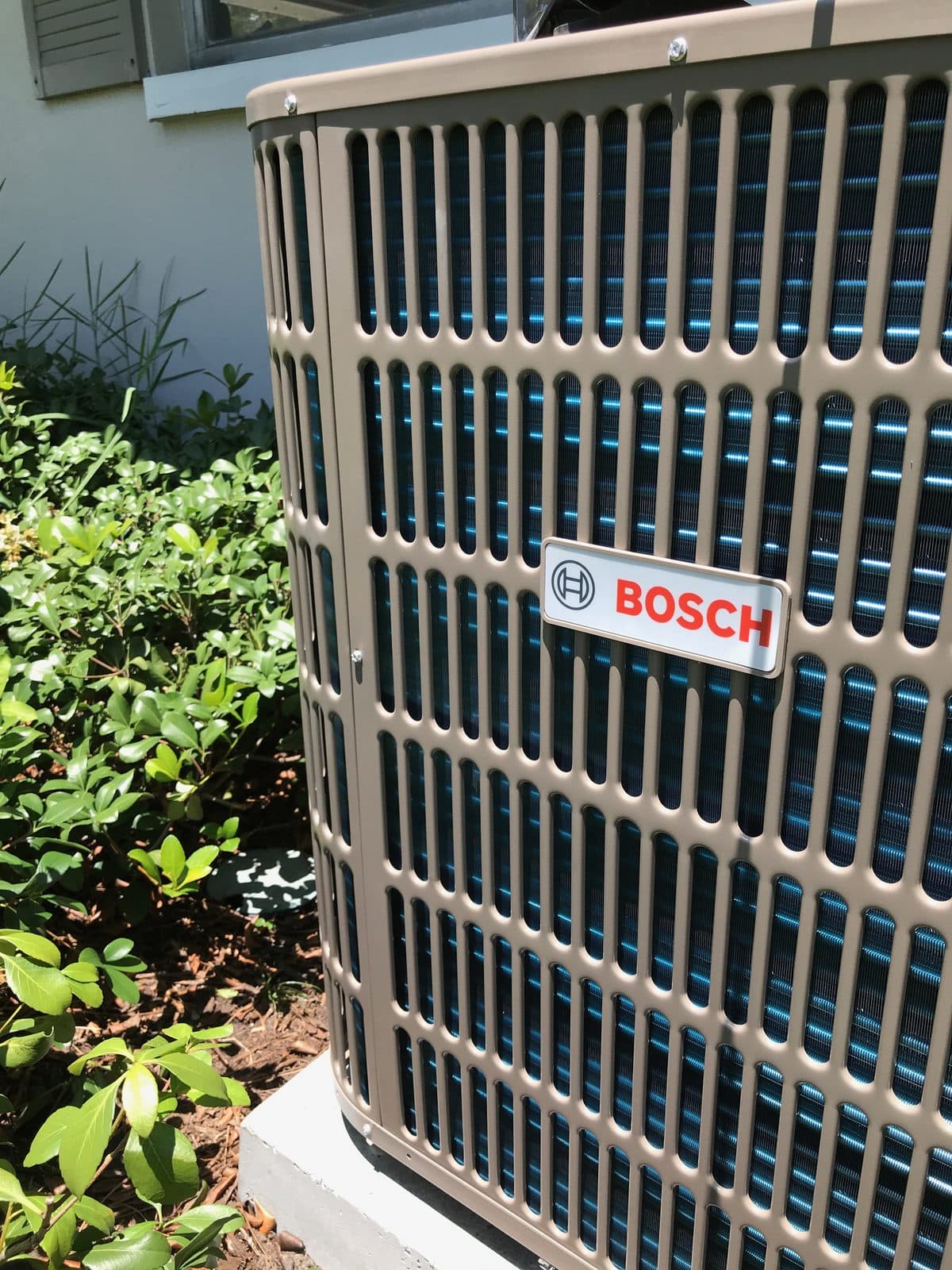
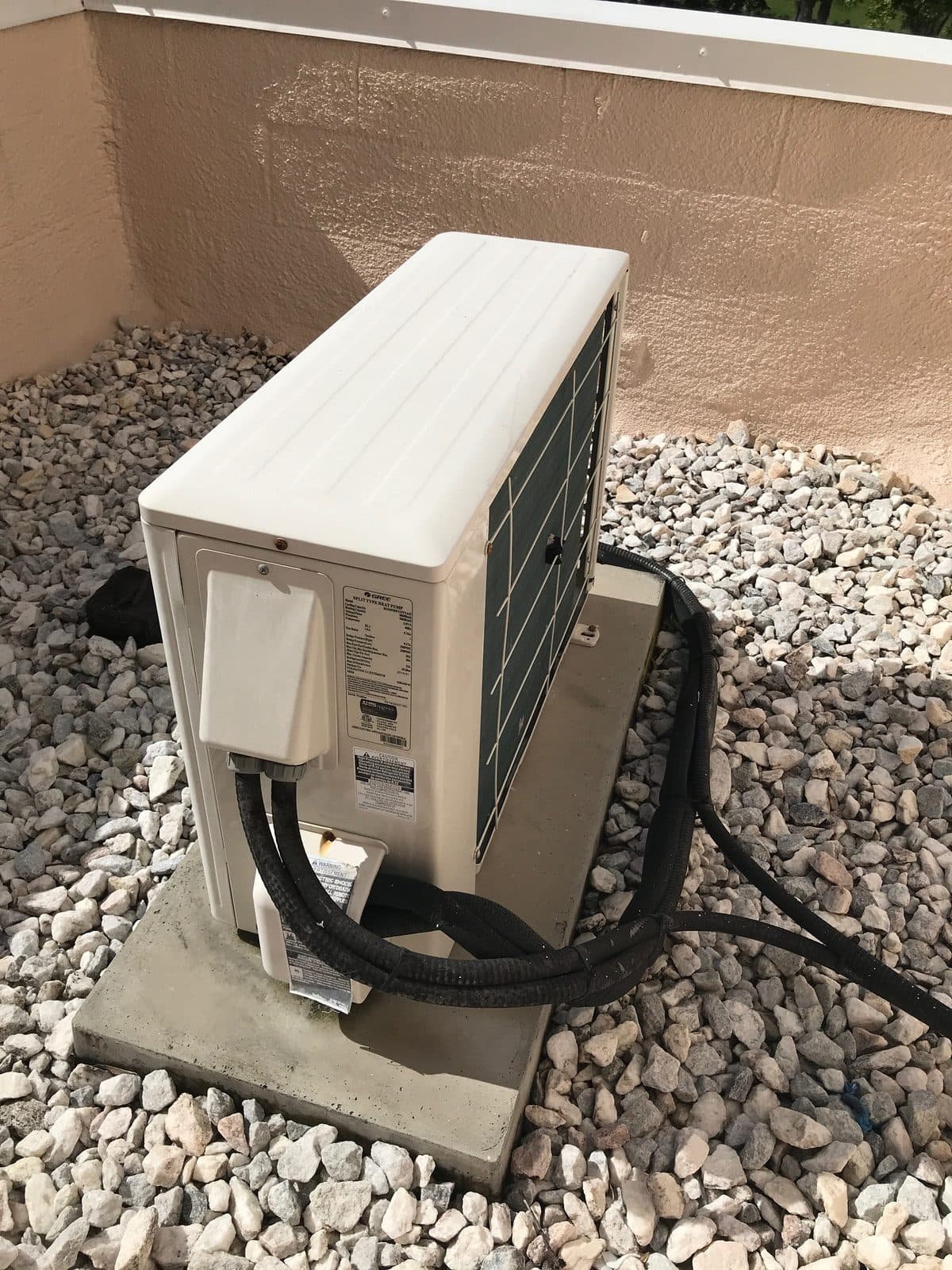
On a heat pump, the outdoor unit holds the compressor, a fan and a large coil; the coil is the condenser in cooling mode and takes heat from the air in heating mode.
Three Florida conditions act on it: salt in the air, water at ground level, and wind. Coastal coil protection covers how salt attacks the coil and when a coated coil is worth specifying, so this page does not repeat it. What follows adds what that page does not: sourced distance figures, how high the unit sits, and what it is fastened to.
How far from salt water counts as coastal
A Florida Building Commission informational notice dated February 12, 2002, reproduces FEMA Coastal Construction Manual guidance. The notice says that guidance may be used as the fastening system for residential mechanical units. That guidance was written about equipment on roofs. For buildings within 3,000 feet of the ocean, it recommends nonferrous (iron-free) metal, stainless steel, or steel with a minimum G-90 hot-dip galvanized (zinc) coating. That covers the equipment itself, its stands and its anchors, and it adds that stainless steel fasteners are also recommended. It is guidance, not a code requirement, and it is more than twenty years old.
Carrier, which sells a coastal line, says on its coastal page that there is no single distance from the coast that determines whether you need a coastal HVAC unit. It says salt water can be carried as far as two miles from the coast. It also says the level of corrosion exposure depends on factors such as distance from the ocean, wind direction, humidity and local contaminants. Three thousand feet is a little over half a mile. Together the two sources describe a gradient, not a boundary, so the checklist below asks about your address.
A 2017 report presented to the Florida Building Commission looks at corrosion of residential fasteners. It lists anecdotal information that corrosion has been observed across a range of installations. It also says the problem is more serious in coastal environments because of chloride ions from salt. That concerns fasteners, not coils, but the hardware holding a unit in place is part of the coastal question.
No document cited on this page measures how much sooner a coastal outdoor unit fails than an inland one. Be cautious with any contractor or website that quotes a precise coastal lifespan without showing where the number comes from.
Flood zones: how high the condenser sits
Section R322.1.6 of the Florida Building Code, Residential, covers heating, ventilating and air conditioning equipment and duct systems. They must be located at or above the elevation required in section R322.2 or R322.3. The state Division of Emergency Management compiles this text in its flood provisions of the 8th Edition code. R322.2 applies in flood hazard areas, and R322.3 in coastal high-hazard areas. Replacement of exterior equipment damaged by flood must meet the same requirements. An exception lets equipment sit lower only if it is designed and installed to keep water out and to resist flood forces. The code points to the engineering standard ASCE 24.
Pinellas County's Application for Construction in a Floodplain, revised 12/24, has a rule for utilities, including the air conditioning compressor/unit. They must be above base flood elevation plus freeboard or the design flood elevation, whichever is higher. Base flood elevation is the flood height used for planning, and freeboard is an extra safety margin above it. The City of Gulfport has a notice on equipment damaged by flood. It says permit applications to replace exterior A/C units must include documentation of how the code requirements will be met.
FEMA's Hurricane and Flood Mitigation Handbook for Public Facilities (FEMA P-2181, March 2022) says HVAC components generally are not flood resistant. They will be damaged or destroyed when exposed to flood water. The handbook lists raising outdoor compressors onto platforms or pedestals above the flood protection level. It is written for public buildings, so for a house it is engineering guidance, not a rule.
The elevation that applies depends on your flood zone and your local floodplain rules. Ask the building or floodplain office what it is for your address, and get the number in writing before any equipment is ordered. HVAC permits in Florida covers the permit side.
Stands, anchors and wind
For coastal flood zones (Zone V), FEMA's guidance is to anchor HVAC equipment to platforms attached to the main structure. It says to use corrosion-resistant connectors and fasteners, to protect the equipment from storm surge and wave action. It also says platforms and pedestals should be well anchored to withstand being dislodged by flood forces.
Wind acts on the same hardware. The Florida Division of Emergency Management's Hurricane Retrofit Guide warns that outdoor equipment such as air conditioner compressors can be blown off their pads or supports. The FEMA manual text reproduced in the 2002 Commission notice says tearing away of roof equipment typically occurs because of inadequate anchorage, inadequate strength of the equipment itself and corrosion. It also says flood waters can force mechanical equipment from its supports.
Hurricane season HVAC prep covers storm preparation for the whole system.
What to specify, and what to ask in writing
These seven questions turn the points above into things a contractor can answer on paper. They work for any contractor's proposal.
- Where will the outdoor unit sit relative to the flood elevation required at this address, and who confirmed that elevation?
- What are the stand or platform and the anchors made of, and are they designed for the wind and flood loads at this site?
- Are the fasteners stainless steel or another corrosion-resistant material?
- Does the manufacturer offer a coastal or corrosion-protected coil option for this model, and what does the warranty certificate say about corrosion?
- How will you confirm the indoor humidity the system holds on a humid day, beyond the thermostat setting?
- Which rated indoor and outdoor combination am I getting, and which refrigerant does the outdoor unit use?
- Does the permit application document how the elevation requirement is being met?
Ask for the answers in the written proposal, not only in conversation. Opening the outdoor cabinet and anchoring a unit to a structure are professional work. The cabinet holds refrigerant under pressure and live electrical parts, so leave it closed.
Frequently asked
Is a heat pump a good choice for a Florida home?
It can be, and the comparison has its own pages: heat pump vs furnace and heat pump vs straight-cool. Florida adds humidity and sizing questions. For a home near the water, it also adds questions about the outdoor unit's elevation, anchoring and corrosion protection.
Does salt air damage the outdoor unit of a heat pump?
Carrier's coastal page says salt and other airborne contaminants can accumulate on outdoor components. It also says standard copper-aluminum coils can suffer from galvanic corrosion without specialized protection. That is corrosion between dissimilar metals. No document cited on this page measures how much sooner a coastal unit fails than an inland one. Coastal coil protection covers the coil.
How high does the outdoor unit have to be in a flood zone?
It depends on the flood zone and the local floodplain rules for your address. The Florida Building Code, Residential, requires HVAC equipment at or above the elevation in section R322.2 or R322.3. Your building or floodplain office can state the number for your address.
Is there a Florida version of the ENERGY STAR label for heat pumps?
Not in the specification itself. It has one national set of levels plus a separate Cold Climate mark, and neither Florida nor salt corrosion appears in its text.
Will a heat pump keep my house from feeling humid?
In the Florida lab-home tests described above, a variable-capacity heat pump held average indoor humidity similar to a fixed-capacity system. It still needed extra moisture removal overnight and in the early morning. Ask the contractor how the indoor humidity will be checked on a humid day.
Do I need to call a pro for this?
Maybe. Near the coast the useful homeowner habit is keeping the ground around the outdoor unit clear so air moves freely and water drains away. That is where your part ends. Salt damage shows up on the coil and in the electrical cabinet, and inspecting or treating either is a licensed contractor's work, not a job for a garden hose.
Related
- Coastal coil protection
- Heat pump vs furnace
- Heat pump vs straight-cool AC
- House humid with the AC running
- Variable-speed air handler
Blume Mechanical Service is a licensed commercial and residential HVAC contractor serving Florida's Tampa Bay region (CAC-1822618). Blume installs and services all major brands as a licensed contractor, and estimates on new systems and retrofits are no-cost. If you are comparing heat pump proposals near the water, take the checklist above with you.
Last updated: 2026-11-05
Sources: Florida Building Commission, Informational Notice #2 (February 12, 2002), reproducing FEMA Coastal Construction Manual ch. 12 (pp. 12-143 to 12-145) · Florida Building Code, Residential, R322.1.6 (8th Edition, via Florida Division of Emergency Management) · FEMA P-2181, Fact Sheet 3.4.1 (March 2022) · Florida Division of Emergency Management, Hurricane Retrofit Guide · Florida Building Commission, Corrosion of Residential Fasteners (June 2017) · Pinellas County, Application for Construction in a Floodplain (12/24) · City of Gulfport, equipment damaged by flood notice · ENERGY STAR, Heat Pump specification Version 6.2 and central air conditioner sunset notice · ENERGY STAR, Air-Source Heat Pumps · Florida Solar Energy Center, DOE webinar (October 3, 2017) · Guide to Sizing & Selecting Air-Source Heat Pumps in Cold Climates (DOE-hosted) · National Weather Service Tampa Bay, Dew Point Statistics and Thunderstorm Season · EPA, SNAP listing, HFC phasedown FAQ, and 86 FR 24444 (2021) · Carrier, Coastal Heating and Air