
HVAC, explained
Hurricane Season HVAC Prep in Florida
Before a storm: cool the house down early, then shut the system off at the thermostat and the breaker before conditions arrive — a running system is the one most likely to be damaged by surges and flying debris. After the storm: do not restart a system whose outdoor unit sat in flood water or that took visible damage; have it inspected first. Most hurricane HVAC losses happen in the restart, not the storm.
Tampa Bay's hurricane season runs June through November, and the air conditioner is one of the most exposed and most expensive pieces of equipment on a Florida home. It lives outdoors, it is full of electrical components, and it sits on or near the ground in a region where storm surge and street flooding are routine. The good news is that most hurricane-related HVAC damage is preventable with about thirty minutes of preparation — and most of the damage we actually see comes not from wind or water directly, but from how the system is restarted afterward. This guide covers what to do before the storm, during the outage, and in the critical first hours after power returns.
Before the storm: cool deep, then shut down
Once a watch is issued, run the system harder than usual — set the thermostat a few degrees cooler than normal so the house and its contents start the outage as cold as possible. A closed-up Florida house holds that stored cooling for a surprisingly long time. Then, before conditions deteriorate, shut the system down deliberately: off at the thermostat first, then off at the outdoor disconnect or the breaker panel. The reason is electrical. Hurricanes bring exactly the grid behavior that kills HVAC components — repeated brownouts, surges as lines fail and reclose, and voltage sag as the grid strains. A compressor that tries to restart into a brownout can stall under load and overheat; a control board hit by a surge is done regardless of what the rest of the unit looks like. A system that is electrically disconnected cannot be hurt by any of it.
Protect the outdoor unit — but never wrap it while it runs
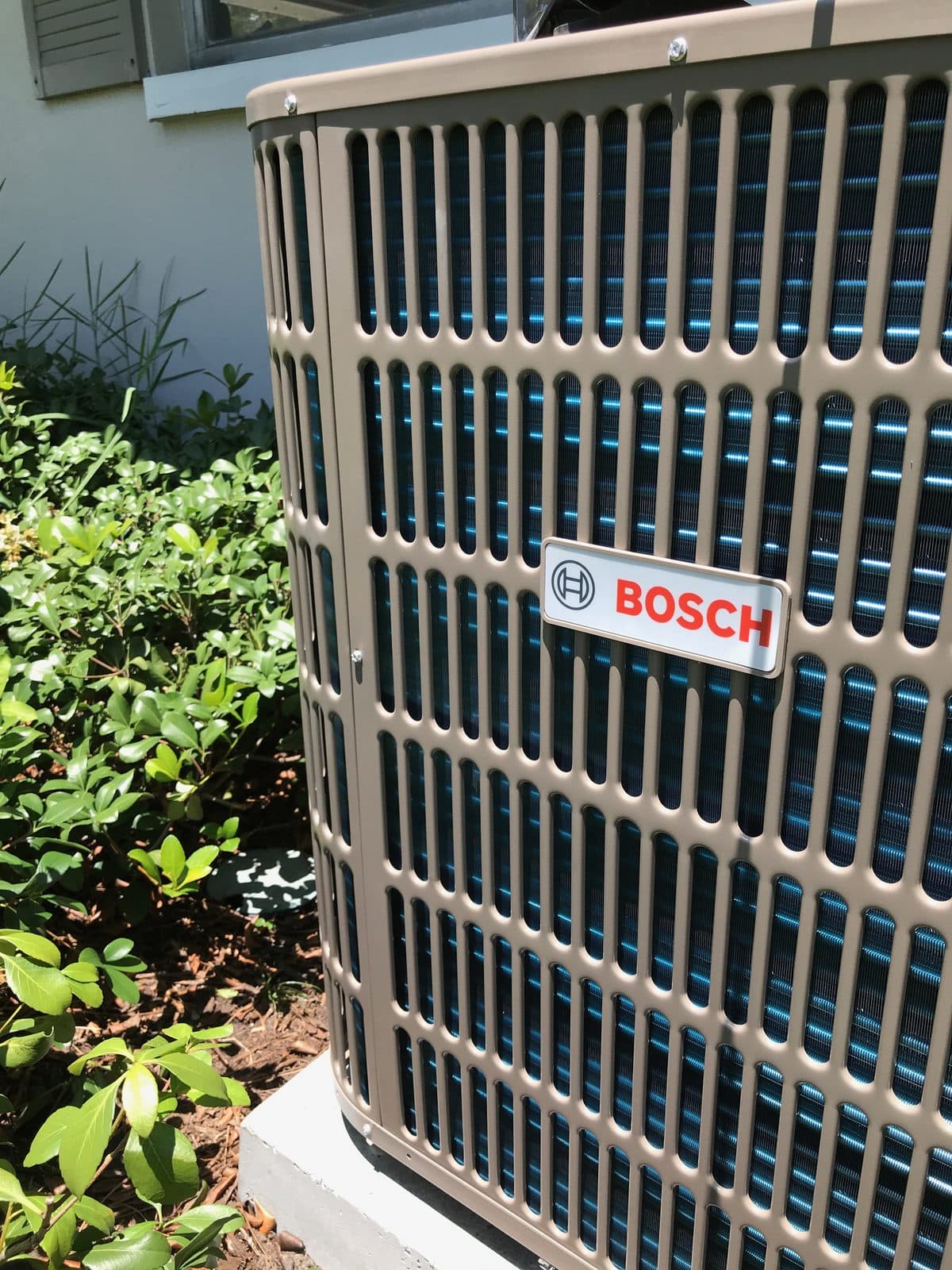
Flying debris is the mechanical threat. If you have time, clear the yard around the condenser: patio furniture, potted plants, trampolines, anything the wind can throw into the coil fins or fan grille. Some homeowners strap a sheet of plywood over the top of the unit to shield the fan from falling branches — that is reasonable if it is anchored well, but anything loosely secured becomes debris itself. A tarp or manufacturer cover is acceptable only on a unit that is fully powered off; never cover a unit that might run, because a covered running condenser cannot reject heat and will trip or damage itself. If your condenser sits low in a flood-prone yard, check whether it is anchored to its pad — hurricane straps for condensers are a small, cheap job that prevents a toppled unit, and Florida code has required tie-downs on new installations for years.
During the outage: leave it off
When the power fails, make sure the system stays off at the breaker even if the thermostat is dark. Grid restoration is messy: power often comes back in surges, drops again, and stabilizes only after several cycles. A system left switched on will try to restart at the first flicker — which is the worst possible moment. Keep the house closed up to hold the stored cooling, run battery fans if you have them, and resist the urge to open windows unless the outside air has genuinely cooled. Humidity is the real enemy of the wait: an opened-up house in post-storm Florida air loads the walls, floors, and furniture with moisture that the system will have to remove later, hours of extra runtime you can avoid by keeping the envelope shut.
After the storm: the restart is where systems die
Before restoring power to the HVAC breaker, walk the equipment. Outdoors: is the unit standing level on its pad, is the coil free of impaled debris, and — critically — is there any evidence it stood in water? A mud line, wet insulation on the refrigerant lines, silt on the pad, or debris caught in the base louvers all mean the unit flooded. A condenser that sat in water, especially brackish surge water, must not be energized until it has been inspected: submerged contactors, capacitors, and compressor terminals can short, and salt residue keeps conducting long after the water is gone. Indoors: check the air handler closet or attic for water staining and confirm the drain line outlet is not buried under storm debris. If everything looks clean and dry, restore the breaker, wait several minutes for the grid and the unit's internal timers to settle, and then call for cooling at the thermostat — one stage, not an aggressive setpoint drop. Listen for the first few minutes: grinding, buzzing, or repeated clicking is a stop-and-call signal, not a break-in period.
Flooded equipment: what insurance and code actually expect
A flooded air conditioner is not automatically a total loss, but it is automatically an inspection case. Water level matters: a unit that got wet feet is different from one submerged past its electrical box. What a proper post-flood inspection covers is the contactor and capacitor condition, compressor terminal insulation, wiring connections, and — on heat pumps and communicating systems — the outdoor control board. Document everything before cleanup: photos of the mud line on the unit, the surrounding yard, and any debris damage support both insurance claims and permit questions if replacement is needed. Be wary of any contractor who quotes a full system replacement from the curb without opening the unit; be equally wary of anyone willing to just flip a flooded unit back on to 'see if it runs.' Both shortcuts get expensive.
Generators and air conditioning: size honestly
Every hurricane season we see systems damaged by undersized portable generators. An air conditioner's compressor draws several times its running current at the moment it starts, and a generator that cannot supply that inrush delivers a voltage sag instead — the same brownout condition that stalls and overheats compressors. Most portable generators can run a refrigerator, fans, and lights but cannot legitimately start a central air conditioner, whatever the label math suggests. If storm-outage cooling matters for your household — and for homes with elderly residents or medical equipment it genuinely can — the honest solutions are a properly sized standby generator installed with a transfer switch, or a soft-start kit on the condenser that reduces the inrush a generator must supply. Both are planned, permitted work for the off-season, not the week a storm has a name.
Inverter air conditioners, starting current and backup power
ENERGY STAR explains the difference using room air conditioners: a conventional compressor works like an on/off switch, either on at maximum capacity or off, while a variable-speed compressor's motor speed can fluctuate in response to the cooling needs of the room. A 2015 test report prepared for Lawrence Berkeley National Laboratory describes the ductless inverter air conditioners it tested the same way: they adjust the rotation speed of the compressor to provide only enough cooling capacity to meet demand.
The same report measured start-up: each of the seven units displayed relatively low inrush currents compared to conventional residential air conditioners, and their compressors typically ramped up slowly over roughly 20 to 50 seconds. None of the seven stalled in the report's undervoltage tests.
For the system you already have, sizing starts with the equipment's plate: utility guidance on the City of San Diego's website says to check the owner's manual and serial plate on each appliance for its wattage, or its amps and volts, and lists air conditioners among appliances with motors that can require more than their normal wattage when the motor starts up. The generator you pick, it adds, must have a surge rating that meets or exceeds those start-up needs. University of Florida IFAS Extension's guide to backup power for greenhouses notes that the current needed to run a motor is given on its nameplate, but the starting amperage will be from two to seven times this amount. OSHA adds: do not overload a generator, because that can lead to overheating and a fire hazard.
OSHA also says never to attach a generator directly to a home's electrical system unless a qualified electrician has properly installed it with a transfer switch; without one, the connection can energize wiring for great distances and create a risk of electrocution for utility workers. Pinellas County notes that most construction jobs that involve changing the electrical or mechanical systems of your home require a permit. Hillsborough County's residential backup generator checklist says a Florida EC or ER licensed contractor can apply for the electrical trade permit, requires electrical rough-in and final inspections, and calls for a signed and sealed load calculation for units rated less than the home's main service rating.
Ready.gov says generators and fuel should always be used outdoors and at least 20 feet away from windows, doors and attached garages, and advises installing working carbon monoxide detectors on every level of your home. OSHA warns never to use a generator indoors or in enclosed spaces such as garages, crawl spaces and basements, and notes that open windows and doors may not prevent carbon monoxide from building up when a generator is in an enclosed space.
Frequently asked
Should I turn my AC off during a hurricane?
Yes. Cool the house down ahead of the storm, then shut the system off at the thermostat and the breaker before conditions arrive. The surges, brownouts, and restoration flickers that come with a hurricane are far more likely to damage a system that is energized. The house holds its stored cooling for hours when kept closed.
My outdoor unit was underwater during the storm. Can I turn it back on once it dries out?
No — not until it has been inspected. Flood water, especially salty surge water, compromises contactors, capacitors, and compressor terminals in ways that are not visible from outside, and salt residue continues to conduct and corrode after drying. Energizing a flooded unit can turn a repairable situation into a full replacement.
Should I cover my AC unit before a storm?
Only if it is fully powered off, and only with something anchored well enough that it cannot blow away. An anchored plywood cap protects the fan from falling debris. Never cover a unit that could run — a covered condenser cannot reject heat. Clearing loose objects from the yard around the unit usually matters more than covering it.
The power came back but my AC won't start. What order should I check things in?
Thermostat first — confirm it has power and is calling for cooling. Then the breaker panel: reset a tripped breaker once. Then the outdoor disconnect. Many units also have built-in restart delay timers of several minutes after an outage, so give it time before assuming failure. If the breaker re-trips or the unit hums without starting, stop and call — repeated forced restarts damage compressors.
Can a portable generator run my central air conditioner?
Usually not. The compressor's starting draw is several times its running draw, and most portable generators cannot supply that inrush — they deliver a damaging voltage sag instead. Running central cooling on backup power realistically requires a properly sized standby generator or a soft-start kit installed on the condenser, both planned ahead of the season.
Do I need to call a pro for this?
Maybe. Your part is real and worth doing before a storm: clear loose items and yard debris away from the outdoor unit so nothing becomes a projectile or blocks airflow afterwards, and know how to shut the system off at the thermostat. Tie-downs, elevation and anything electrical are licensed contractor work. After flooding, have the system inspected before it is run again.
Related
Storm-damaged system, or want the equipment checked before the season peaks? Blume Mechanical Service is a Class A licensed Florida contractor (CAC-1822618) serving Tampa Bay since 2009 — call (727) 330-9131.
Last updated: 2026-11-05
Sources: FEMA guidance on flooded HVAC equipment and post-flood electrical safety · Florida Building Code condenser tie-down requirements · NOAA National Hurricane Center — Atlantic hurricane season (June 1 – November 30) · Compressor inrush current and locked-rotor amperage engineering fundamentals · ENERGY STAR — Variable Speed Means More Savings with Room Air Conditioners (https://www.energystar.gov/products/ask-the-experts/variable-speed-means-more-savings-room-air-conditioners) · Lawrence Berkeley National Laboratory — Residential Air Conditioner with VFD Test Report, prepared by Southern California Edison, 2015 (https://eta-publications.lbl.gov/sites/default/files/robles-residential-airconditioner-vfd-report.pdf) · City of San Diego — Facts You Should Know About Portable Electric Generators (https://www.sandiego.gov/sites/default/files/legacy/environmental-services/energy/pdf/generators.pdf) · University of Florida IFAS Extension — Auxiliary Power Units For Greenhouse Operations, AE033 (https://ask.ifas.ufl.edu/publication/AE033) · OSHA — Using Portable Generators Safely, Fact Sheet FS-3286 (https://www.osha.gov/sites/default/files/publications/OSHA3286.pdf) · Pinellas County — Applying for a Building Permit (https://pinellas.gov/applying-for-a-building-permit/) · Hillsborough County — Residential Backup Generators Requirements (https://hcfl.gov/businesses/hillsgovhub/residential-and-mobile-home-checklists/residential-backup-generators-requirements) · Ready.gov — Power Outages (https://www.ready.gov/power-outages)