
Pinellas County · Florida CAC-1822618
Indian Rocks Beach AC Maintenance and Air Conditioning Tune-Ups
AC maintenance in Indian Rocks Beach is about two pressures: salt carried off the Gulf and the Narrows on either side of the city, and months of heavy, humid heat. This page explains what an air conditioning tune-up should cover, why timing it before the rainy season and storm season matters here, and what you can check yourself between visits.
Why an Indian Rocks Beach air conditioner needs more attention
Indian Rocks Beach is an incorporated city with more water inside its limits than land. The Census Bureau's 2024 gazetteer lists 0.845 square miles of land and 1.047 square miles of water. The city's flood page places it between the Gulf of Mexico, the Intracoastal Waterway it calls the "Narrows", and Clearwater Harbor.
That setting matters to an outdoor unit. Carrier, an equipment manufacturer, says salt water can be carried as far as two miles inland from the coast. It adds that how badly equipment corrodes depends on distance from the ocean, wind direction, relative humidity and coil temperatures.
What corrosion does between visits
Carrier says standard copper-aluminum coils without special protection can suffer galvanic corrosion, which leads to refrigerant leaks and system failure. Carrier says galvanic corrosion occurs between dissimilar metals, and a standard coil pairs copper with aluminum. Carrier also says salt and other airborne contaminants build up on outdoor components, which is why it calls for regular maintenance and cleaning on coastal equipment.
It is just as clear about the limits. In Carrier's words, maintenance cannot eliminate corrosion, but it can help keep the system operating properly and allow problems to be found earlier. That is the honest case for a tune-up here: it buys warning time, not immunity.
What the local climate asks of your system
These figures come from the federal weather station at St. Petersburg-Clearwater International Airport. They are NOAA's 1991-2020 climate normals for that station.
- Heat. The station averages about 94 days a year at 90°F or above. Normal highs reach 90.3°F in July and 90.6°F in August.
- Warm nights. Normal lows stay near 76°F in July and August.
- Cooling far outweighs heating. The station logs about 3,701 cooling degree days a year against about 447 heating degree days. The National Weather Service counts cooling degree days by how far a day's average temperature sits above 65°F.
- Rain arrives in June. Normal rainfall rises from 2.73 inches in May to 8.86 inches in June and stays above six inches a month through September.
Humidity is the other half of the load. The National Weather Service office for the Tampa Bay area dates the rainy season from May 25 to October 10 for West Central Florida outside Southwest Florida. It says that season typically brings persistent dew points above 70°F. The dew point is the temperature at which moisture in the air starts to condense, so a high one means sticky air.
ENERGY STAR says a plugged condensate drain can cause water damage in the house and affect indoor humidity levels.
What an AC maintenance visit should cover
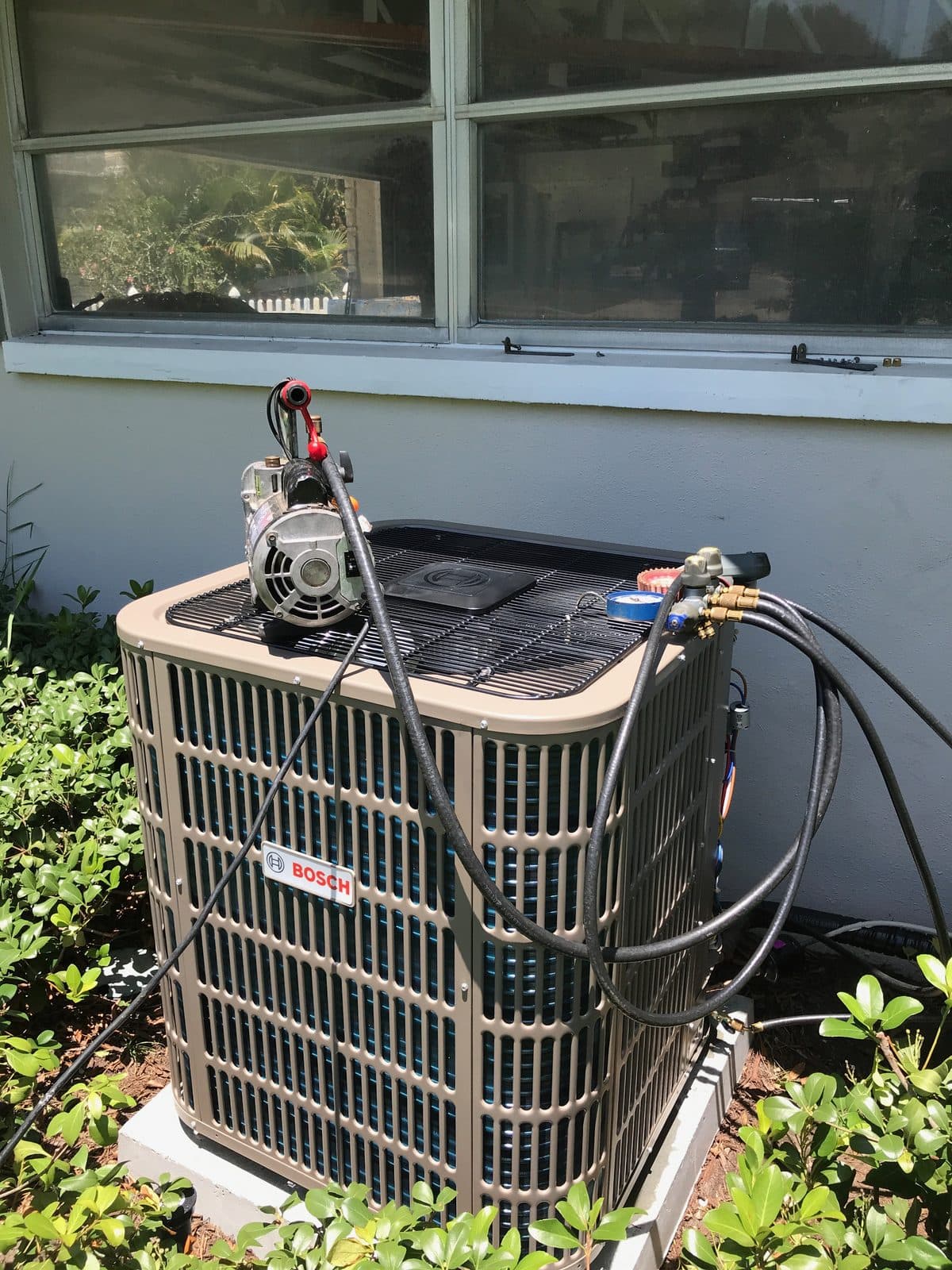
ENERGY STAR, the federal efficiency program, publishes a list of what a typical maintenance check-up should include. On the cooling side it covers:
- Thermostat settings, so the system keeps you comfortable at home and saves energy when you are away.
- Electrical connections and motors. Connections are tightened and voltage and current on motors are measured. ENERGY STAR warns that faulty connections can cause unsafe operation and shorten the life of major parts.
- Moving parts. Lubricate all moving parts.
- The condensate drain. ENERGY STAR says a plugged drain can cause water damage in the house and affect indoor humidity.
- Controls and start-up. The technician confirms the system starts, runs and shuts off properly.
- Both coils. The evaporator coil indoors and the condenser coil outdoors are cleaned, because dirty coils cut cooling and make the system run longer.
- Refrigerant level, checked and adjusted if needed, since too much or too little lowers efficiency and equipment life.
- The blower, cleaned and adjusted for proper airflow.
What changes on the island
Near this much saltwater, the outdoor coil and cabinet deserve a closer look than the checklist alone suggests. Carrier advises inspecting them for visible buildup or corrosion and having a qualified professional service the system to the manufacturer's recommendations.
When Blume commissions equipment, static pressure, airflow and refrigerant charge are measured and documented. Refrigerant work is handled by EPA Section 608 certified technicians, who hold the federal refrigerant-handling credential.
How often to schedule AC maintenance in Indian Rocks Beach
ENERGY STAR recommends an annual pre-season check-up and says it is best to check the cooling system in the spring, because contractors get busy once summer comes. In Indian Rocks Beach, a sensible target is a visit before the rainy season starts in late May. That puts a cleared drain and a cleaned coil in place before the hottest, wettest months.
Spring timing has a second benefit here. The city says all of Indian Rocks Beach lies in an Evacuation Level A Zone, the first level ordered to evacuate. A spring visit lets you hear about corrosion, loose mounting or a weak part while there is still time to act before storm season.
When once a year may not be enough
Some homes on the island are worth a second look mid-season. Consider asking about one if:
- The outdoor unit faces the Gulf or sits on an open balcony or roof.
- Your last visit found visible buildup or corrosion on the coil or cabinet.
- The condensate drain has clogged before.
- The home sits empty for long stretches, so nobody would notice a problem early.
Your technician should explain why a second visit is or is not worth it for your equipment. If you want a standing arrangement, our AC maintenance plan page explains how plans work.
Storm season: before you leave and after you return
Evacuation here comes early, and the city notes the Tampa Bay region could need as long as 26 hours to evacuate. Its advice is to be prepared ahead of time.
Before you leave
Pinellas County's evacuation page says to turn off your utilities if you are leaving home. For your air conditioner, that means switching the system off at the thermostat before you go. The county also lists a barrier island emergency access permit among the documents that help with re-entry.
When you come back
Duke Energy Florida listed Indian Rocks Beach among Pinellas County's barrier islands in its October 2024 restoration schedule. Duke said customers who could not receive power due to damage to the property's meter base, breaker panel or customer-owned wiring should contact their local municipalities for guidance, and that inspections may be required after repairs are complete.
Our AC repair page for Indian Rocks Beach covers what to do when equipment has been wet. For a fuller seasonal list, see hurricane season HVAC prep for Florida.
What you can do between visits
A few checks are yours, and none of them needs tools or an open panel.
- Filter. ENERGY STAR suggests inspecting, cleaning or changing the filter once a month, and says your contractor can show you how. Replace it when it looks loaded. Our AC filter change guide covers the basics.
- Thermostat. Confirm it is set to Cool with the fan on Auto, and that a vacation or hold setting has not been left on.
- Outdoor unit. Keep leaves, sand, plants and stored items clear so air can move through it. Leave coil washing to the technician.
- Drain line. Glance at the drain line where it leaves the house during the rainy months. If it is not dripping while the system runs, or water is collecting near the air handler, call before it overflows. Our page on a clogged AC drain line explains the warning signs.
- Breaker. If the breaker for the system has tripped, leave it off and call.
Do not open the outdoor unit's electrical panel, handle the capacitor or add refrigerant. Those belong to a licensed contractor.
When to call before the next visit
Do not wait for the scheduled visit if you notice any of these:
- The home feels clammy even though the system runs, or warm air comes from the vents.
- Ice forms on the copper lines or the indoor unit.
- Water appears around the air handler, or the system shuts itself off.
- The breaker for the system trips.
- The outdoor unit hums without starting, or you smell something burning.
- Visible buildup or corrosion appears on the outdoor coil faster than usual.
For a system that stops entirely, Blume offers 24/7 emergency HVAC service, with same-day response available based on location and technician availability.
AC maintenance with Blume Mechanical Service
Blume Mechanical Service is a Class A licensed Florida air conditioning contractor, license CAC-1822618, and is fully insured. We work on residential and commercial systems from our office at 2840 West Bay Drive #114, Belleair Bluffs, FL 33770. Pinellas, Hillsborough and Pasco counties are our core service area, which includes Indian Rocks Beach. We are brand-agnostic and service all major manufacturers as a licensed contractor.
If a visit turns up a problem that maintenance will not fix, you get a written, upfront price before any work, with repair and replacement numbers side by side. Blume does not sell equipment a building does not need. Paid priority scheduling is also available.
For local flood, permit and storm context, see our Indian Rocks Beach HVAC page. For what salt does to an outdoor coil, read coastal coil protection. For the full seasonal task list, see our AC maintenance checklist for Florida homes.
Frequently asked
How often should I have my AC maintained in Indian Rocks Beach?
At least once a year, in spring, before the rainy season begins in late May. ENERGY STAR recommends a spring check-up for cooling because contractors get busy in summer. Ask about a mid-season visit if your outdoor unit faces the Gulf or has shown corrosion.
Can maintenance stop salt from corroding my outdoor unit?
No. Carrier, a manufacturer, says regular maintenance cannot eliminate corrosion, but it can help keep the system running properly and catch problems earlier. Cleaning and inspection help keep the system running and give you earlier warning of a problem.
Should I turn off my air conditioner before I evacuate?
Yes. Pinellas County says to turn off your utilities if you are leaving home, and for your air conditioner that means switching the system off at the thermostat before you go.
Do I need to call a pro for this?
Yes, for the maintenance visit itself. Changing the filter, checking thermostat settings, clearing debris from around the outdoor unit and looking at the drain line are yours to do. Coil cleaning, electrical connections and refrigerant checks need a licensed contractor.
Do you only service certain brands?
No. Blume is brand-agnostic and services all major manufacturers as a licensed contractor.
Homeowner guides
To schedule AC maintenance in Indian Rocks Beach, call Blume Mechanical Service at 727-330-9131.
References: 2024 Gazetteer Files: Places, Florida · Flood Hazard Information - Indian Rocks Beach · NOAA NCEI 1991-2020 U.S. Climate Normals, monthly, St Petersburg Intl AP (USW00012873) · NOAA NCEI 1991-2020 U.S. Climate Normals, annual/seasonal, St Petersburg Intl AP (USW00012873) · What Are Heating and Cooling Degree Days · Florida Thunderstorm Season · Maintenance Checklist · Coastal Heating and Air | Corrosion-Resistant HVAC Systems | Carrier · Evacuation - Pinellas County · Duke Energy Florida issues estimated times of restoration for Pinellas County's barrier islands; mobilizes customer care units in severely impacted areas
Also in Indian Rocks Beach: AC repair in Indian Rocks Beach · Heat pump repair in Indian Rocks Beach
Residential AC Maintenance nearby: AC maintenance in Tampa · AC maintenance in St. Petersburg · AC maintenance in New Port Richey · AC maintenance in Clearwater