
Pinellas County · Florida CAC-1822618
Residential AC Maintenance in St. Petersburg, Florida
Blume Mechanical Service maintains residential air conditioning systems in St. Petersburg and across Pinellas County. In a salt environment with the oldest housing stock among Florida's large counties, maintenance is mostly about catching corrosion and distribution problems before they become failures. Florida license CAC-1822618.
Maintenance means something different on a peninsula than it does inland. Two forces are working on equipment here continuously — salt carried across a narrow county by onshore breezes, and a housing stock whose median construction year is 1977. The first attacks components from the outside. The second means the ductwork moving the air is usually decades older than the equipment producing it. A maintenance visit that ignores either one is checking the wrong things.
What a maintenance visit should actually measure
For many companies annual service means a filter change, a rinse of the outdoor coil and a capacitor reading. That is not nothing, but it is not a system evaluation, and it explains how a system can be maintained for years while a significant problem goes unrecorded.
Static pressure is the measurement that goes missing most often, and in this housing stock it is the one most likely to reveal something. It is rarely taken on a routine visit, which means a system working against an undersized or partially collapsed return can run that way for years while everyone believes it is fine. The cost does not appear as an obvious symptom — it appears as a compressor that does not reach the service life it should have.
The blower wheel is the second blind spot. The evaporator coil gets rinsed because it is visible through the access panel, but the wheel behind it accumulates dust and biofilm that measurably reduces airflow, and it looks clean from the panel. You have to pull it to know. The third is the condensate float switch: flushing the drain addresses today's blockage, while testing the switch answers a different question — whether the safety will actually stop the system the next time the drain restricts. Pouring water into the secondary pan and confirming shutdown takes a minute, and in a climate that produces condensate continuously for most of the year, that device is doing real work.
Corrosion is the maintenance item this county adds
Inland, a maintenance visit is largely about wear and accumulated running hours. Here it is also about what the environment is doing to the equipment between visits, because with water on three sides and eleven barrier islands, onshore breezes carry salt particulate across most of the county's land area.
The outdoor coil is the visible part of that. Salt attacks the aluminum and copper, and corrosion at the coil face restricts heat rejection — which raises head pressure and makes the compressor work harder for less capacity. It progresses gradually rather than failing outright, so the useful maintenance question is not whether the coil is dirty but whether it is deteriorating, and how fast.
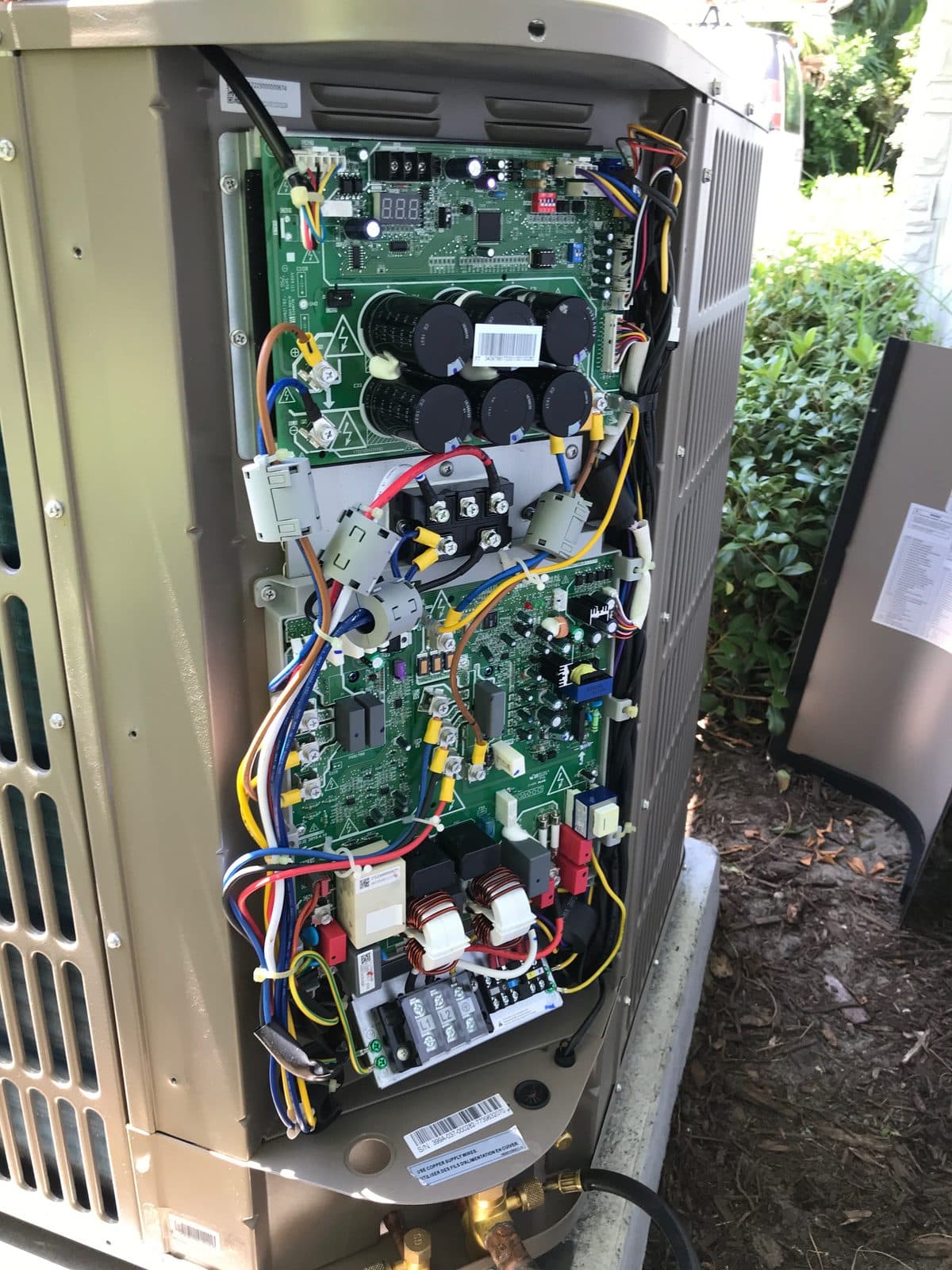
The less visible part is electrical. In a salt environment contactor contacts pit faster, terminal connections corrode where a coating has been nicked, and disconnects and whips exposed to the weather become a source of intermittent faults — the kind that make a system run perfectly for a technician in the morning and fail again in the afternoon. A capacitor reading taken at rest is useful, but connections that are loose or beginning to arc frequently do not reveal themselves until the equipment is running under load. Measured current while the system operates catches what a static reading cannot.
In this housing stock, the duct system is the maintenance item
With a median construction year in the late 1970s, the equipment in a Pinellas home has usually been replaced more recently than the system distributing its air. That inverts the normal maintenance priority. The equipment may be five years old and in good condition while the ductwork is original to the house.
What that looks like in an attic: flexible duct installed with too much slack that has sagged into low points, so air has to work upward out of the sag and the room at the end of that run is always the warm one. Connections at the plenum or boot held by tape that dried out and separated years ago. Duct board plenums delaminated at the seams. Insulation levels below what current code calls for in unconditioned space. And returns sized for a different era of equipment, which is one of the most common reasons a healthy system underperforms.
Meaningful duct leakage sends conditioned air into the attic where it does the house no good, and the air replacing it is hot and humid. The system runs longer while delivering less to the rooms, so comfort and humidity both suffer even though the equipment is working harder. Sealing is worth doing when the duct system is structurally sound and the leakage is at connections rather than distributed through deteriorated material. Replacement is the honest answer when the flexible duct is old enough that the jacket is brittle, when duct board has delaminated, or when the layout itself is wrong — because sealing a system that was never designed correctly fixes the leakage and leaves the design problem in place.
What genuinely prevents a summer failure, and what is theater
Some maintenance tasks have a direct relationship to whether a system survives the hardest part of the season. Capacitors degrade measurably before they fail, so one reading well below its rated capacitance in spring is a capacitor that gives out under a long summer duty cycle. A condenser coil packed with debris runs elevated head pressure, which means the compressor runs hotter and draws more current all season. A pitted contactor is a contactor that will fail, and in this environment they pit faster. And servicing the condensate drain before the season is among the highest-value tasks available in this climate.
Other things are theater, and homeowners deserve to know which is which. Checking refrigerant without measuring superheat and subcooling is not a check — charge cannot be evaluated from a glance or a single gauge reading without knowing the operating conditions. A condenser rinsed from the outside with a garden hose usually ends up worse, because debris is driven deeper into the coil rather than out of it; a loaded coil needs cleaning from the inside out. A filter change is something a homeowner can do and should not be the substance of a service visit. And a visit producing no measurements and no written record of what was found is not maintenance. It is attendance.
The honest argument for a maintenance agreement
We will not sell a maintenance agreement on the promise that it saves money. That claim is unprovable in advance and homeowners know it — it asks you to pay now for a benefit you may or may not see.
The honest argument is different. An agreement is about knowing the condition of your equipment before it fails. In Florida air conditioning is not optional, and when a system quits in August you do not have the luxury of collecting three bids and thinking it over. You call whoever answers, pay what they ask, and make a significant decision under pressure in a hot house. An agreement means you learn in spring that a capacitor is drifting, a contactor is pitted or a coil is corroding, and you decide on your schedule instead of the equipment's.
It also means working with people who already know your system — which unit it is, that the return was never resized when the equipment was replaced, that the secondary drain has a history of draining slowly. That context changes the quality of every service call afterward. What it is not: it is not insurance, it does not cover compressor or coil replacement, and it is not a warranty. It is a scheduled relationship with someone who knows your equipment, and it tends to be worth the most to homeowners who would rather not think about HVAC at all.
Frequently asked
Does salt air change what maintenance should include here?
Yes. Inland, maintenance is largely about wear. In Pinellas it also has to account for corrosion — the outdoor coil deteriorating rather than simply getting dirty, and electrical connections and contactor contacts degrading faster than they would a few counties east. Those are inspection items here in a way they are not in Polk County.
My system is newer than my house by decades. Does that change anything?
Considerably, and it is the normal situation in this county. New equipment inherits the distribution system that was already there, so a maintenance visit that only looks at the equipment can miss the thing actually limiting performance. Static pressure is the measurement that usually reveals it.
How do I know whether my last maintenance visit was thorough?
Ask for the numbers. A real visit produces measurements — static pressure, current draw under load, a tested float switch — and a written record of what was found. If there are no readings on file, the system was looked at rather than evaluated.
Homeowner guides
Want a maintenance visit that produces measurements, not reassurance?
References: Pinellas County profile research — housing age, geography (data/county-profiles.json) · ACCA — residential maintenance and airflow guidance · ASHRAE — filtration, airflow and dehumidification guidance · Florida Building Code — duct insulation in unconditioned space
Also in St. Petersburg: AC repair in St. Petersburg · AC installation in St. Petersburg · AC replacement in St. Petersburg · Mini-split installation in St. Petersburg · Heat pump repair in St. Petersburg
Residential AC Maintenance nearby: AC maintenance in Tampa · AC maintenance in New Port Richey · AC maintenance in Clearwater