
Pinellas County · Florida CAC-1822618
Residential AC Installation in St. Petersburg, Florida
Blume Mechanical Service installs and replaces residential air conditioning systems in St. Petersburg and across Pinellas County. In a county with the oldest housing stock of Florida's large counties, a change-out is the one chance to correct what forty years of previous installations left behind. Florida license CAC-1822618.
A replacement in Pinellas is rarely just an equipment swap. With a median home construction year of 1977, most systems here are the second or third piece of equipment installed into a distribution system that has never been reconsidered. And with water on three sides of a narrow county, the equipment being installed will spend its entire life in a salt environment — which changes what should be specified, not just what should be connected.
Specify for salt, because the coil usually ends the system here
Most homeowners think of the compressor as the expensive component and therefore the one that determines when a system is finished. In a coastal county that is frequently wrong. Salt attacks the aluminum and copper of the outdoor coil continuously, and corrosion at the coil face restricts heat rejection — which raises head pressure, makes the compressor run hotter, and produces compressor failures that are really the downstream consequence of a coil that has been choking the system for a long time.
That has a direct consequence for what gets specified at replacement. Factory-applied protective coil coatings and coil geometries that are inherently more corrosion-resistant meaningfully extend service life in this environment. They are not indefinite protection, but they change the arithmetic in a county where onshore breezes carry salt across most of the land area. In Polk County that specification is optional. Here it deserves a real conversation before the equipment is ordered, because it is far cheaper to specify at purchase than to discover at year eight.
The same logic applies to the disconnect, the whip and the outdoor electrical connections. Components that would be adequate inland are the ones that produce intermittent faults here after a few years of exposure.
What a low bid leaves alone, in a house built in 1977
The return system is the most commonly ignored item on any change-out, and in this housing stock it is the most consequential. New equipment goes in and the existing return grille and duct stay exactly as they were — sized for the assumptions and equipment of decades ago. Equipment needs a certain volume of air moving through it to produce its rated capacity, and a return that cannot deliver that leaves a new system operating below its rating from the first day, while the homeowner assumes they purchased the capacity on the label.
The condensate system is second. The new air handler goes in and the existing drain simply gets reconnected: nobody flushes it, confirms it slopes to drain, verifies a proper secondary path, or tests the float switch. Six months later there is water in a ceiling. The electrical is third — new equipment carries a minimum circuit ampacity and a maximum overcurrent protection rating on its nameplate, and the breaker and disconnect left from the previous system may match neither.
And in a house of this age there is a fourth: the distribution system itself. If the ductwork is losing a significant share of the conditioned air into an unconditioned attic, installing larger equipment to compensate is the expensive way to solve a problem that was never about capacity.
Sizing, and why the honest answer is often a smaller unit
In Florida the existing system is more often oversized than undersized. The original was usually selected by rule of thumb, and in the decades since, many Pinellas homes have been re-insulated, had windows replaced, or had roofing upgraded — so equipment that was merely generous at installation is now clearly too large for the load.
That produces an uncomfortable conversation worth having honestly, because a homeowner hears smaller and reasonably thinks less. What is actually happening is that the oversized system reaches setpoint in a few minutes, shuts off, and lets humidity climb during every off cycle — which is why a house can feel cold and clammy at the same time. ACCA's guidance is to select the smallest equipment that satisfies the calculated load, precisely because short cycling undermines moisture removal in humid climates. A correctly sized system runs longer cycles, removes more moisture per cycle, and generally feels comfortable at a higher thermostat setting.
When the calculation supports smaller equipment than what is being replaced, we document the load calculation and the conversation — so that in the first summer, when the house is comfortable and the bills are lower, there is a record of why.
Line sets, and what the refrigerant transition changes
Reusing an existing line set is defensible under specific conditions: the copper is correctly sized for the new equipment, the insulation is fully intact rather than cracked or crushed, the length and configuration fall within the manufacturer's application guidelines, and there is no history of refrigerant leaks — because a system that leaked also contaminated the oil in that line set.
It must be replaced when the insulation has deteriorated, which in an unconditioned Florida attic means the suction line is absorbing heat and the system is working against itself. It must be replaced after a compressor burnout, which sends acid and carbon through the entire refrigerant circuit. And it must be replaced when it is undersized for the new equipment, because that is a permanent capacity restriction no amount of correct charging overcomes.
Newer residential equipment uses lower-GWP refrigerants such as R-454B, which is classified as mildly flammable and carries different handling requirements than R-410A. The copper itself is generally compatible, but residual oil from the previous system matters, any questionable fitting or prior leak becomes more significant than before, and some manufacturers specify a new line set outright — which means the equipment's own installation manual has the final word. On a new system using current refrigerants, replacing the line set is the conservative and defensible choice.
Commissioning is not paperwork at the end
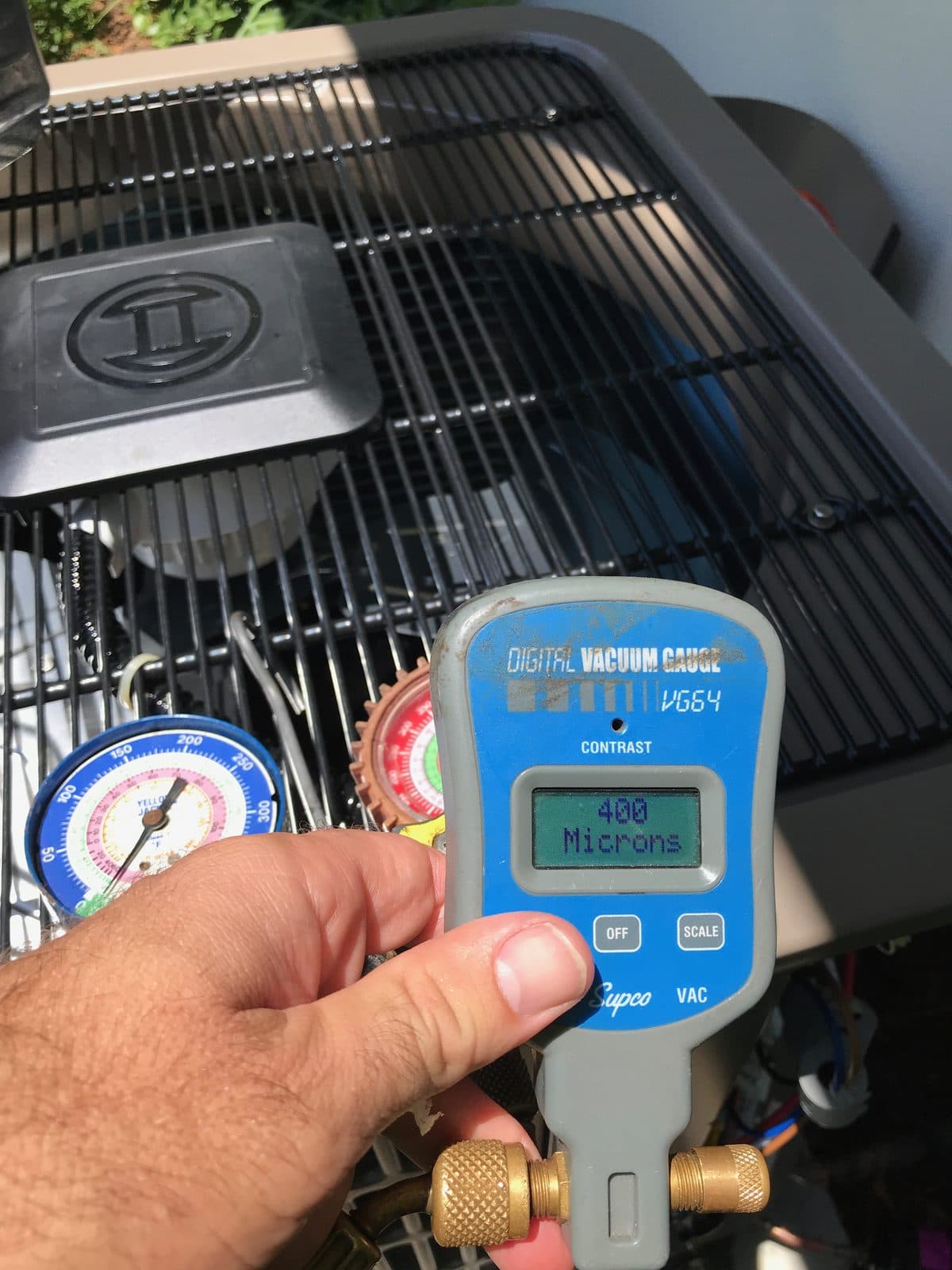
A system is commissioned when its performance can be demonstrated with numbers, not when cold air arrives at the registers. That means pulling the refrigerant circuit into a deep vacuum and holding it to confirm the system is leak-free before any refrigerant goes in — because skipping the hold is how a small leak gets sealed inside brand-new equipment. It means charging to the manufacturer's specification by weight or by superheat and subcooling rather than to what looks reasonable on a gauge set, since factory charge does not account for the actual line set length or the day's conditions. It means measuring supply and return static pressure against the equipment's rated external static pressure, recording supply temperatures at multiple registers and the split across the coil, confirming water actually flows from the primary condensate drain, testing the float switch by filling the secondary pan, and verifying electrical connections with measured current on the compressor and blower.
And it means the walkthrough that costs nothing and gets skipped most often — where the filter is, what size it takes, how the thermostat works, what a correctly draining condensate line looks like. A same-day install-and-leave looks like efficiency: the crew is gone by late afternoon and the air is cold. The measurements nobody took are the ones that surface in August, by which time the crew that skipped them is long gone.
Which permit office applies depends on your address, not your county
Pinellas County permitting is unusually fragmented. County Building and Development Review Services covers unincorporated areas plus several small municipalities including Belleair Beach, Belleair Shore, Indian Rocks Beach, Kenneth City, Oldsmar and Safety Harbor — but the county contains twenty-four incorporated municipalities, and the larger cities including St. Petersburg, Clearwater, Largo and Pinellas Park operate their own building departments. Countywide contractor licensing runs separately through the Pinellas County Construction Licensing Board, so licensing and permitting do not follow the same map.
The reason a homeowner should care is not administrative. The permit inspection is what catches exactly the items a rushed installation leaves wrong — disconnect and breaker sizing against the nameplate, condensate configuration with a proper secondary path or float switch, line-set support, and refrigerant line insulation in unconditioned space. Those are the same items that later cause failures and water damage. Unpermitted work also tends to surface at the worst moment, because Florida insurers commonly require a four-point inspection on older homes, and in a county where the median home dates to 1977, a great many homes here qualify.
Frequently asked
Should I pay extra for a coated coil in St. Petersburg?
In this county it deserves serious consideration. Salt reaches most of Pinellas, and the outdoor coil is frequently what ends a system's usable life here rather than the compressor. Protective coatings and more corrosion-resistant coil designs are far cheaper specified at purchase than discovered at year eight.
Why would you recommend a smaller system than the one I have?
Because the load calculation supports it, and because oversized equipment creates the exact comfort complaint homeowners describe. A system that is too large reaches setpoint in a few minutes and shuts off before removing much moisture, leaving a house cool and clammy. Correctly sized equipment runs longer and dehumidifies properly.
Does my old ductwork need to be addressed during a replacement?
It should at least be evaluated. In a county where the median home was built in 1977, the duct system is usually decades older than the equipment. If it is losing a meaningful share of the conditioned air into the attic, new equipment inherits that loss on day one.
How do I compare two installation quotes that list the same equipment?
Ask what happens beyond the box. Is the return being evaluated or reused as-is? Is the condensate line flushed, sloped and fitted with a tested float switch? Are the breaker and disconnect checked against the new nameplate? Is a coated coil being offered given the location? Will you receive a startup sheet with actual measurements? Identical equipment can mean very different installations.
Homeowner guides
Planning a replacement in St. Petersburg? Get a quote that covers more than the box.
References: Pinellas County Building and Development Review Services; Pinellas County Construction Licensing Board · Pinellas County profile research — housing age and geography (data/county-profiles.json) · ACCA Manual J / Manual S — load calculation and equipment selection · US EPA — AIM Act refrigerant transition and A2L handling
Also in St. Petersburg: AC repair in St. Petersburg · AC maintenance in St. Petersburg · AC replacement in St. Petersburg · Mini-split installation in St. Petersburg · Heat pump repair in St. Petersburg
Residential AC Installation nearby: AC installation in Tampa · AC installation in Largo