
Hillsborough County · Florida CAC-1822618
Residential AC Installation in Tampa, Florida
Blume Mechanical Service installs and replaces residential air conditioning systems in Tampa and Hillsborough County. We size the equipment from a load calculation, correct what the old installation got wrong instead of building on top of it, pull the permit, and commission the system with documented measurements. Florida license CAC-1822618.
A change-out is the one moment when everything wrong with an installation can be corrected — and the one moment most contractors skip past. The equipment is the visible part of the job and the easiest part to compare between quotes. The return duct, the condensate path, the breaker, the line set and the commissioning are where a system either performs for fifteen years or fights its installation for its whole life.
What a low bid leaves alone
The return system is the most commonly ignored item on a residential change-out. New equipment goes in and the existing return grille and duct stay exactly as they were, even when the new system is a different size or the old return was already undersized for the system it served. Equipment needs a certain volume of air moving through it to produce its rated capacity, and if the return cannot deliver that, the new system operates below its rating from the first day — while the homeowner assumes they bought the capacity on the label.
The condensate system is the second. On a change-out the new air handler goes in and the existing drain line simply gets reconnected. Nobody flushes it, nobody confirms it actually slopes to drain, nobody verifies there is a proper secondary path, and nobody tests the float switch. Six months later there is water in a ceiling. Then there is the electrical: new equipment carries a minimum circuit ampacity and a maximum overcurrent protection rating on its nameplate, and the breaker and disconnect that were there for the old system may not match. A low-bid change-out connects to whatever is already on the wall.
The last one is quieter and shows up as disappointment rather than failure. A modern system installed on old thermostat wiring that does not support all of its functions will run — but its dehumidification mode, its variable-speed staging and its fault reporting will not. The homeowner paid for capability that was never connected.
Sizing, and the conversation about a smaller unit
In Florida, the existing system is more often oversized than undersized. The original was usually selected by rule of thumb, and in the years since, the house may have been re-insulated or had its windows replaced — so equipment that was merely generous at installation is now clearly too large. On homes that have seen envelope improvements, the correctly sized replacement is frequently one size smaller than what is currently there.
That creates an uncomfortable conversation, and it is worth having honestly. A homeowner hears 'smaller' and reasonably thinks 'less.' What is actually happening is this: the oversized system was reaching setpoint in a few minutes, shutting off, and letting humidity climb during every off cycle — which is why the house felt cold and clammy at the same time. A correctly sized system runs longer cycles, removes more moisture per cycle, and the house feels comfortable at a higher thermostat setting, which is also the cheaper setting to hold.
The proof arrives in the first summer, and it is consistent enough that homeowners who were skeptical about a smaller unit tend to become the strongest advocates for load calculations afterward. When we do install smaller equipment than what was there, we document the load calculation and the conversation — not to protect ourselves, but so that six months later when the house is comfortable and the bills are lower, there is a record of why it works.
Line sets: when to reuse and when to replace
Reusing an existing line set is defensible under specific conditions: the copper is properly sized for the new equipment's capacity, the insulation is fully intact rather than cracked, missing or crushed flat, the length and configuration fall within the new equipment's application guidelines, and there is no history of refrigerant leaks — because a system that leaked also contaminated the oil in that line set.
It has to be replaced when the insulation has deteriorated, which in a Florida attic means the suction line is absorbing heat and the system is working against itself before the refrigerant ever reaches the compressor. It has to be replaced after a compressor burnout, which sends acid and carbon through the entire refrigerant circuit; flushing is possible, but on a residential change-out replacement is the cleaner and more defensible answer. And it has to be replaced when it is undersized for the new equipment, because that is a permanent restriction on capacity that no amount of correct charging will overcome.
The refrigerant transition adds a consideration. Newer residential equipment uses lower-GWP refrigerants such as R-454B, which is classified as mildly flammable and carries different handling requirements than R-410A. The copper itself is generally compatible, but residual oil from the previous system is a real concern, any questionable fitting or leak history becomes more significant than it was before, and some manufacturers specify a new line set for these installations — which means the equipment's own installation manual has the final word. Our honest position: on a new system using the current refrigerants, replacing the line set is the conservative and defensible choice. Reuse requires a clean history, intact insulation, correct sizing and a thorough flush.
Where the air handler lives, and what fails there
Each location fails differently, and knowing which failure to design against is most of the job.
A closet installation fails on access. If it went in without adequate service clearance, the coil cannot be cleaned properly, the blower wheel cannot be pulled and the drain pan cannot be inspected — so maintenance quietly gets skipped and the system degrades faster than it should. Closet condensate problems follow the same pattern: the drain runs fine until it blocks, and without a working float switch the first sign is water on the floor or in the ceiling below.
A garage installation fails on the return-air path, and this one is a safety issue rather than a comfort issue. An air handler drawing return air from the garage — through gaps in the cabinet or an improperly sealed return — is pulling vehicle exhaust and fumes into the house and distributing them. Florida code does not permit garage air to be used as return air, and we still find it on older installations. The other garage issue is simply heat: an unconditioned Florida garage in August is punishing to equipment.
An attic installation fails at everything eventually, on a timeline set by the environment. Summer attic temperatures, humidity cycling, equipment vibration and awkward access that causes maintenance to be deferred all take their toll. The specific failures are sagging condensate lines that trap water, deteriorating insulation on the unit, and leaks that go undetected because nobody goes up there — which means a condensate overflow damages the ceiling below before anyone knows there is a problem. On an attic installation a float switch is not optional. It is the only early warning the house has. For what it is worth, our honest ranking for Florida is a properly sealed garage installation first, then a closet with real service clearance, then an attic — but attic installations are common here because of slab construction and there is often nowhere else to put the equipment. They work. They require more attention.
Commissioning is not paperwork at the end — it is the install
A system is commissioned when we can prove with numbers that it does what it was designed to do. Not that it is running. Not that it is blowing cold. Proven.
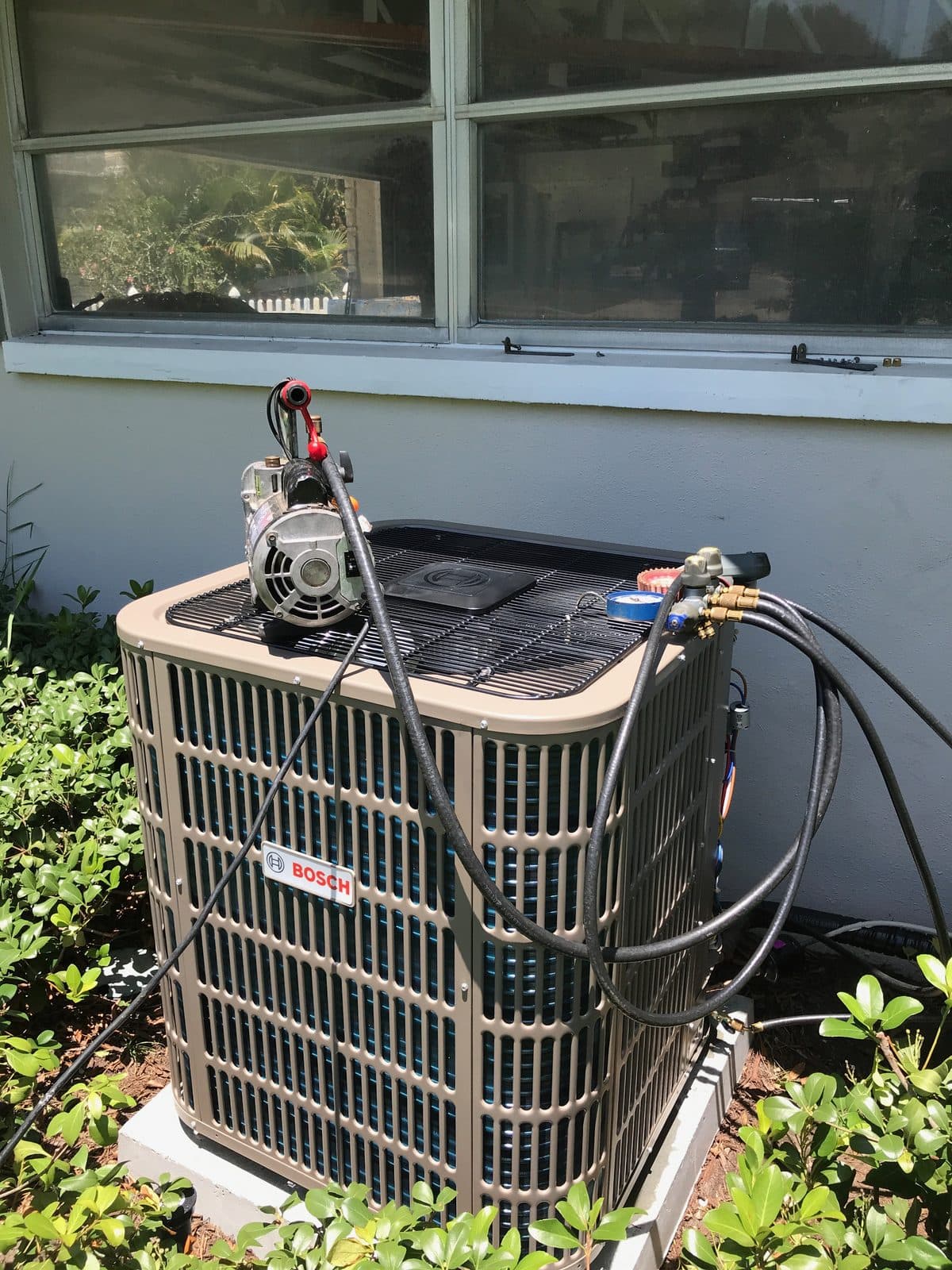
That means static pressure measured at the supply and return plenum and compared against the equipment's rated external static pressure — if it is over, the blower is fighting resistance it was never built for, and we find that out now rather than in August. It means airflow verified rather than assumed, because the tonnage on the label means nothing if the air is not moving. It means refrigerant charge set by subcooling or superheat depending on the metering device, not by what looks about right on a set of gauges; charge set by feel drifts, charge set by numbers is documented. It means supply and return temperatures taken at multiple registers to confirm the distribution is even and the split across the coil is in range. It means the condensate drain flushed, the trap primed and the float switch actually tested by pouring water into the pan — not assumed to work because it is new. It means measured amperage on the compressor and the blower compared against the nameplate, because a compressor drawing high current on day one is telling you something. And it means cycling every stage at the thermostat, verifying heat, confirming emergency heat on a heat pump, and setting the schedule with the homeowner watching.
Here is what gets skipped on a same-day install-and-leave, and why. Static pressure takes ten minutes and a manometer — it gets skipped because the answer might mean more work, a duct that needs resizing or a return that needs to be added. It is easier not to know. Charge verification gets skipped because factory charge is close enough for a standard line set, but if the line set is longer or shorter, or the equipment sat on a truck in July heat, factory charge is a starting point and not a finish line — and a crew on a schedule leaves before the system has run long enough to stabilize. The float switch test gets skipped because new equipment and a new pan make it feel redundant; it is not, because a switch that is wired backward, kinked or not seated will let the pan overflow the first time the drain slugs, and you find out when the homeowner calls about water damage. The full electrical check takes five minutes and gets skipped when the truck needs to be at the next job. And the walkthrough gets skipped entirely — where the filter is, what size it takes, how to read the thermostat, what the drain looks like when it is draining correctly, what the outdoor unit sounds like running normally. If a homeowner does not know what normal looks like, every unfamiliar noise becomes a service call.
None of these problems appear on day one. They appear in August, when a system that ran fine at install is short-cycling because the charge was never verified, or flooding the air handler because the float switch was never tested, or drawing more current than its nameplate allows because static pressure was double what it should have been and the equipment has been fighting the ductwork since the first day. By then the install crew is long gone, a service technician takes the callback, and the homeowner has no reason to connect the failure to the installation. They simply know the new system is broken.
So a same-day install-and-leave is not faster. It is deferred. The time nobody spent commissioning gets paid back with interest on the first hot weekend. We do not leave until the numbers are written down — static pressure, charge, amperage, temperature split — on paper and in the job file. If something is out of spec we know before the panel closes. You get a copy of what we measured, not just a receipt for what we installed. That is not extra. That is the job.
Permits, and why they matter more than they seem
At least four permitting jurisdictions operate inside Hillsborough County: unincorporated Hillsborough plus the cities of Tampa, Plant City and Temple Terrace. The permit path and fee schedule follow the municipal boundary rather than the county line, which is why two houses a few streets apart can face different processes for the same equipment change-out. Mechanical permits for unincorporated county work go through the HillsGovHub portal, and a contractor performing permitted work must hold either a Florida DBPR license or a Hillsborough County-issued license — the county maintains its own local licensing tier on top of state licensure, which is not universal across Florida counties.
The reason to care is that the permit inspection is what catches the items a rushed installation leaves wrong: disconnect and breaker sizing against the equipment nameplate, condensate configuration with a proper secondary path or float switch, line-set support, and refrigerant line insulation in the attic. Those are the same items that later cause failures and water damage. And the consequence of skipping it arrives years later at the worst moment — Florida insurers commonly require a four-point inspection on older homes, and inspectors flag equipment whose installation date matches no permit record. From there a carrier may require the permit be pulled retroactively, decline the policy, or exclude the HVAC system. Any of those can delay a closing. The homeowner is rarely the one who made that choice; the permit was skipped because it was faster and cheaper for the contractor.
Frequently asked
Why are you recommending a smaller system than the one I have?
Because the load calculation says so, and because in Florida an oversized system creates the exact comfort problem homeowners complain about. Equipment that is too large reaches setpoint in a few minutes and shuts off before it has removed much moisture, so the house ends up cool and clammy. A correctly sized system runs longer, dehumidifies properly, and usually feels comfortable at a higher thermostat setting.
Can my existing line set be reused?
Sometimes. It needs to be correctly sized for the new equipment, have fully intact insulation, fall within the manufacturer's length and configuration guidelines, and have no history of leaks or a compressor burnout. With the newer refrigerants, some manufacturers specify a new line set outright — the equipment's installation manual decides. When there is any doubt, replacing it is the defensible choice.
Do I need a permit to replace my air conditioner in Tampa?
Equipment change-outs generally require a mechanical permit, and which office issues it depends on whether your property sits in the City of Tampa, another municipality, or unincorporated Hillsborough County. It is worth confirming for your specific address before work begins, because an unpermitted change-out becomes the homeowner's problem at resale or at an insurance inspection, not the installer's.
How do I compare installation quotes that look similar?
Ask what happens beyond the equipment. Is the return duct being evaluated or reused as-is? Is the condensate line being flushed, sloped and fitted with a tested float switch? Are the breaker and disconnect being checked against the new nameplate? Is the line set being replaced or reused, and on what basis? Will you receive a startup sheet with actual measurements? Two quotes with the same equipment can be very different installations.
Homeowner guides
Planning a replacement? Get an installation quote that covers more than the box.
References: ACCA Manual J (load calculation) and Manual S (equipment selection) · Hillsborough County permitting and contractor licensing — hcfl.gov · US EPA — AIM Act refrigerant transition and A2L handling · Florida Building Code — mechanical and return-air provisions
Also in Tampa: AC repair in Tampa · AC maintenance in Tampa · AC replacement in Tampa · Mini-split installation in Tampa · Heat pump repair in Tampa
Residential AC Installation nearby: AC installation in St. Petersburg · AC installation in Largo