
Hillsborough County · Florida CAC-1822618
Residential Heat Pump Repair in Tampa, Florida
Blume Mechanical Service repairs residential heat pumps across Tampa and Hillsborough County, from historic Hyde Park and Seminole Heights to the newer sprawl of New Tampa. We diagnose the actual failure in both heating and cooling before quoting, pull the permit the correct jurisdiction requires, and document what we found. Florida license CAC-1822618.
Tampa is a large, dense city in a humid subtropical climate, and its scale creates an urban heat-island effect: paved, built-up neighborhoods hold and re-radiate heat, so a heat pump in the urban core can run under a heavier cooling load than one on the outskirts. The housing spans a century — 1920s bungalows in Hyde Park, craftsman homes in Seminole Heights, mid-century ranches, and newer subdivision builds in New Tampa. A heat pump has to be judged against both the neighborhood's real load and the home's actual duct system, and in Tampa those vary enormously block to block.
A heat pump runs both directions — and Tampa runs it mostly one way
A heat pump is the same refrigeration machine as an air conditioner with one added part: a reversing valve that lets it heat as well as cool. In summer it moves heat out of the house; in winter it reverses and pulls heat from the outdoor air to warm the house without burning fuel. In Tampa's climate the system spends the overwhelming majority of its life in cooling, and that shapes how these units wear and fail.
Because the compressor and outdoor coil run so many hours cooling under a heavy urban load, the failures we see most in Tampa are cooling-side: weak capacitors that start a compressor on a mild morning and refuse on the first genuinely hot afternoon, pitted contactors, blower motors drifting out of spec, and low charge from a slow leak. The heating-side failures — a stuck reversing valve, a failed defrost control, dead auxiliary heat strips — show up in the handful of cold snaps each winter, and they catch homeowners off guard precisely because the system heats so rarely that no one notices the fault until the one cold week arrives.
When someone says the system 'is not heating,' the cause is one of a few different things, and they are not interchangeable — a stuck valve, a leak that weakens heating first, an iced coil from a defrost failure, or dead heat strips. We measure before we replace, because these present the same from inside the house and the reversing valve in particular is far too expensive to swap on a guess.
The heat island and why load varies across Tampa
Tampa's urban core is a lot of pavement, roofing, and low tree canopy, and built-up surfaces absorb heat during the day and release it into the evening. The practical effect is that a home in a dense urban neighborhood can carry a heavier and longer cooling load than an identical home with more shade and open space on the edge of the county. A heat pump's outdoor unit also cares where it physically sits — a condenser boxed into a narrow side yard between two masonry walls, on a hot roof, or against a west-facing wall with no shade rejects heat into an environment that is already warm, and it runs at higher head pressure for it.
This is why we do not assume a system's behavior from its size on paper. Two homes with the same square footage and the same nameplate tonnage can behave very differently if one sits shaded and open and the other is boxed into a hot urban lot with the condenser starved for airflow. When a Tampa heat pump runs constantly and struggles to hold setpoint on the hottest afternoons, part of the evaluation is where and how the outdoor unit is placed and whether it is getting the airflow and clearance it needs.
None of this changes the repair when a real part has failed. But it changes the honest conversation about whether a struggling system is broken or simply working hard in a demanding spot — and whether relocating or shading a poorly placed outdoor unit would do more than replacing a component.
A century of housing means a century of ductwork
Tampa's neighborhoods span roughly a hundred years of construction, and the duct system behind the heat pump varies just as much. In Hyde Park and Seminole Heights the homes are old — 1920s bungalows and craftsman houses retrofitted for central air long after they were built, with ductwork threaded through tight attics and crawlspaces, undersized returns, and joints that have separated over decades. In New Tampa and the newer subdivisions the ducts are younger but not automatically better: rushed builder installations, long flex runs, and kinks that throttle airflow are common.
A heat pump can only deliver what the duct system carries. The complaint a homeowner feels is not 'duct leakage' — it is uneven rooms, weak airflow at the far register, a system that runs and runs, or a house that will not dehumidify. In an old Seminole Heights bungalow that is usually a return that cannot breathe or a duct run baking in a hot attic. In a New Tampa build it is often a crushed flex run or a return path the builder shortchanged. Either way, blaming the equipment misses it.
We check static pressure across the air handler and inspect accessible duct runs before condemning a compressor or a coil. A heat pump forced to push air through a restrictive or leaky duct system runs hotter, works harder, and fails younger. Fixing the box without addressing the ducts just resets the clock on the same complaint — and in Tampa, where the housing is this varied, that duct evaluation is not optional.
Permits in Hillsborough County are not one process
At least four permitting jurisdictions operate inside Hillsborough County: unincorporated Hillsborough plus the cities of Tampa, Plant City, and Temple Terrace. The permit path and fee schedule follow the municipal boundary, not the county line, which is why two neighbors a few streets apart can have different processes for the same heat pump change-out. A contractor who does not know which jurisdiction a property sits in is a contractor who has not pulled many permits here.
Mechanical permits for unincorporated county work are filed through the county's online portal, and contractors performing permitted work must hold a Florida DBPR license or a Hillsborough County-issued license — the county maintains its own local licensing tier in addition to state licensure. Unpermitted equipment work is a problem that surfaces later, at resale or an insurance claim, long after the installer is gone.
The consequence usually arrives at the worst moment. Florida insurers commonly require a four-point inspection on older homes, and inspectors increasingly flag equipment whose installation date does not match any permit record. From there a carrier may require the permit be pulled retroactively, decline to write the policy, or exclude the HVAC system from coverage — any of which can delay a closing or force a renegotiation, with the seller in the worst position. When we find unpermitted work we say it plainly: the system may run fine, but there is no record it was installed correctly, and that record matters to your insurer and to the next buyer.
Humidity, short cycling, and why a house can feel damp at setpoint
A heat pump cooling a Tampa home does two jobs: it lowers temperature and it removes moisture. In this climate the moisture half is substantial, and it is the half a house notices when it is missing — the thermostat reads 74 and the rooms still feel clammy. A heat pump only dehumidifies while it runs, so a system that short-cycles — satisfying the thermostat in a few minutes and shutting off — leaves the house cool and damp.
There are two common causes and neither is fixed by adding refrigerant. An oversized system, chosen by rule of thumb rather than a load calculation, cools the air fast and shuts off before drying the house. Or leaky attic ductwork pulls humid air into the system, so the equipment fights moisture the ducts keep importing. We prove the machine first — charge, airflow, whether the indoor coil gets cold enough to pull water out of the air — then look at what feeds it. A rise in temperature or humidity between the room's return grille and the air arriving at the coil is a clear tell the ducts are adding load before the equipment sees it.
Only after refrigeration, airflow, the coil, and the ducts are all clean, and the system still short-cycles, does oversizing become the credible answer. That is a selection decision confirmed by a Manual J load calculation rather than by floor area alone. Variable-capacity equipment helps in a mild, humid stretch because it can run longer at reduced output instead of cycling fully on and off, but more runtime cannot dry a house that is importing moisture through leaking ducts faster than the coil removes it.
Refrigerant, the R-410A phase-down, and honest repair-or-replace
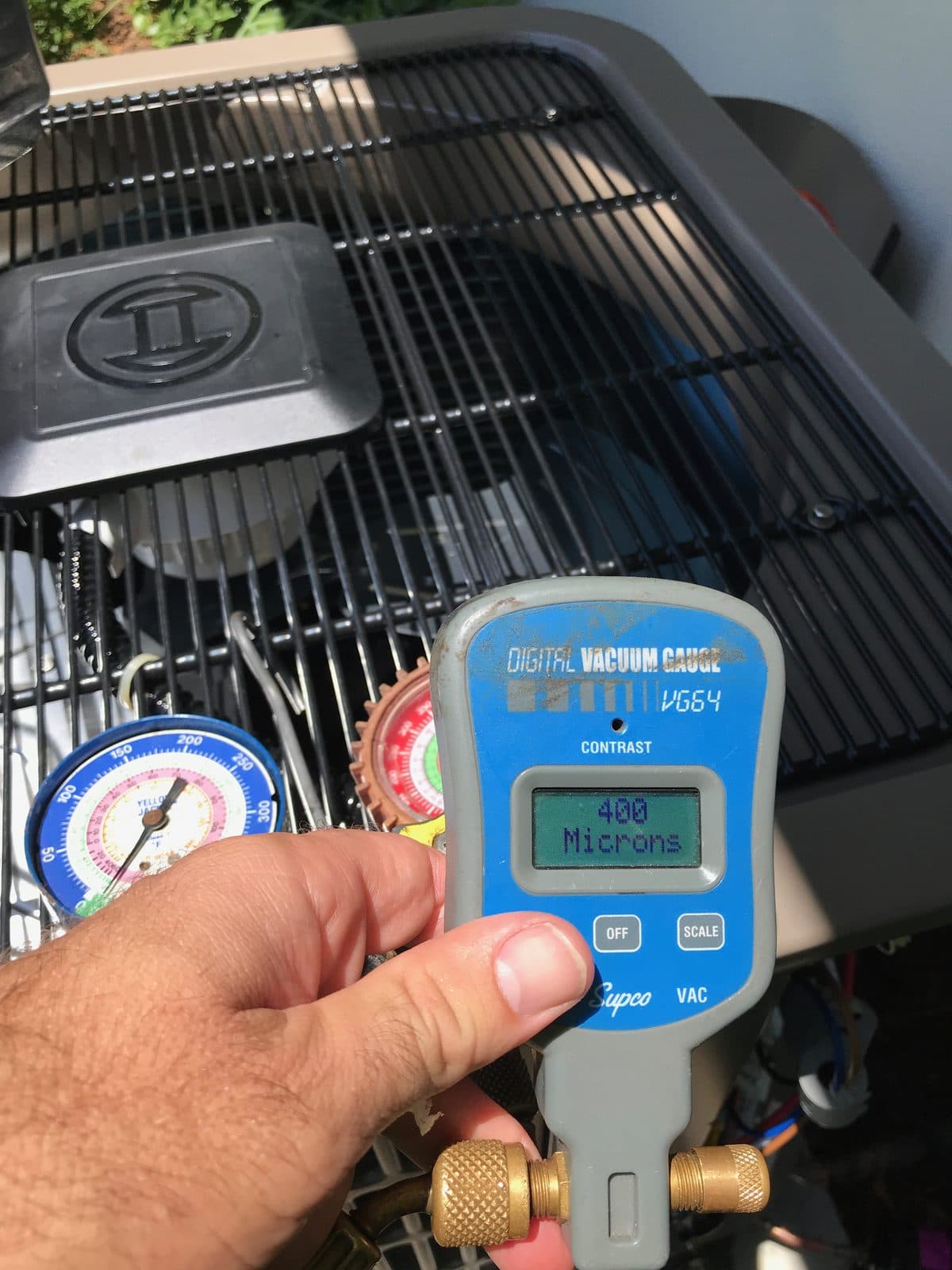
A heat pump does not consume refrigerant, so a system that is low has a leak, and the honest repair finds the leak rather than topping off the charge. Refrigerant work is regulated — only EPA Section 608-certified technicians may open a sealed circuit, recover refrigerant, and recharge a system. Under the federal AIM Act the country is phasing down high-GWP refrigerants, and new residential heat pumps have moved from R-410A to lower-GWP refrigerants such as R-454B. Existing R-410A systems remain legal to operate and service, and refrigerant is still available for them.
The repair-or-replace call in Tampa rarely turns on refrigerant alone. It turns on the equipment's age and condition, whether the failure is a cheap component or the compressor or coil, whether the duct system is worth building around, and sometimes whether a struggling outdoor unit is simply badly placed in a hot urban lot. Replacing a heat pump behind a leaky, undersized duct system just moves an expensive new machine into an old problem.
Here is the part we say out loud. A heat pump that holds its charge, has a sound coil, and lost a capacitor or a contactor does not need replacing because it uses R-410A. There is a reliable tell for an unnecessary replacement quote: whether anyone measured anything. If no one checked static pressure, no one read superheat and subcooling, and no one opened the air handler, then the system was looked at, not evaluated. When we are asked for a second opinion and the first company condemned a Tampa system on age or refrigerant type alone, with no mechanical reason behind it, we will tell you to keep it.
Frequently asked
My heat pump runs constantly on hot afternoons and barely keeps up. Is it broken?
Not necessarily. Tampa's urban heat-island effect means built-up neighborhoods hold and re-radiate heat, so a home there carries a heavier cooling load, and an outdoor unit boxed into a hot, narrow, unshaded spot rejects heat into an already-warm environment and runs at high head pressure. We check whether a real part has failed — charge, capacitor, contactor, airflow — but also whether the outdoor unit is simply placed poorly and starved for clearance. Sometimes the fix is a component; sometimes it is airflow, shade, or placement rather than a broken machine.
Do I need a permit to replace a heat pump in Tampa?
Generally yes, and which office issues it depends on the exact address. At least four jurisdictions operate in Hillsborough County — unincorporated Hillsborough plus the cities of Tampa, Plant City, and Temple Terrace — and the permit path follows the municipal boundary, not the county line. Two neighbors a few streets apart can have different processes for the same change-out. Confirm the requirement for your specific address before work begins, because an unpermitted change-out becomes your problem at resale or an insurance four-point inspection, not the installer's.
My heat pump blows cold air when I set it to heat. What is wrong?
On a heat pump that has several possible causes and they are different repairs. The reversing valve may be stuck in cooling. The refrigerant charge may be low from a leak, which weakens heating first. The defrost control may have failed and iced the outdoor coil. Or the auxiliary heat strips may be dead, so the house feels cold on the rare freeze even though the heat pump runs. Because Tampa systems heat so seldom, these faults often go unnoticed until the one cold week. We measure before replacing, since the reversing valve is expensive and the wrong guess is costly.
My AC feels like it cools but the house stays humid. Is that a repair?
Sometimes, and the order matters. A heat pump only removes moisture while it runs, so a cool-but-clammy house often has a system that short-cycles. We prove the equipment first: charge, airflow, and whether the indoor coil gets cold enough to pull water out of the air. Leaky attic ducts pulling in humid air are a common cause and a real repair. If everything measures correct and the system still short-cycles, it is likely oversized for the load, which is a selection issue confirmed by a load calculation, not fixed by adding refrigerant.
Do you work on both homes and commercial buildings?
Both. Roughly half our work is commercial mechanical service, which is where our documentation and diagnostic discipline comes from — a warranty denial on commercial equipment is expensive, so we learned to prove failures with measurements rather than guess. Tampa homeowners get the same process on a smaller system: the failure is measured, the cause is identified, and you are told plainly whether a repair or a replacement is the honest call, with the duct system and the outdoor unit's placement weighed into that decision rather than a part swapped on a hunch.
Homeowner guides
Heat pump trouble in Tampa? Talk to a licensed technician.
References: Hillsborough County permitting and contractor licensing (primary) · US Department of Energy — heat pump systems · ACCA Manual J (residential load calculation) and Manual S (equipment selection) · US EPA — AIM Act HFC phasedown and Section 608 refrigerant handling
Also in Tampa: AC repair in Tampa · AC maintenance in Tampa · AC installation in Tampa · AC replacement in Tampa · Mini-split installation in Tampa
Residential Heat Pump Repair nearby: Heat pump repair in Clearwater · Heat pump repair in Dunedin · Heat pump repair in Largo · Heat pump repair in Palm Harbor