
Pinellas County · Florida CAC-1822618
Madeira Beach AC Maintenance and Air Conditioning Tune-Ups
In Madeira Beach, the right time for AC maintenance depends on whether anyone will be home through the summer. The city calls itself a Gulf Coast barrier island community, and many of its homes are held for seasonal or occasional use. This page covers when to book a tune-up, what the visit should check, and how to leave the system ready if you close the home for the hot months.
The Census Bureau's 2019-2023 survey counts 1,293 homes in Madeira Beach held for seasonal, recreational or occasional use. When a seasonal home sits empty, nobody is there to notice a clogged drain or a system that stops. The University of Florida advises a professional air conditioner check-up three weeks before you leave a seasonal home.
Who is home in Madeira Beach, and when
The U.S. Census Bureau's American Community Survey for 2019-2023 estimates 3,920 housing units in Madeira Beach. It counts 1,940 of them as occupied and 1,980 as vacant. Of the vacant units, 1,293 are listed as for seasonal, recreational or occasional use.
Of the 1,940 occupied homes, the survey counts 1,172 as owner-occupied and 768 as renter-occupied. More homes date from 1970 to 1979 than from any other decade, at 787 units, followed by 721 built from 1950 to 1959 and 675 built from 1980 to 1989.
What that means for maintenance:
- Seasonal owners. If you close the home for part of the year, book the visit around your departure date, not the calendar. The section below explains why.
- Landlords. A yearly visit booked on the owner's schedule keeps the maintenance record in your hands.
- Condo owners. The University of Florida notes that many condominiums or communities take care of some of the exterior maintenance. Check with your management before the visit, so you know who handles the outdoor unit.
- Older buildings. If your home dates from the 1970s or 1980s, tell the technician what you know about past work on the ducts and the air handler. The air handler is the indoor cabinet holding the blower and coil.
How much cooling the year asks for
The National Weather Service explains cooling degree days this way. Degree days are based on the assumption that at an outside temperature of 65°F, no heating or cooling is needed. When a day's mean temperature is above 65°F, the difference is that day's cooling degree days. The daily figures are added up so months and seasons can be compared, and their most common use is tracking energy use.
NOAA's 1991-2020 climate normals for the St. Petersburg airport station give these totals. That station is in St. Petersburg, not in Madeira Beach.
- About 3,912 cooling degree days in a normal year.
- About 1,706 in summer (June through August).
- About 1,113 in fall (September through November).
- About 881 in spring (March through May).
- About 213 in winter (December through February).
By that measure, fall asks more of the system than spring, and winter still asks something. The city says hurricane season runs from June 1 through November 30. Summer and fall carry both the heaviest cooling load and the storm risk.
ENERGY STAR recommends a pre-season check-up for cooling in the spring, because contractors get busy once summer comes. A spring visit in Madeira Beach comes before the hurricane season and before the summer load.
Closing the home for the summer
The University of Florida's guide to closing a seasonal home says Florida's environment creates the possibility for mildew growth, storm damage and pests. It says unoccupied homes are more susceptible to these types of damage.
Book the check-up before you leave
The same guide says to have an air conditioner check-up performed by a professional three weeks before you leave. Its list for the professional includes cleaning the blower wheel and the coil, inspecting wiring and connections, and cleaning the condensate pan and pipe. The condensate pan and pipe carry away the water the system pulls out of your indoor air.
Set the thermostat for moisture, not comfort
The University of Florida says there is no reason to keep cool temperatures while you are away in summer. It adds that periodic air conditioner operation will remove moisture from your home. It advises leaving the system set to no higher than 85°F.
The Florida Solar Energy Center, a research institute of the University of Central Florida, adds a caution. It reports that setting the thermostat at 85°F did not yield acceptable humidity control, because the system did not run long enough to remove enough moisture. It identified running the air conditioner at a low temperature for a two-hour period, or running a dehumidifier on a timer, as methods that could provide good control of indoor humidity.
If you will be away for months, ask the technician which approach suits your system. Our guide to a whole-home dehumidifier in Florida explains that option.
Leave the filter fresh
The University of Florida guide lists changing the air filter, or washing a washable one, as a step you can take yourself before leaving.
What a maintenance visit should cover
ENERGY STAR's maintenance checklist sets out what a typical check-up should include. On a Madeira Beach system, those items look like this.
- Thermostat. The technician checks the settings, so the system keeps you comfortable at home and saves energy while you are away.
- Electrical connections. ENERGY STAR has the contractor tighten all electrical connections and measure voltage and current on motors. It says faulty connections can cause unsafe operation and reduce the life of major components.
- Moving parts. The checklist says to lubricate all moving parts, because parts that lack lubrication cause friction in motors.
- Condensate drain. ENERGY STAR says a plugged drain can cause water damage in the house and affect indoor humidity levels. In a closed-up home, nobody is there to see the water.
- Controls and start-up. The technician checks that the system starts, operates and shuts off properly.
- Coils. An air conditioner has two coils: the indoor one takes heat out of your air, and the outdoor one releases it. ENERGY STAR says dirty coils reduce the system's ability to cool and make it run longer.
- Refrigerant. Refrigerant is the fluid that carries heat from inside to outside. ENERGY STAR says too much or too little makes the system less efficient. Refrigerant work belongs to a licensed contractor; Blume has EPA Section 608 certified technicians.
- Blower. The checklist has the contractor clean and adjust blower components to provide proper airflow.
The outdoor unit on a barrier island
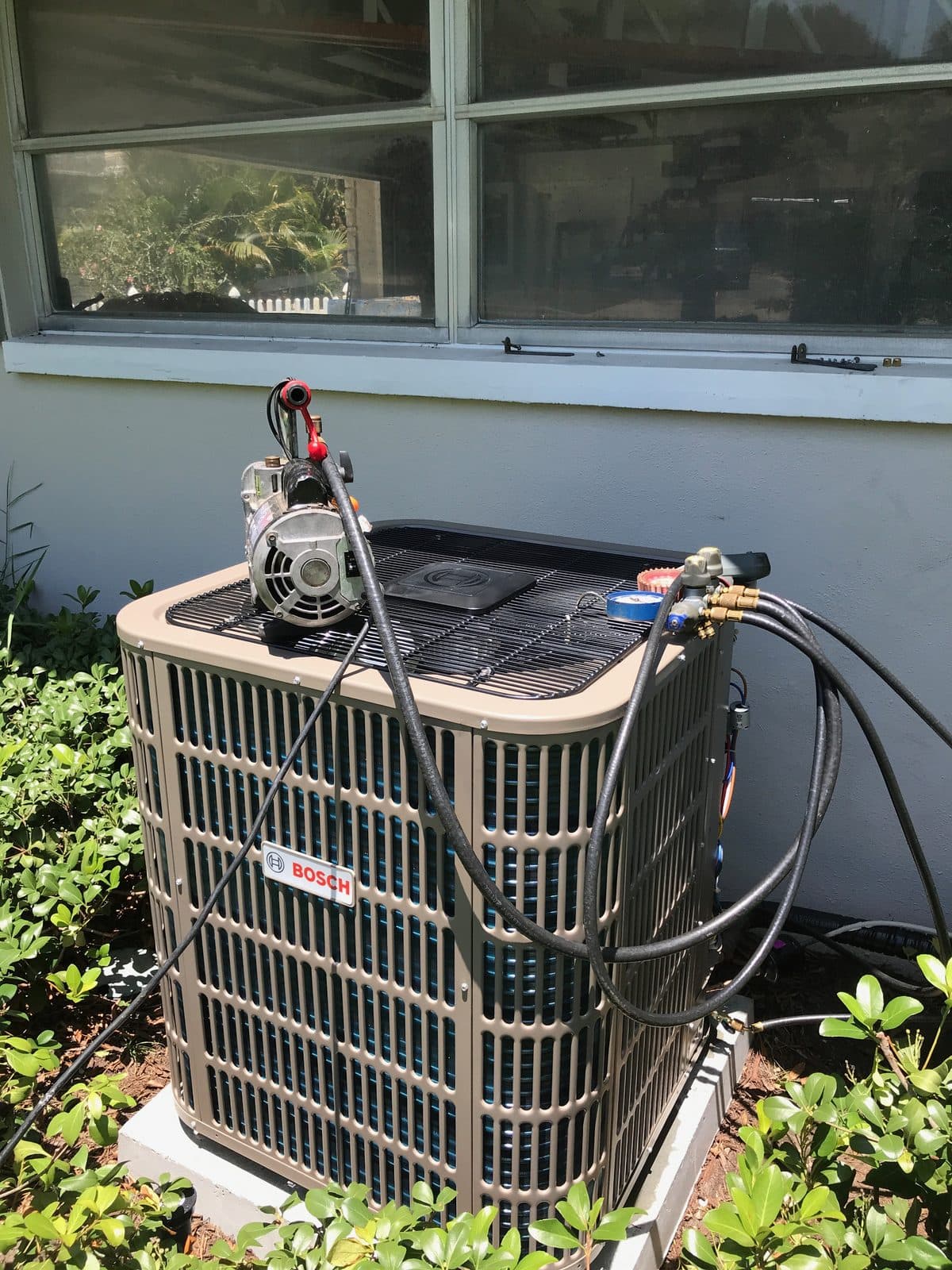
Carrier, an equipment manufacturer, says salt and other airborne contaminants can accumulate on the outdoor components of coastal HVAC equipment. It tells owners to periodically inspect the outdoor coil and cabinet for visible buildup or corrosion. Carrier also says regular maintenance cannot eliminate corrosion. It can help keep the system operating properly and let potential issues be identified earlier. Our guide to coastal coil protection goes further.
Storm season and your air conditioner
The city says hurricanes, tropical storms and other threatening weather can present flood hazards from high tides, wind-driven storm surge and heavy rainfall. Pinellas County's 2026 hurricane guide says flooding can happen year-round but is most common in summer.
The county's guide lists ways to protect a home from flooding. One of them is to elevate your air conditioner, water heater and electric panel. If your outdoor unit sits on a ground-level pad, ask about elevation at the maintenance visit. Our Madeira Beach HVAC page covers the city's permit and elevation rules for a replacement.
Pinellas County tells residents to turn off utilities if they are leaving home under an evacuation. For the full storm checklist, see our hurricane-season HVAC prep guide.
What you can do between visits
Three checks are yours, and they need no tools and no panels opened.
- Filter. ENERGY STAR says to inspect, clean or change air filters once a month. It says a dirty filter can damage your equipment, leading to early failure. Our guide to HVAC air filters explains sizes and ratings.
- Thermostat settings. Confirm the mode, the set temperature and any away or hold schedule, especially before you leave for a long stay. Our page on thermostat settings covers the basics.
- Vents, returns and the outdoor unit. Keep furniture and stored items off the supply vents and return grilles. Clear leaves, sand and storm litter from around the outdoor unit by hand.
Leave the rest to a licensed contractor. Do not open electrical panels, do not touch the capacitor (the part that helps motors start), and do not add refrigerant. If a breaker for the air conditioner has tripped, leave it off and call a licensed contractor.
When to call before the next visit
Do not wait for the scheduled visit if you notice any of these:
- The house feels damp or smells musty, even with the system running. Our guide to a house that stays humid with the AC running explains the usual causes.
- Water in or around the pan under the air handler.
- Ice on the copper lines or the indoor coil.
- A breaker for the air conditioner has tripped.
- White crust or flaking fins on the outdoor coil.
- Weak airflow, warm air from the vents, or a new noise.
For a system that stops entirely, Blume offers 24/7 emergency HVAC service, with same-day response available based on location and technician availability. A person answers the 24/7 dispatch line.
AC maintenance with Blume Mechanical Service
Blume Mechanical Service is a Class A licensed Florida air conditioning contractor, license CAC-1822618, and is fully insured. Our office is in Belleair Bluffs, and our core service area is Pinellas, Hillsborough and Pasco counties, which includes Madeira Beach. We are brand-agnostic and service all major manufacturers as a licensed contractor.
If a visit turns up a problem, you get a written, upfront price before any work. Where repair and replacement are both on the table, Blume lays them out side by side and does not sell equipment a building does not need. Paid priority scheduling is also available.
For the full seasonal list, see our AC maintenance checklist for Florida homes. Details on plans are on the AC maintenance plan page.
Frequently asked
How often should I have my AC maintained in Madeira Beach?
At least once a year. ENERGY STAR recommends a spring check-up for cooling, which lands before hurricane season starts on June 1. If you close the home for summer, the University of Florida suggests a professional check-up three weeks before you leave.
I leave Madeira Beach for the summer. What should the thermostat be set to?
The University of Florida advises no higher than 85°F, so the system still runs and removes moisture. The Florida Solar Energy Center reports that an 85°F setting did not yield acceptable humidity control, because the system did not run long enough. Ask your technician about humidity control for a long absence.
Can maintenance stop salt from corroding my outdoor unit?
No. Carrier says regular maintenance cannot eliminate corrosion, but it can help keep the system operating properly and let problems be found earlier. Ask the technician to look at the outdoor coil and cabinet for buildup or corrosion on each visit.
Do I need to call a pro for this?
Yes, for the maintenance visit itself. Changing the filter, checking thermostat settings and clearing debris from vents, returns and the outdoor unit are yours to do. Coil cleaning, electrical connections, drain service and refrigerant need a licensed contractor.
My condo association handles the building. Who maintains my AC?
Check with your management. The University of Florida notes that many condominiums or communities take care of some exterior maintenance. Find out which parts of your system the association covers before you book a visit.
Drain line care and maintenance plans
If the drain line is why you are here, these pages cover what we offer for it:
- DrainGuard condensate drain protection plan
- AC maintenance plans
- Clogged AC drain line: causes and what to do
- AC capacitor replacement, installed by a licensed technician
Homeowner guides
To schedule AC maintenance in Madeira Beach, call Blume Mechanical Service at 727-330-9131.
References: City of Madeira Beach, Hurricane Information (updated June 14, 2024) · City of Madeira Beach, About (no date printed) · U.S. Census Bureau, B25004 Vacancy Status, 2019-2023 American Community Survey 5-Year Estimates, Madeira Beach city, Florida (read November 13, 2026) · U.S. Census Bureau, DP04 Selected Housing Characteristics, 2019-2023 American Community Survey 5-Year Estimates, Madeira Beach city, Florida (read November 13, 2026) · NOAA National Centers for Environmental Information, 1991-2020 U.S. Climate Normals, annual and seasonal, station USW00092806 St Petersburg AP (read November 13, 2026) · National Weather Service, What Are Heating and Cooling Degree Days (no date printed) · Pinellas County, 2026 Hurricane Guide (January 2026) · Pinellas County, Evacuation (no date printed) · ENERGY STAR (U.S. EPA), Maintenance Checklist (no date printed) · University of Florida IFAS Extension, FCS3154/HE887: Closing Your Seasonal Home (revised April 2026) · Florida Solar Energy Center (University of Central Florida), FSEC Looking for Vacant Homes to Study Ways to Control Relative Humidity and Avoid Mold in Seasonal-Resident Homes (May 12, 2005) · Carrier, Coastal Heating and Air (read November 13, 2026)
Also in Madeira Beach: AC repair in Madeira Beach
Residential AC Maintenance nearby: AC maintenance in Tampa · AC maintenance in St. Petersburg · AC maintenance in New Port Richey · AC maintenance in Clearwater