
Pinellas County · Florida CAC-1822618
AC Repair in Treasure Island, FL
Professional AC repair and HVAC service available 24/7
Treasure Island is a low-lying barrier island, and the Special Flood Hazard Area includes the entire city. That shapes AC repair in Treasure Island: where the equipment sits, how a replacement is permitted, and how the work is planned after a storm. Blume Mechanical Service is a Class A licensed Florida mechanical contractor (license CAC-1822618) and is fully insured. Our office is in Belleair Bluffs, and Pinellas County is part of our core service area. We handle air conditioning repair, heating repair, maintenance, installation, replacement and design-build work for homes and commercial buildings.
What makes Treasure Island different for HVAC
Most HVAC advice assumes a house on dry, inland ground. Treasure Island does not fit that picture.
The whole city is in the flood zone
The entire city is considered to be in the Coastal High Hazard Area, meaning it lies below the elevation of a Category 1 storm surge line according to SLOSH models. In addition, all sites in Treasure Island are in a wind-borne debris zone.
Equipment elevation
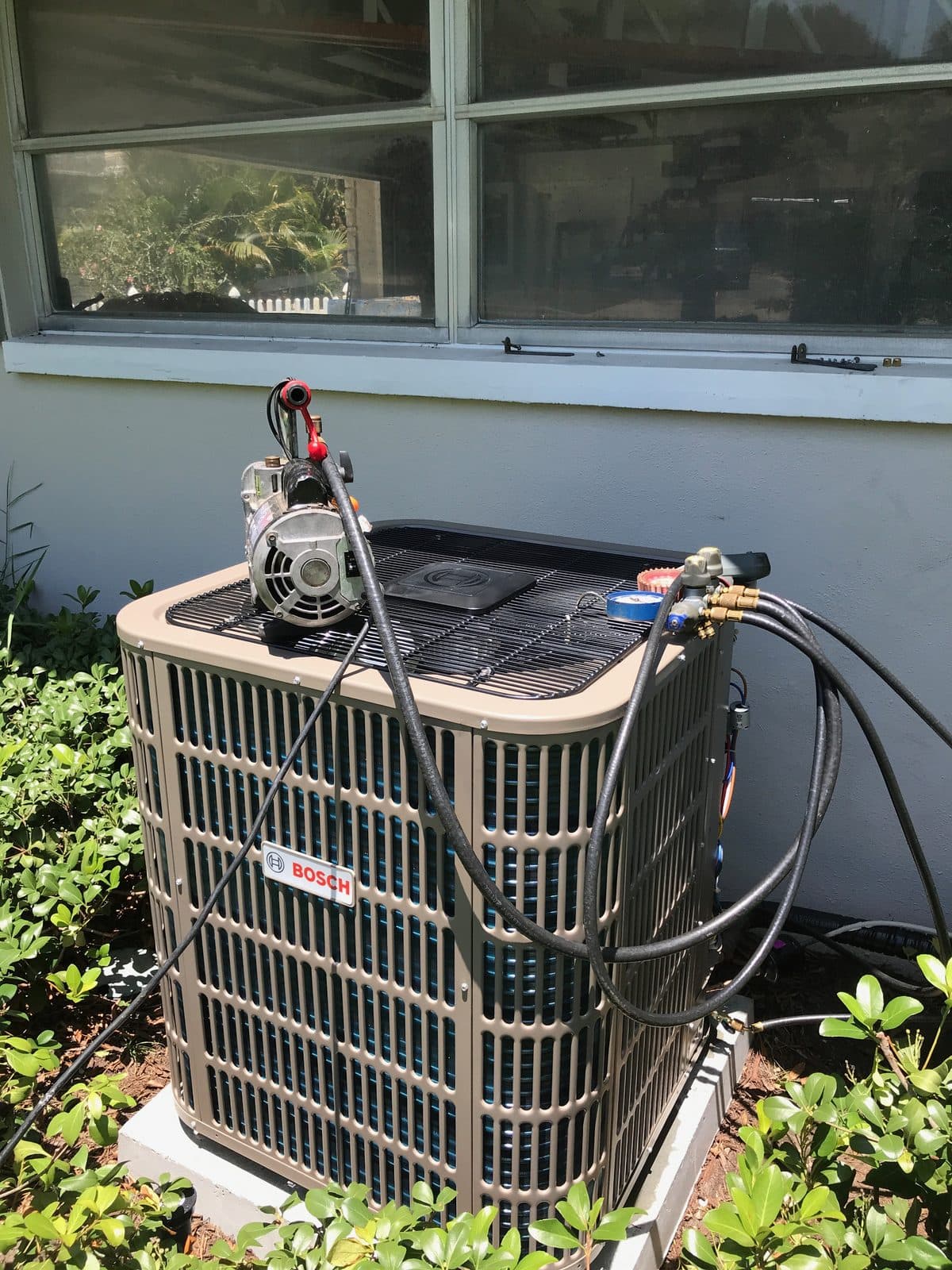
The outdoor condensing unit normally sits at ground level, and the indoor air handler or furnace may sit in a garage, closet or ground-floor utility space.
The building code addresses this directly. The mechanical, plumbing and fuel gas codes include provisions requiring equipment and systems to be located at or above the elevation specified in Sec. 1612.4, which matches the elevation of the building.
The Design Flood Elevation is the FEMA Base Flood Elevation plus 2 feet of freeboard, and owners are pointed to the city's Forerunner map to check the required elevation. We do not guess at your required elevation. It depends on your property, and the city map is where you confirm it.
The practical consequence shows up at the permit counter. If the equipment is being elevated, a site plan is required showing the location of the equipment or platform, its dimensions and its distance from property lines. So if a replacement involves raising equipment, there is drawing work and measuring that comes before the installation day.
The 50 percent rule and what it means for AC work
If the cost of improvements or repairs exceeds 50 percent of the structure's market value, the building must be brought into compliance with current floodplain regulations.
Maintenance projects of any type are logged toward the 50 percent calculation. Work on your building is not judged in isolation; it is counted, and the count can matter later.
The practical advice does not require a calculator:
- Keep every invoice and permit record for HVAC work on your property.
- If you are planning a larger renovation, tell your contractor before the AC is replaced, so the HVAC work is planned alongside everything else.
- If your building has been through storm damage, ask the city how your property is being evaluated before you commit to an equipment purchase.
The permit paperwork reflects this. For substantial improvement or substantial damage, it includes a FEMA Cost Breakdown Worksheet, with affidavits for the homeowner and the contractor. Not every AC job needs that paperwork, but the contractor you hire should be comfortable with it.
Salt, wind and storm exposure
An island unit lives in salt air. Salt settles on the outdoor coil, the cabinet, the fasteners and the electrical connections. Over time it corrodes thin aluminium coil fins and copper tubing, and it speeds up rust on screws, brackets and the unit base. A coil that is losing metal to corrosion loses heat-transfer ability and, eventually, refrigerant through pinhole leaks.
FEMA NFIP Technical Bulletin 7, Corrosion Protection of Metal Connectors in Coastal Areas, is among the city's floodplain reference manuals. That bulletin is about structural connectors, not air conditioners, but the principle is the same: in a coastal area, metal parts need to be chosen and protected with the environment in mind. Our guide to coastal coil protection explains what that means for outdoor coils and cabinets, and the maintenance habits that slow corrosion down.
Wind is the other half. For an outdoor condenser in a wind-borne debris zone, that means securing the unit properly to its pad or platform, keeping loose items away from it, and checking that nothing nearby can become a projectile in a storm.
The housing mix
The Sunshine Beach and Sunset Beach ends of the island are more residential than commercial, with homes ranging from quaint beach cottages to Key West-style three-story homes. That range matters for equipment. A small cottage and a three-story home do not have the same cooling needs, the same duct layout or the same place to put the air handler.
The permit office pays attention to age as well. Among the city's criteria for technical review of a permit is a pre-FIRM structure, meaning one built before 1974, or a structure that does not meet the current Design Flood Elevation. Another criterion is work valued at 25 percent or more of the structure's value per the Pinellas County Property Appraiser. If your property is an older building, ask early whether technical review could apply to your job. It affects the timeline.
Heat, humidity and the long cooling season
Treasure Island has a warm, humid subtropical climate, with temperatures between 72° and 90° in the summer and between 55° and 75° in the winter. That means your air conditioner is not a seasonal appliance here. It is working most of the year, and the humidity load matters as much as the temperature.
The rainy season runs from May 25 to October 10 for most of West Central Florida. That is the stretch when condensate drains, float switches and drain pans earn their keep. When a condensate line clogs, a float switch is supposed to shut the system down before water overflows into the ceiling or closet. A system that keeps tripping on that switch is telling you the drain needs attention, and bypassing the switch is not a fix.
A heat pump handles both cooling and heating, so the same equipment that carries the summer also covers the cooler weeks. We service heating as well as cooling, and a heat pump that has not been checked since last spring is worth a look before the first cool snap.
Permits for AC replacement in Treasure Island
Permitting here is handled by the city itself. The city's Building Division oversees plan review, permitting, inspections and the issuing of Certificates of Occupancy or Completion. The city has adopted the 2023 Florida Building Code, Building and Residential, 8th Edition, effective December 31, 2023.
When a permit is needed
Altering the mechanical (HVAC) system is among the home improvement projects that require a permit in the city. Under city code Section 66-104.1 a permit is required for all work in the floodplain, and all of Treasure Island is within a floodplain.
Maintenance of mechanical systems is work that does not need a permit, but only if it is not a substantial damage situation, in which case a permit to repair substantial damage must cover all work needed to return the building to its pre-damaged condition. In plain terms, a routine tune-up or a filter and drain cleaning is maintenance. Replacing the equipment is a change-out, and if your building was storm damaged, even maintenance-level work can fall under a larger permit.
Our longer guide on HVAC permits in Florida covers the general picture.
Over the counter, or technical review
An ordinary replacement can be quick. The city can issue certain permits over the counter if the permit does not require technical review, and an HVAC mechanical change out is on that list.
For storm-damaged equipment, water-damaged HVAC replacements are among the city's expedited review categories for storm recovery permitting, along with roofs, electrical service reconnections, and fencing and safety measures. That is helpful if your unit was flooded. It does not remove the requirements about where the new equipment goes.
Following Hurricane Idalia in 2023, emergency demolition permits were issued for drywall, insulation, flooring and trim removal, but those permits were for demolition only, and repairs and replacement require standard permitting procedures. Cleanup and rebuild are separate steps with separate permits. Do not assume an emergency permit for tear-out covers the new system.
Contractor registration
The city requires all contractors to complete its registration process before applying for permits. Construction contractors can be licensed either by the State of Florida Department of Business and Professional Regulation or by the Pinellas County Construction Licensing Board, and all contractors need to be registered with that board regardless of state or county license.
Before you sign with anyone, including us, ask who will pull the permit and confirm their license number with the state. Ours is CAC-1822618, and you can look it up on the Florida DBPR site. A contractor who offers to skip the permit on an island replacement is asking you to carry the risk, because unpermitted work does not show up in the record the city keeps.
Power and the meter
Duke Energy is the local power company in Treasure Island. Customers who cannot receive power because of damage to the meter base, breaker panel or customer-owned electrical wiring should contact their local municipalities for guidance, and inspections may be required after repairs are complete.
If your house has no power because of electrical damage, a new air conditioner will not fix that. Sort out the service first, then the AC.
Services we offer in Treasure Island
We are a brand-agnostic contractor. Blume installs and services all major brands as a licensed contractor, so our recommendation is built around your building and not around a manufacturer's catalog.
Air conditioning repair. This covers systems that will not start, run but do not cool, freeze up, leak water, short-cycle or make noise. Refrigerant work is done by EPA Section 608 certified technicians.
Heating repair. Heat pumps, furnaces and electric heat strips are worked on the same way: find the cause first, then talk about the fix.
Maintenance. A maintenance visit on a coastal system should look at the outdoor coil and cabinet for corrosion, the condensate drain and float switch, the electrical connections, the blower, and the filter. Our AC maintenance checklist for Florida lays out what to expect and what you can do between visits. Paid priority scheduling is available if you want maintenance and service visits to get priority on the calendar.
Replacement and installation. We size equipment for homes with an ACCA Manual J load calculation and Manual S selection, not rule-of-thumb swaps. A beach cottage with big west-facing windows and a three-story home with a long duct run to the top floor can need very different answers, even on the same block. If the equipment location or elevation changes, we deal with the site plan the city asks for.
Design-build and commercial work. For commercial buildings and larger projects, we design, build and service systems as a Class A mechanical contractor.
Financing. Financing is approved through Synchrony Bank for customers who want it.
How a service visit works
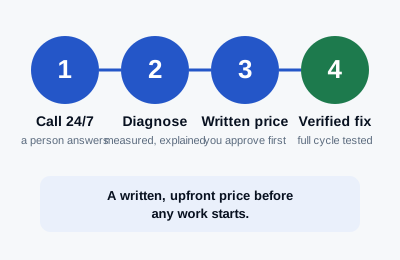
Here is what to expect when you call.
-
The call. You describe what the system is doing. We ask about the symptoms, when they started, and whether there has been any recent storm, water or electrical trouble. A person answers the 24/7 dispatch line. We offer 24/7 emergency HVAC service, with same-day response available based on location and technician availability.
-
The diagnosis. The technician looks at the whole system before touching a part. That means checking power at the unit, the thermostat and controls, the condensate drain, airflow, and the refrigerant side with proper gauges. The aim is to find why the system failed, not just to replace what stopped.
-
The explanation. You get a plain account of what failed, what caused it, and what your options are. If repair and replacement are both reasonable, we lay the two out side by side so you can compare. We do not sell equipment a building does not need.
-
The repair or the plan. Replacement is planned: load calculation, equipment selection, permit and, where needed, the site plan for elevated equipment.
-
The finish. On installations, we commission the system with measured static pressure, airflow and refrigerant charge, and we document the results. A new system that is installed but not measured is only assumed to work.
If you are a landlord or manage a property, tell us when you call. Access, tenant scheduling and who approves the work are easier to arrange up front.
When to call
Some situations are urgent and some can wait a day. Here is how to sort them.
Call right away
- The system is off and the house is hot, especially if someone in the home is elderly, very young or has a medical condition.
- There is water around the air handler or under the unit, or water stains on a ceiling near it. Turn the system off at the thermostat while you wait.
- A burning smell, smoke or visible sparking at the unit or the electrical panel. Switch off the breaker if it is safe to reach, and call.
- The unit or its wiring was in floodwater. Do not try to run a unit that has been under water. Electrical parts and controls need to be checked or replaced first.
- The breaker keeps tripping when the system starts. Resetting it repeatedly can make the damage worse.
Call within a day or two
- The system runs but cooling is weak, or some rooms are noticeably warmer than others.
- The air feels damp or clammy, or you see moisture on vents or windows.
- Ice appears on the indoor coil or refrigerant line. Turn the system to fan only to let it thaw, and call.
- Strange noises: grinding, squealing, rattling or clicking at start-up.
- Visible corrosion on the outdoor coil, base or fasteners.
Schedule ahead
- Maintenance before the hot, rainy season, so a small problem does not turn into a breakdown in the middle of summer.
- Replacement planning, if your system is old, repeatedly failing, or sits lower than the elevation the city requires. Planning ahead gives you time to check your required elevation on the city's map and gather the paperwork the city asks for.
Frequently Asked Questions
How high did the water get along the Pinellas coast during Helene, and why does it matter for my AC?
For Hurricane Helene, peak water levels measured elsewhere along coastal Pinellas County generally ranged from 4 to 7 feet above MHHW (mean higher high water). Those readings were taken elsewhere on the county's coast, not on Treasure Island itself. They show how much water a coastal Pinellas storm can push in, and a condenser or air handler sitting at ground level can be reached long before the water gets that high. That is why the elevation of new equipment deserves a conversation before a replacement, not after.
Will a Duke Energy load-management program shut off my air conditioner?
In Duke Energy Florida's EnergyWise Home program, central air conditioning units are the last appliances cycled off, for up to 16.5 minutes every 30 minutes, and are rarely impacted. That applies to customers enrolled in the program. If your system stops cooling for long stretches, or keeps shutting off, do not assume it is a utility program. A technician can check the controls, the condensate float switch and the electrical side to find the real cause.
How does salt air affect my AC, and what can I do about it?
Salt on the outdoor coil and cabinet speeds up corrosion, which can lead to refrigerant leaks and early failure. Regular coil cleaning, checking the cabinet and fasteners, and protective measures can slow it down. Read our guide on coastal coil protection for specifics.
For AC and HVAC service in Treasure Island, call Blume Mechanical Service at 727-330-9131.
HVAC Services in Treasure Island
Every service we offer in Treasure Island — each link covers scope, pricing factors, and scheduling.
AC Repair & Installation (Residential)
AC Repair & Installation (Commercial)
HVAC Repair & Installation (Residential)
HVAC Repair & Installation (Commercial)
HVAC Service Guides for Treasure Island Homeowners
Start with the symptom or service you need — every guide connects to the same 24/7 dispatch serving Treasure Island.
More: all HVAC services · commercial HVAC
Homeowner guides: AC troubleshooting · Florida AC maintenance checklist · how long AC units last here
Local resources
Official sites, including where to check permitting. A city issues permits for addresses inside its limits; the county covers unincorporated addresses.
HVAC Service in Treasure Island
Blume Mechanical Service provides comprehensive HVAC repair, maintenance, and installation for residents and businesses throughout Treasure Island, Pinellas County. With 24/7 emergency response, licensed technicians, and a written, upfront price before any work starts, we're your trusted partner for all air conditioning and heating needs.
Why Choose Blume for Treasure Island HVAC Service?
✓ Licensed & Insured
Florida HVAC License #CAC-1822618
✓ 24/7 Emergency Service
Available anytime, day or night
✓ Same-Day Response
Available based on location and technician availability
✓ Written, Upfront Price
Before any work starts
Emergency AC Repair in Treasure Island
Your air conditioning stopped working? Our emergency HVAC team responds quickly to get your home or business comfortable again. Call us immediately at (727) 330-9131.
Call Now: (727) 330-9131Our HVAC Services
Air Conditioning Repair
AC unit diagnosis and repair services
Emergency AC Service
24/7 emergency HVAC response
Maintenance Plans
Preventative HVAC maintenance
Installation
New HVAC system installation
Other Cities in Pinellas County
Pinellas County · 24/7 dispatch
Need AC Repair in Treasure Island?
A person answers the 24/7 dispatch line, so call now. Same-day response is available based on location and technician availability.