
Pinellas County · Florida CAC-1822618
AC Repair and HVAC Service in Gulfport, FL
Professional AC repair and HVAC service available 24/7
For AC repair in Gulfport, start with the water: the city sits on Boca Ciega Bay, and Hurricane Helene's storm surge, up to 8 feet high, inundated its downtown. About 27 percent of its land is in the AE flood zone, and more than 90 percent of its dwelling units were built before 1980. Those facts change how a system should be repaired, where its outdoor unit should sit, and which permit steps apply when a unit is replaced.
Blume Mechanical Service is a Class A licensed Florida mechanical contractor (license CAC-1822618), fully insured, working in residential and commercial HVAC. Our office is at 2840 West Bay Drive #114 in Belleair Bluffs, and we serve Pinellas, Hillsborough and Pasco counties, which includes Gulfport. Blume installs and services all major brands as a licensed contractor, and our technicians hold EPA Section 608 certification, the federal credential for handling refrigerant.
What makes Gulfport different for HVAC
A bay-front city with a lot of flood-zone land
The majority of Gulfport's land area, 67 percent, is in FEMA Flood Zone X, which has a 0.2 percent or less annual chance of flooding.
For a homeowner this means two neighbors a few blocks apart can be in different flood categories. The category can affect how high outdoor equipment has to sit and what the city asks for when you replace it.
There is one more local quirk. Low-lying coastal areas along Boca Ciega Bay occasionally receive reverse flow of saltwater through the drainage system into the streets when heavy rain coincides with high tides. Salt water standing at street level is a different problem from rain, and it is hard on anything metal that sits near the ground, which describes outdoor AC condensers.
Equipment elevation
Elevation is a major HVAC issue in a flood-prone city. Heating, ventilating and air conditioning equipment, duct systems and other service equipment must be located at or above the elevation required in Section R322.2 or R322.3.
Such equipment is permitted below that elevation only if it is designed and installed to prevent water from entering or accumulating in the components and to resist hydrostatic and hydrodynamic loads and stresses. In plain terms, the default is to put the equipment up out of the water. Putting it low is the exception, and it carries design conditions.
After flood damage, the requirement is more specific: damaged exterior HVAC or electrical components must be elevated to at least one foot above Base Flood Elevation (BFE). Related to that, permits can be issued for HVAC units in flood zones, with exterior equipment installed at the code-required elevation.
What this means in practice:
- Replacing a ground-level condenser with an identical one on the same pad may not be an option if the pad is below the required elevation.
- An elevated platform or wall bracket changes the job: line sets, electrical disconnects and condensate routing all have to be planned for the new height.
- The required elevation depends on your property's flood designation, so we do not guess it. The permit process settles it.
The 50 percent rule
One rule matters after a storm. Owners of substantially damaged structures, defined as those with damage equal to or exceeding 50 percent of the structure's pre-damage market value, must bring their properties into compliance with current floodplain management regulations.
Why does this matter for HVAC? Because after a storm, an AC replacement might not be a standalone decision. If the structure as a whole crosses that threshold, the property is judged against current floodplain rules, and the equipment is part of that review.
Salt and storm exposure
Salt air and standing salt water attack the aluminum fins and copper tubing of an outdoor coil. The effect is slow corrosion that cuts into capacity and eventually opens leaks. In a bay-front city, it is a real maintenance concern. Our page on protecting coils in coastal conditions goes into detail.
Storms are the other exposure. Hurricane Irma in 2017 brought Category 1 hurricane winds, extreme high tides and very heavy rainfall to the Tampa Bay area, downing many trees and large branches, some of which knocked down power lines. In all, 17 transformers were destroyed, knocking out power for about a week for about 85 percent of Gulfport, including City Hall.
Power loss and power restoration are hard on HVAC equipment. Compressors dislike being restarted instantly into a pressure imbalance, and surges can damage control boards. If your power has been off and returns, wait a few minutes before turning cooling back on, and have the system checked if it does not run normally.
Hurricane Helene came on 26 September 2024 and Hurricane Milton on 9 October 2024. Helene's damage was primarily flooding with some wind damage, and Milton's was primarily wind and rain with some flooding.
Water that reached or rose around an outdoor unit does not leave the equipment as it was. Electrical components, motors and controls may have taken damage that is not visible. A system that was submerged or sprayed with salt water should be inspected by a licensed contractor before it is energized.
Keep generators 20 feet away from windows, doors, vents and air conditioning equipment. Residents are directed to Duke Energy to report power outages.
The housing mix
Gulfport has 8,007 housing units: 4,821 single-family (60.2 percent), 214 townhomes, 572 duplex, triplex and fourplex units, 2,177 multifamily (27.2 percent) and 223 mobile homes (2.8 percent).
That mix points to a few kinds of buildings, each with its own HVAC questions:
- Single-family homes are the largest share of units. A home may have its own split system or heat pump, an air handler and a duct system.
- Condos, apartments and small multifamily buildings raise questions about who owns which piece of equipment and whether a replacement needs association or landlord approval. Those arrangements vary by building, so check with your association or lease before scheduling work.
- Mobile homes can have different duct arrangements and equipment sizes, and replacements need to match what the home was built to accommodate.
Age matters too. By decade built, 28.2 percent date from 1950 to 1959 and 26.3 percent from 1970 to 1979.
Older homes can have ductwork that was designed for a different system, return paths that are undersized for modern equipment, and ducts running through spaces that were never insulated well. The practical point is that swapping in a new outdoor unit without looking at the duct system can leave you with a new system that underperforms.
About 14 percent of Gulfport's housing units are held for seasonal, recreational or occasional use, either by seasonal residents or as vacation rentals. A home that sits closed up for months in a humid climate is exposed to moisture build-up. The warm-season pattern typically brings persistent dew points above 70°F, with daily lows in the 70s to around 80° and highs in the upper 80s to middle 90s. If you are an owner who is away part of the year, ask us about checking the system before you leave and after you return. A drain line that clogs while no one is home can overflow, which is exactly the kind of damage a float switch is meant to prevent.
Permits for AC replacement in Gulfport
Who issues them
In Gulfport, mechanical permits go through the City of Gulfport, which has a mechanical permit checklist.
The city also keeps its own contractor registration. Contractors who are no longer required to register with PCCLB must still register with the City of Gulfport to be able to pull a building permit or schedule inspections on the city's online portal. Effective June 24, 2024, state certified contractors do not have to register or renew their registrations with PCCLB to work in Pinellas County.
Florida's Construction Industry Licensing Board FAQ lists air-conditioning and mechanical among the contractor categories that require state registration or certification. When you hire for an AC replacement, ask for the license number, and look it up with the state's licensing authority.
What the application needs
The permit description must specify whether the job is an equal change-out or a new installation. If any work is being performed on units, it must also list make, tons, SEER and kilowatts for heating, if applicable.
That detail is why a proper replacement starts with knowing exactly what is being installed. It also means "equal change-out" is a defined category. A change that adds capacity, adds a system or alters the arrangement is described differently on the application.
Code requirements for replacing exterior A/C equipment come from the Florida Building Code, Existing Building Code, Eighth Edition (2023). The effective date for the Florida Building Code, 8th Edition (2023), is December 31, 2023. Permit applications to replace these units must include documentation of how the applicant intends to meet those requirements.
Why not skip the permit
The minor-work exemption for single-family residences does not cover electrical, mechanical, plumbing, gas or structural work. An AC replacement is mechanical work, so the exemption does not apply to it.
The consequences are direct: failure to obtain a permit is a violation, and work done before a permit is issued will not be approved and must be removed.
There is a practical benefit as well. Duke Energy's Florida rebate prerequisites say heat pump and HVAC system installations must be permitted by the appropriate local agency. If you plan to apply for a utility rebate, an unpermitted installation can cost you that option. Check the current program terms with the utility.
For a broader explanation, see our guide to HVAC permits in Florida.
Services we offer in Gulfport
Blume Mechanical Service handles design-build, maintenance, repair, installation and replacement, for residential and commercial buildings.
AC repair and diagnosis
Diagnosis comes before any repair: we find what failed and why. A tripped float switch, a frozen evaporator coil, a failed capacitor and a refrigerant leak can all produce "not cooling," and the fixes are very different.
Heating and heat pump service
A heat pump moves heat rather than making it, and runs through the same refrigerant circuit as the cooling side. We service heating and cooling together, since a problem in one often shows up in the other.
Maintenance
Routine maintenance covers coil condition, condensate drain, electrical connections, airflow and refrigerant operation. Paid priority scheduling is available for customers who want it. For a seasonal list you can work through yourself, see our AC maintenance checklist for Florida.
Replacement and installation
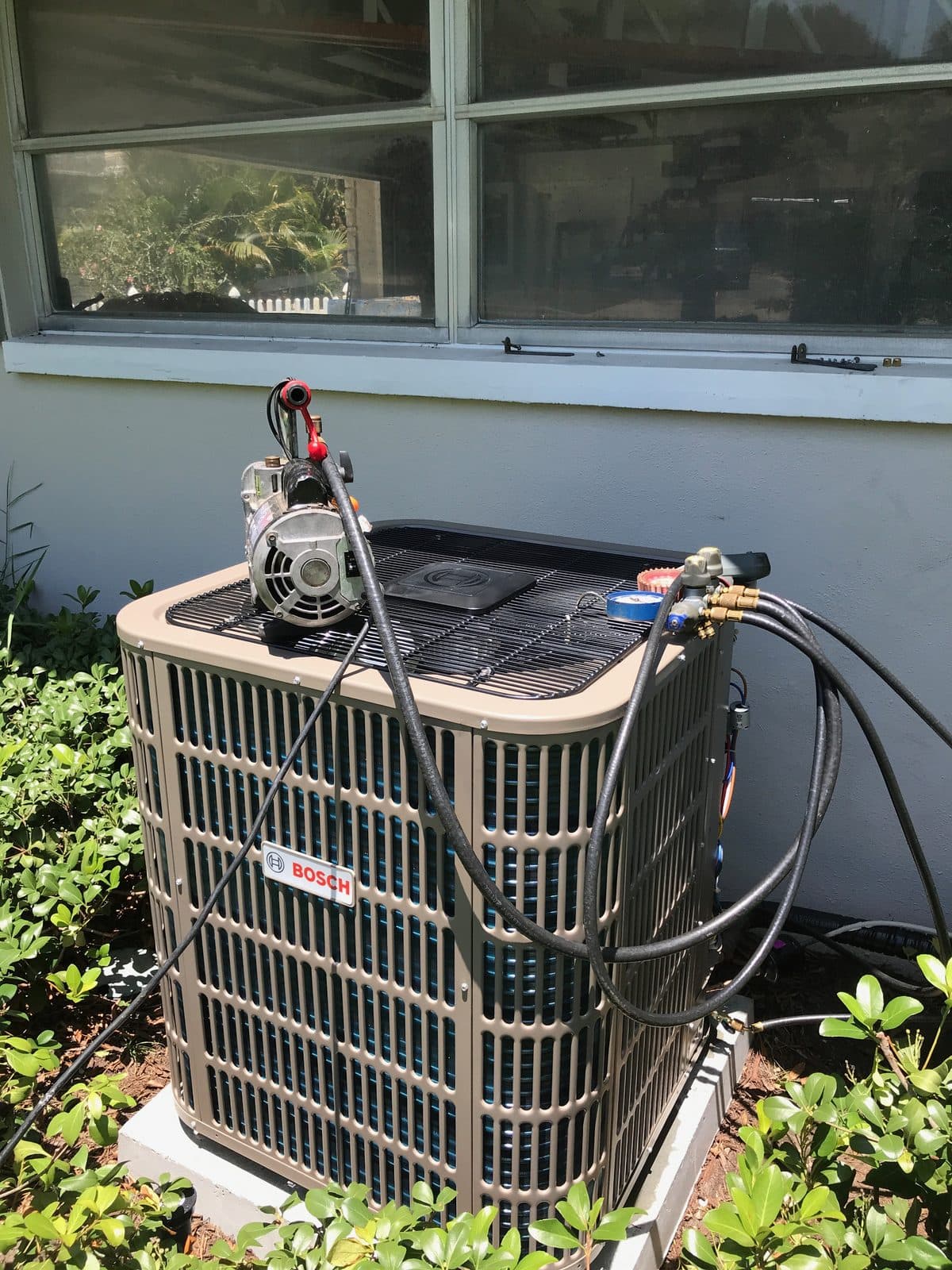
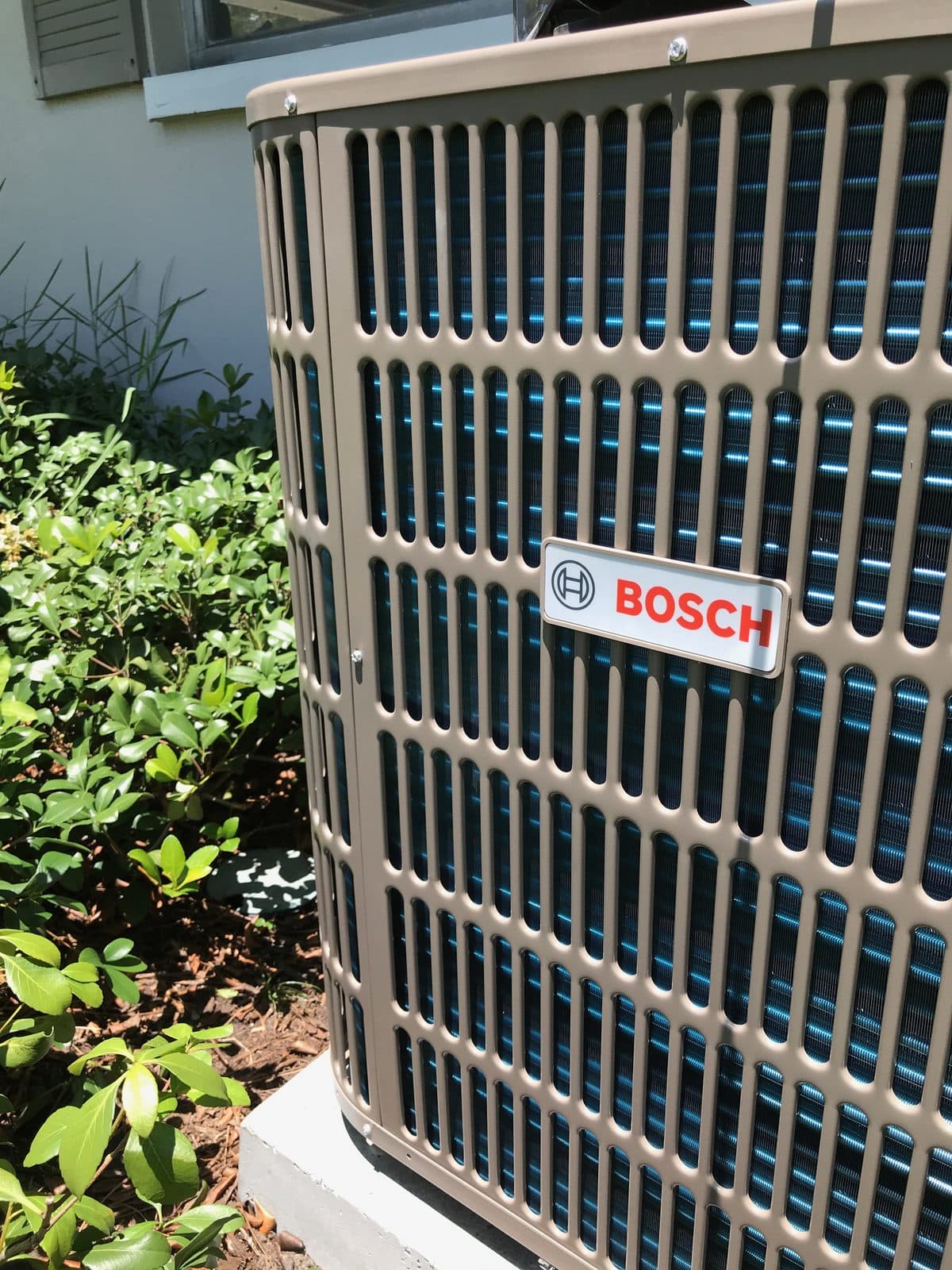
When a system is at the end of its useful life, or a repair does not make sense, we design and install the replacement. For homes, we size equipment with an ACCA Manual J load calculation and select it with Manual S, in place of a rule-of-thumb swap. We commission the finished system with measured static pressure, airflow and refrigerant charge, and document those readings. In flood-zone locations, that includes planning the outdoor unit's height against the code requirements described above.
Financing is available, approved through Synchrony Bank.
Commercial work
Blume also works on commercial HVAC. Commercial load calculations follow their own methods; Manual J is for homes only.
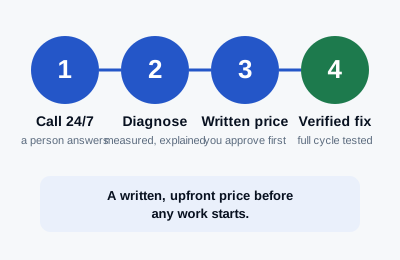
How a service visit works
Here is how a typical visit goes, from the call to the finished work.
- You call. A person answers the 24/7 dispatch line. We do not promise an arrival time, since it depends on the day's calls and where our technicians are working.
- We ask questions first. What is the system doing, when did it start, has the power been off, did anything get wet? For storm-affected equipment in particular, those answers tell us what to look for before anyone touches the unit.
- The technician inspects and tests. A diagnosis rests on measurements, not guesses: electrical readings, airflow, temperature difference across the coil and refrigerant operation.
- We explain what we found. You get a plain account of what failed, why it probably failed, and the options. Where a repair and a replacement are both reasonable, we put the options side by side so you can compare them.
- You decide before work begins. We do not sell equipment a building does not need.
- We do the work and confirm it. After a repair, we check that the system runs correctly and the original symptom is gone. After a replacement, commissioning readings are documented.
When to call
Some problems can wait for a regular appointment. Others should not.
Call right away
- Water or flooding reached the outdoor unit or the air handler. Do not run the system. Switch it off at the thermostat and the breaker if it is safe to reach, and call a licensed contractor to inspect it first.
- Burning smell, smoke or sparking. Turn the system off and call.
- No cooling during extreme heat, especially with elderly residents, infants or anyone with a medical condition in the home.
- Ice on the refrigerant lines or indoor coil. Turn the system to fan-only to let it thaw, and call. Continuing to run a frozen system can damage the compressor.
- Water dripping from the air handler or a wet ceiling. A clogged condensate line can overflow into the home.
Call soon
- The system runs constantly but never reaches the set temperature.
- Cooling is uneven, with some rooms hot and others cold. In an older home, this can point to duct problems.
- The system turns on and off in short bursts.
- The air feels humid and clammy even though the system is running.
- Your outdoor unit shows visible corrosion on the coil or cabinet. In a bay-front city, that is a sign to schedule an inspection. See protecting coils in coastal conditions.
Plan ahead
- Before hurricane season, have the system inspected and know your flood zone.
- Before a seasonal home is left empty for months, check the condensate drain and consider a maintenance visit.
- When a system is old and repair costs keep returning, start talking about replacement before an emergency forces the decision.
Landlords, condo owners and seasonal residents
Landlords benefit from a service history. When a tenant calls in a no-cool complaint, a maintained system with a documented record is easier to troubleshoot than one with no history.
Frequently Asked Questions
What should I do with an old air conditioner after a replacement or storm damage?
Storm debris is to be separated into six categories, with air conditioners listed under Large Appliances, alongside refrigerators, washers and dryers, stoves, water heaters and dishwashers. That is guidance for sorting storm debris, so check with the city about what applies to your situation. The refrigerant inside an old system should be recovered by a technician certified to handle it, not released, so have that done before the unit is set out.
Is the bay getting higher, and should that change where my outdoor unit goes?
The mean sea level trend at the St. Petersburg tide station is 3.09 millimeters per year, equal to a change of 1.01 feet in 100 years. That is a long-term trend at a regional station, not a forecast for your street. The elevation your unit needs today comes from the code and your property's flood designation. If you are choosing a platform or bracket height, it is reasonable to ask about the margin above the minimum when we plan the job.
What should I have ready when I call about storm-damaged equipment?
Gather a few things before you dial. Note the date of the storm and whether the unit sat in standing water or only got wet from rain and spray. Take photos of the outdoor unit, the waterline on or near it, and any exposed wiring. Tell us what the breaker and thermostat did when the power came back, and whether a generator ran nearby. Leave the system switched off until a licensed contractor has looked at it.
If my neighborhood flooded, should I assume my AC was damaged?
Not automatically, but do not assume it was fine either. Helene caused significant damage in Gulfport, including storm surge, flooding and debris; the waterfront and downtown areas were especially affected, and about 25 percent of the town was flooded. That is a share of the town, so it does not tell you whether water reached your equipment. What matters is whether water reached your outdoor unit, air handler or electrical connections. If it did, or you are not sure, keep the system off and have a licensed contractor inspect it before it is energized.
For AC or heating service in Gulfport, call Blume Mechanical Service at 727-330-9131.
HVAC Services in Gulfport
Every service we offer in Gulfport — each link covers scope, pricing factors, and scheduling.
AC Repair & Installation (Residential)
AC Repair & Installation (Commercial)
HVAC Repair & Installation (Residential)
HVAC Repair & Installation (Commercial)
HVAC Service Guides for Gulfport Homeowners
Start with the symptom or service you need — every guide connects to the same 24/7 dispatch serving Gulfport.
More: all HVAC services · commercial HVAC
Homeowner guides: AC troubleshooting · Florida AC maintenance checklist · how long AC units last here
Local resources
Official sites, including where to check permitting. A city issues permits for addresses inside its limits; the county covers unincorporated addresses.
HVAC Service in Gulfport
Blume Mechanical Service provides comprehensive HVAC repair, maintenance, and installation for residents and businesses throughout Gulfport, Pinellas County. With 24/7 emergency response, licensed technicians, and a written, upfront price before any work starts, we're your trusted partner for all air conditioning and heating needs.
Why Choose Blume for Gulfport HVAC Service?
✓ Licensed & Insured
Florida HVAC License #CAC-1822618
✓ 24/7 Emergency Service
Available anytime, day or night
✓ Same-Day Response
Available based on location and technician availability
✓ Written, Upfront Price
Before any work starts
Emergency AC Repair in Gulfport
Your air conditioning stopped working? Our emergency HVAC team responds quickly to get your home or business comfortable again. Call us immediately at (727) 330-9131.
Call Now: (727) 330-9131Our HVAC Services
Air Conditioning Repair
AC unit diagnosis and repair services
Emergency AC Service
24/7 emergency HVAC response
Maintenance Plans
Preventative HVAC maintenance
Installation
New HVAC system installation
Other Cities in Pinellas County
Pinellas County · 24/7 dispatch
Need AC Repair in Gulfport?
A person answers the 24/7 dispatch line, so call now. Same-day response is available based on location and technician availability.