
Pinellas County · Florida CAC-1822618
AC Repair and HVAC Service in Safety Harbor, FL
Professional AC repair and HVAC service available 24/7
AC repair in Safety Harbor comes with a local twist: mechanical and A/C changeout permit applications go solely to Pinellas County, not to the city. Flood-zone rules can also affect where equipment sits. Whether your system stopped cooling or still runs but seems off, you will want to know if it is a repair or a replacement. It covers how Blume Mechanical Service works in Safety Harbor, what is different about HVAC in this city, how permits for AC replacement work here, and when a problem should not wait.
Blume Mechanical Service, LLC is a Class A licensed Florida mechanical contractor (license CAC-1822618) and is fully insured. We work on residential and commercial systems. Our office is in Belleair Bluffs, and Safety Harbor is part of our core service area of Pinellas, Hillsborough and Pasco counties.
Who we are and what we do in Safety Harbor
Blume was started by Tye Blume in September 2009. Tye grew up in a family HVAC business and was sweeping the floor of the family's sheet-metal shop by age six, so the trade is not new to him. Our technicians hold EPA Section 608 certification, the federal credential for handling refrigerant.
We design, install, replace, maintain and repair air conditioning and heating systems. We are brand-agnostic: Blume installs and services all major brands as a licensed contractor, so a recommendation from us is based on your building and not on a brand obligation.
- AC repair and diagnosis: a system that is not cooling, cools unevenly, short-cycles, freezes up, leaks water, or makes noises it did not make before.
- Heating repair: heat pumps in heating mode, furnaces and air handlers with electric heat strips that fail to produce warm air.
- Maintenance: seasonal inspections and cleaning so small problems are found before a hot week turns them into a no-cool call.
- Replacement and installation: sized to the building, not swapped like for like.
- Commercial service: for small commercial spaces and buildings, with commercial load calculations handled as commercial work.
What makes Safety Harbor different for HVAC
Flood zones and where the equipment sits
Relocating electrical panel boxes, air conditioning units, water heaters and washer/dryers to a location less likely to be flooded is one way to protect a property.
Flood rules also reach into how equipment is placed. Heating, ventilating and air conditioning equipment and duct systems must be located at or above the elevation required by the flood provisions of the Florida Building Code, Residential.
Pinellas County's application for construction in a floodplain goes further for utilities, including the air conditioning compressor or unit, the furnace and the water heater, which must be above base flood elevation plus freeboard or the design flood elevation, whichever is higher.
In practice, that means a replacement in a flood-prone location is not only a question of "what unit fits the old pad." It can also be a question of where the new equipment must sit. We do not decide your flood zone or required elevation. The city and county do. What we can do is look at the existing equipment location during the visit and tell you plainly if it looks like a question worth raising with them before anything is ordered.
Flood maps are also changing. FEMA's new flood maps for Pinellas County will affect the Alligator Creek area of Safety Harbor and are scheduled to take effect in summer 2027. If you own property in that area, it is worth checking with the city about how the map change applies to your address before you plan a major system project.
The 50 percent rule, and why you will see two numbers
If you read about flood rules and remodeling, you will meet the "substantial improvement" rule. Pinellas County's flood guide labels it the "50 percent rule": remodeling projects that cost half of the value of the original structure will require you to elevate the building above the flood level.
In the City of Safety Harbor, the threshold is 49 percent. If the combined cost of improvements equals or exceeds 49 percent of the market value of the structure before the start of construction, the building is considered substantially improved. It is then treated as a new structure and must meet Florida Building Code requirements. For a property in Safety Harbor, treat the city's 49 percent figure as the one that applies and confirm with the city.
If your building is in a flood hazard area, what the city counts toward "combined cost of improvements" is a question for the city, not for us. We will not guess at it. If your project is part of a larger renovation, ask the city to review it before you commit to a schedule.
Storm and salt exposure
The Coastal High Hazard Area is defined as the area below the elevation of the Category 1 storm surge line, as established by the SLOSH storm surge model. If your address is inside that area, a storm-surge event is a realistic risk to ground-level equipment.
Wind matters too. Outdoor equipment such as air conditioner compressors can be blown off their pads or supports. Securing a condenser to its pad or stand, and checking that the connections and supports are still sound, is ordinary pre-season work and part of a maintenance visit.
Permits resulting from Hurricanes Helene and Milton are not exempt from Substantial Damage and Substantial Improvement rules. If your system was damaged in a storm and you are repairing or replacing it, that rule can apply to your project.
Salt air is the other coastal factor. Salt-laden air attacks the aluminum fins and copper tubing of outdoor coils over time, and a coil that is rinsed and inspected regularly lasts longer than one left alone. We cover this in detail in our guide to coastal coil protection.
Humidity is the daily job
Even without a storm, Tampa Bay air is humid, and your air conditioner is a dehumidifier as much as a cooler.
For your system, that means long run times and a lot of condensate. A drain line that clogs, a float switch that trips, or a coil that ices over shows up fast in this climate. That is why a maintenance visit includes the drain, not only the filter. Our AC maintenance checklist for Florida lists what to look at and what to leave to a technician.
The housing mix and the age of the systems
A new condenser connected to old, leaky or undersized ducts will not perform as designed. This is why we check airflow and static pressure rather than only the equipment itself. See "How a visit works" below.
In Pinellas County, Pre-FIRM homes include those built before flood maps were in place in the late 1970s. Certain Pre-FIRM homes, along with homes with major storm damage, need a substantial damage inspection before a permit can be issued. If your home predates the flood maps, or was heavily damaged in a storm, expect the permit process to include that extra step.
Permits for AC replacement in Safety Harbor
The answer here is a little unusual: the city does not issue the permit.
Mechanical and A/C changeout permit applications are submitted solely to Pinellas County, using the county's forms and procedures. Inspection duties are divided: City staff inspect for the Land Development Code, City Code and Fire Code, and Pinellas County inspects for compliance with the Florida Building Code.
There is one flood-zone step. Structures in the Special Flood Hazard Area must be reviewed for Substantial Improvement and Substantial Damage (the 49 percent rule) by the City of Safety Harbor before the application goes to Pinellas County. So if your home is in a mapped flood hazard area, the order is city review first, then the county permit.
What the county process looks like
Pinellas County's express permits are simple, standalone projects that qualify for faster review of 0 to 2 business days. They are available online for licensed contractors only, and owner-builders can apply in person.
One caution: any repair work that normally requires a permit will still require one after a storm. This includes mechanical and HVAC repairs.
When you hire for a replacement, ask who is pulling the permit and ask to see the license number. Ours is CAC-1822618, and you can check any Florida license with the Department of Business and Professional Regulation.
Our guide to Florida HVAC permits covers the general process, and the Safety Harbor details above are what sit on top of it.
Services in Safety Harbor and how a visit works
Repair and diagnosis
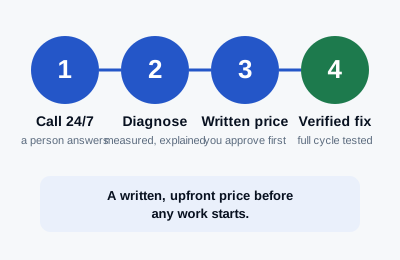
When your AC is not working, the goal of the visit is to find the cause, not to replace the first part that looks suspicious. A typical diagnostic visit covers:
- Your description of the problem. When it started, what it does, and whether anything changed: a power flicker, a storm, a filter left too long.
- The thermostat and controls. Wrong settings, dead batteries and failed wiring.
- The indoor side. Filter, blower, evaporator coil, condensate drain and float switch.
- The outdoor side. Condenser coil, fan, contactor, capacitor and electrical connections.
- Refrigerant and airflow. Measured, not guessed. Low refrigerant means there is a leak somewhere, and adding more without finding it does not fix anything.
- An explanation of what we found. In plain language, with the options.
Parts and labor are explained to you before work begins. We give you the repair-versus-replace picture side by side so you can decide, and we do not sell equipment a building does not need.
Repair or replace
There is no single age at which a system should be replaced. The real questions are:
- Is the problem a single failed part, or one in a series of failures?
- Is the system a type and size that suits the building, or was it never right?
- Are the ducts, drain and electrical supply sound enough to support a new unit?
- Is the equipment in a location that would cause trouble in a storm or flood?
If a replacement is on the table and your equipment sits low, the flood provisions above are worth raising early.
Replacement and installation
For a replacement, we size equipment with an ACCA Manual J load calculation for homes and select it using Manual S. We do not swap by rule of thumb. This applies to homes; commercial buildings get a commercial load calculation. An oversized system short-cycles and handles humidity poorly, which in Tampa Bay air is a real problem. An undersized one runs constantly and never catches up.
Once installed, the system is commissioned. We document measured static pressure, airflow and refrigerant charge, so you have a record of how it was set up, and not only the word of the person who installed it.
We offer estimates on new systems. Financing is available through Synchrony Bank, subject to approval.
Maintenance and priority scheduling
Regular maintenance catches the things that fail in this climate: clogged drains, dirty coils, loose electrical connections, worn capacitors. For storm preparation, it also means checking that the outdoor unit is secure. Paid priority scheduling is available if you want a faster place in the queue. Ask us about it when you call.
Landlords, condo owners and commercial properties
If you manage a rental or condo unit, the same diagnostic approach applies, but the practical details differ. You may need to coordinate access with a tenant or an association, and you may not control where the equipment sits. Tell us when you call who has keys and who approves work. We are a licensed commercial and residential contractor, so we can work with either arrangement.
When to call
Some problems can wait for a normal appointment. Others should not.
Call right away:
- The system is off and the indoor temperature is climbing, particularly if anyone at home is elderly, very young or in poor health.
- You smell burning, see smoke, or hear loud grinding or banging from the equipment. Turn the system off at the thermostat and the breaker.
- Water is running from the air handler into the home, or the drain pan is overflowing.
- The system has been under water or the electrical components got wet. Do not turn it back on. Have it inspected first.
- A storm moved or damaged the outdoor unit.
We provide 24/7 emergency HVAC service, with same-day response available based on location and technician availability. A person answers the 24/7 dispatch line. We do not promise a specific arrival time.
Call to schedule soon:
- The AC runs but the house does not get as cool as it used to.
- Rooms cool unevenly.
- The unit short-cycles, turning on and off often.
- Ice forms on the refrigerant lines or indoor coil.
- The indoor air feels sticky even when the thermostat is satisfied.
- Your energy use has risen with no change in how you use the home.
Before storm season:
- Have the system inspected.
- Confirm that the outdoor unit is secured.
- Know where your breaker and the system's shutoff are.
- If you are in a flood hazard area, ask whether the equipment's location is a concern.
Call Blume for AC repair in Safety Harbor
Blume Mechanical Service, 24/7 emergency HVAC service: 727-330-9131.
Frequently Asked Questions
Did back-to-back storms in 2024 change anything for outdoor AC equipment?
The Safety Harbor pier was first damaged by Hurricane Debby in August 2024, and back-to-back hits from Hurricanes Helene and Milton then worsened the structural damage. The HVAC lesson is that repeated storms in a short span do not give equipment time to be checked in between. If your outdoor unit went through more than one event, have the pad, mounting, electrical connections and coil looked at, even if the system still cools.
Why is my AC freezing up?
Ice on the indoor coil or the refrigerant lines usually points to restricted airflow or low refrigerant. A dirty filter, a failing blower or blocked ducts can cause the first, and a leak can cause the second. Turn the system off and let the ice melt, and keep the thermostat fan setting on to help it thaw. Then have a technician find the cause, because running a frozen coil can damage the compressor.
Why is air coming from my vents weak even though the AC runs?
Weak airflow is often a restriction rather than a cooling failure. The filter, the blower, the evaporator coil and the ductwork are the usual places to look. A disconnected or crushed duct can also leave a room short on air. A technician can measure static pressure and airflow to show where the restriction is, rather than guessing.
What should I have ready before I call?
Have your Safety Harbor address, what the system is doing or not doing, and when it started. Note whether the thermostat shows anything, whether a breaker has tripped, and whether water has reached the outdoor unit or the air handler's space. If you can read the model information on the outdoor unit's data plate, have that handy. Say whether you own the property or manage it for someone else, and who can give access.
HVAC Services in Safety Harbor
Every service we offer in Safety Harbor — each link covers scope, pricing factors, and scheduling.
AC Repair & Installation (Residential)
AC Repair & Installation (Commercial)
HVAC Repair & Installation (Residential)
HVAC Repair & Installation (Commercial)
HVAC Service Guides for Safety Harbor Homeowners
Start with the symptom or service you need — every guide connects to the same 24/7 dispatch serving Safety Harbor.
More: all HVAC services · commercial HVAC
Homeowner guides: AC troubleshooting · Florida AC maintenance checklist · how long AC units last here
Local resources
Official sites, including where to check permitting. A city issues permits for addresses inside its limits; the county covers unincorporated addresses.
HVAC Service in Safety Harbor
Blume Mechanical Service provides comprehensive HVAC repair, maintenance, and installation for residents and businesses throughout Safety Harbor, Pinellas County. With 24/7 emergency response, licensed technicians, and a written, upfront price before any work starts, we're your trusted partner for all air conditioning and heating needs.
Why Choose Blume for Safety Harbor HVAC Service?
✓ Licensed & Insured
Florida HVAC License #CAC-1822618
✓ 24/7 Emergency Service
Available anytime, day or night
✓ Same-Day Response
Available based on location and technician availability
✓ Written, Upfront Price
Before any work starts
Emergency AC Repair in Safety Harbor
Your air conditioning stopped working? Our emergency HVAC team responds quickly to get your home or business comfortable again. Call us immediately at (727) 330-9131.
Call Now: (727) 330-9131Our HVAC Services
Air Conditioning Repair
AC unit diagnosis and repair services
Emergency AC Service
24/7 emergency HVAC response
Maintenance Plans
Preventative HVAC maintenance
Installation
New HVAC system installation
Other Cities in Pinellas County
Pinellas County · 24/7 dispatch
Need AC Repair in Safety Harbor?
A person answers the 24/7 dispatch line, so call now. Same-day response is available based on location and technician availability.