
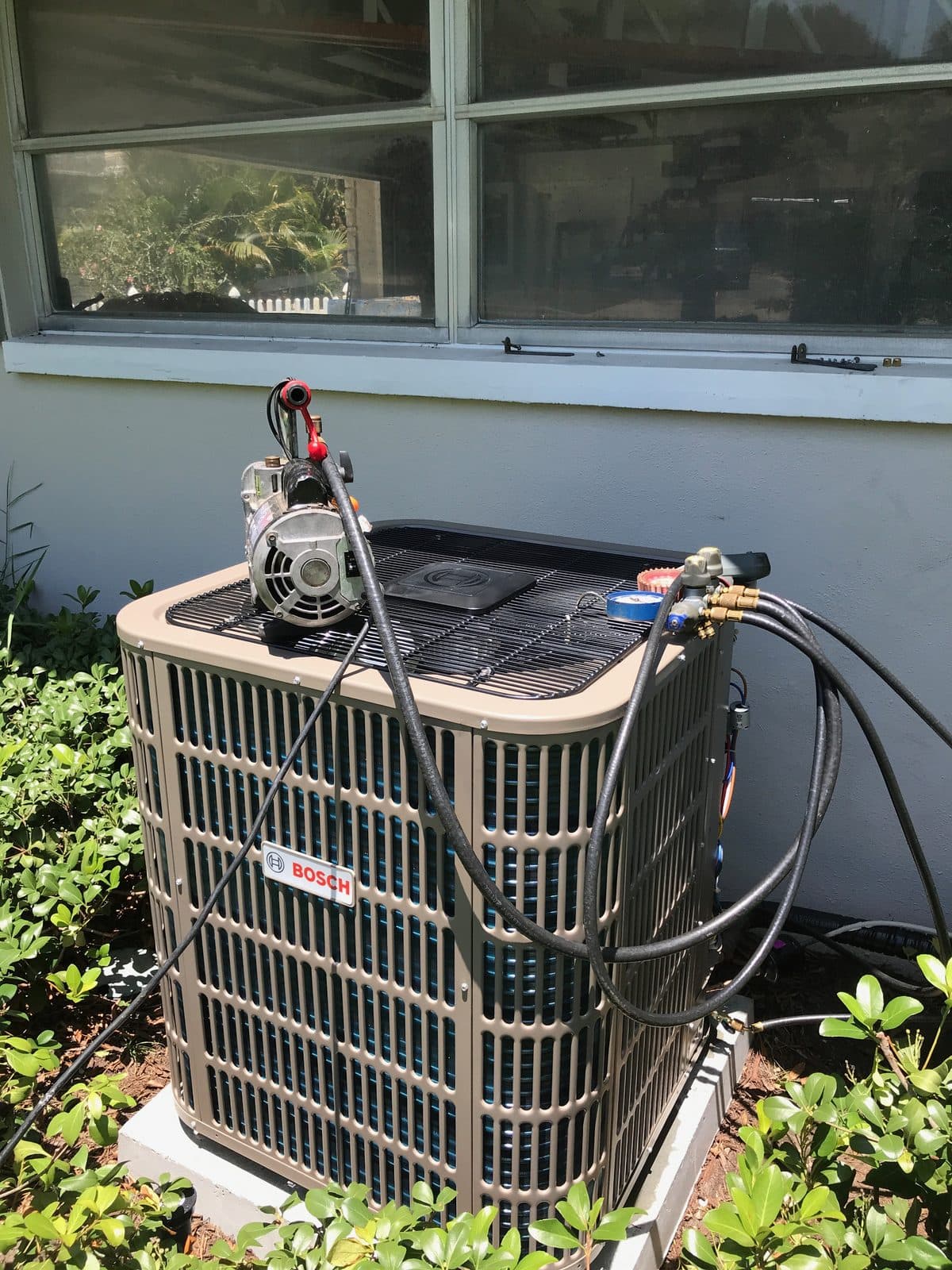
Pasco County · Florida CAC-1822618
Heat Pump Repair in Holiday, FL
This page is for a Holiday homeowner or renter whose heat pump has stopped heating or cooling properly. It explains how a heat pump works, the three checks that are safe to make yourself, and when a licensed contractor is the right call. Holiday is an unincorporated community in Pasco County. Blume Mechanical Service is a licensed Florida air conditioning contractor (license CAC-1822618), and Pasco County is part of our core service area.
A heat pump is an air conditioner that can also run in reverse to warm the house. In Holiday it works both ways in one year. NOAA's normals for the nearby Tarpon Springs station put the normal July high at 90.6°F and the normal January low at 50.7°F. So the same machine that cools through a long hot season also has to heat on cool winter mornings. Holiday's homes add their own questions: who owns the equipment in a rented home, and how a mobile home is laid out.
Holiday is governed by Pasco County, not a city hall
The U.S. Census Bureau counts Holiday as a census-designated place. It describes those places as unincorporated communities without an active, functioning governmental structure. A University of Florida GeoPlan Center report on Holiday lists Pasco as its county.
That means the building office for Holiday is the county's. Pasco County Building Construction Services lists its office at 8661 Citizens Drive, Suite 100, in New Port Richey. The county says its plans review and inspections cover the building and trade disciplines governed by the Florida Building Code.
If a repair turns into a replacement, ask your contractor how the county permit and inspection will be handled. Our Holiday HVAC page covers flood zones and the county's role in more detail.
How a heat pump heats and cools
A heat pump moves heat from one place to another with refrigerant, the fluid that carries heat between the indoor coil and the outdoor coil. The Building America Solution Center, run by the Pacific Northwest National Laboratory for the U.S. Department of Energy, explains the parts that matter for a repair.
The refrigeration cycle
The Solution Center says heat pumps use the same refrigeration cycle technology as your home's refrigerator or air conditioner. In summer the system pulls heat out of the house and dumps it outdoors, just as a central air conditioner does.
The reversing valve
It says heat pumps have a reversing valve, a part that lets them reverse the cycle to pull heat from the outdoor air. That is how the same outdoor unit warms the house in winter.
The defrost cycle
It says heat pumps have a built-in defrost cycle to keep the outdoor coils from icing up. Our guide to heat pump defrost mode explains what that looks like from the yard.
Strip heat
It says all-electric heat pumps come with electric resistance strip heaters for supplementary heat if needed. Your thermostat may call this auxiliary heat. See our guide to auxiliary heat, and if you are not sure what you have, how to tell if you have a heat pump.
Holiday winters and the heating side
Holiday's winter numbers are mild. They come from NOAA's 1991 to 2020 climate normals for the Tarpon Springs station, close to Holiday.
- December: a normal high of 71.4°F and a normal low of 53.5°F.
- January: a normal high of 69.3°F and a normal low of 50.7°F.
- February: a normal high of 72.0°F and a normal low of 53.8°F.
The Solution Center says a standard central heat pump's heating efficiency drops when the outside temperature falls below about 35°F. The normal winter lows at the station sit well above that point. On a cold snap below it, the strip heaters may come on to help.
If your thermostat shows auxiliary or emergency heat running often on mild nights, mention it when you call. Our guide to emergency heat explains the difference between the two settings.
Switch the thermostat to heat on a cool afternoon in late fall and check for warm air at the vents. Finding a fault then is better than finding it on the first cold morning.
Air that feels cool when the heat is on
Part of this symptom can be normal. The Solution Center says heat pumps blow more air at cooler temperatures than gas- or oil-fired furnaces. Air from a working heat pump can feel lukewarm at the register compared with furnace air.
Air that is plainly cold, with the thermostat set to heat and above the room temperature, is a different matter. The Solution Center describes the parts that let a heat pump heat: a reversing valve that reverses the cycle, a defrost cycle that keeps the outdoor coils from icing up, and strip heaters for supplementary heat. It also says too much or too little refrigerant can affect performance and efficiency. A licensed contractor checks each one.
These are not jobs for a homeowner with a screwdriver. If the outdoor coil is covered in ice that does not clear, switch the system off at the thermostat and call.
Summer in Holiday: the cooling side
Through the hot season a Holiday heat pump runs as an air conditioner. At the Tarpon Springs station the normal daily high stays near 90°F from June through September. The normal low in July and August stays above 75°F.
ENERGY STAR says a typical maintenance check-up should include the following:
- Electrical connections and motors. The checklist includes tightening all electrical connections and measuring voltage and current on motors.
- Controls. It includes checking the system's controls for proper and safe operation.
- The condensate drain. It says to inspect the drain in a heat pump when in cooling mode, and that a plugged drain can cause water damage in the house.
The filter matters in summer too. ENERGY STAR says to inspect, clean or change air filters in a heat pump once a month. It says a dirty filter can damage your equipment, leading to early failure. Our guide to HVAC air filters covers sizes and types.
Owners, renters and mobile homes in Holiday
The GeoPlan Center report counts 12,854 housing units in Holiday, using 2017 to 2021 American Community Survey estimates. Who calls about a broken heat pump depends on which kind of home you are in.
Renters
The same report counts 4,006 renter-occupied units and 5,749 owner-occupied units. If you rent, check your lease and call your landlord or property manager before you book a repair yourself.
Long-time owners
Among owner households, the report gives 2010 as the median year the householder moved in. In other words, half of Holiday's owner households moved in during 2010 or earlier. If the heat pump came with the house, tell the technician what you know about its history, including any past refrigerant top-ups.
Mobile homes
The report counts 1,910 mobile home units in Holiday. The layout of a manufactured home is different from a site-built house, and our guide to mobile home air conditioning explains where the equipment and ducts usually sit.
R-22, leaks and an honest repair
Older heat pumps may run on R-22, an older refrigerant the EPA also calls HCFC-22. The EPA says that as of January 1, 2020, no new HCFC-22 is made or imported into the United States. It also says the EPA does not require homeowners to replace their existing equipment, and that you can continue to service an existing HCFC-22 system.
If your system leaks refrigerant, the EPA's advice to homeowners is to ask your technicians to locate and repair the leak instead of topping it off. It also suggests asking whether the company's technicians are Section 608-certified, the federal credential for handling refrigerant. Blume has EPA Section 608 certified technicians.
Our guides to converting from R-22 to R-410A and when to replace a heat pump walk through the choices.
Blume Mechanical Service in Holiday
Blume Mechanical Service, LLC is a Class A licensed Florida air conditioning contractor (license CAC-1822618) and is fully insured. We are brand-agnostic and service all major manufacturers' equipment. Our office is at 2840 West Bay Drive #114, Belleair Bluffs, FL 33770, and our core service area is Pinellas, Hillsborough and Pasco counties.
You get a written, upfront price before any work starts. When a heat pump is near the end of its life, we lay out repair and replacement side by side and do not sell equipment a home does not need. A replacement is sized with an ACCA Manual J load calculation and Manual S equipment selection. New equipment is commissioned with measured static pressure, airflow and refrigerant charge. Financing is available through Synchrony Bank.
What to have ready when you call
- Whether the problem is heating, cooling or both.
- What the thermostat is set to, what it reads, and whether it shows auxiliary or emergency heat.
- Whether the outdoor unit runs, and whether you see ice on it.
- Whether the home is a house, a mobile home or a rental, and who owns the equipment.
- Whether the system uses R-22, if you know.
Nearby, we also have pages on AC repair in New Port Richey and heat pump repair in Palm Harbor.
Frequently asked
Do I need to call a pro for this?
Maybe. If the cause was a thermostat setting, a dirty filter, or leaves and clutter blocking a vent, a return or the outdoor unit, you may not need anyone. If a breaker has tripped, leave it off and call a licensed contractor. Call one too if the air stays cold in heat mode or ice will not clear from the outdoor coil. Refrigerant, wiring and capacitor work belongs to a licensed contractor only.
Why does my heat pump air feel only lukewarm in heat mode?
Some of that is normal. The Building America Solution Center says heat pumps blow more air at cooler temperatures than gas- or oil-fired furnaces. If the air stays plainly cold with the thermostat set above room temperature, have a licensed contractor diagnose it.
Should auxiliary heat come on often in Holiday?
Normal winter lows here sit well above about 35°F. The Solution Center says a standard heat pump's heating efficiency drops below about 35°F. NOAA's normal January low at the nearby Tarpon Springs station is 50.7°F. If auxiliary or emergency heat runs often on mild nights, mention it when you call.
My heat pump uses R-22. Do I have to replace it?
No. The EPA says it does not require homeowners to replace their existing equipment, and that an existing HCFC-22 system can still be serviced. The EPA says that as of January 1, 2020, no new HCFC-22 is made or imported into the United States. If the system is leaking, the EPA advises asking for the leak to be found and repaired rather than topped off.
I rent my home in Holiday. Who should I call?
Start with your landlord or property manager, and check your lease. A University of Florida GeoPlan Center report counts 4,006 renter-occupied units, using 2017 to 2021 Census estimates. Whoever books the repair, tell the dispatcher whether the problem is heating, cooling or both.
Drain line care and maintenance plans
If the drain line is why you are here, these pages cover what we offer for it:
- DrainGuard condensate drain protection plan
- AC maintenance plans
- Clogged AC drain line: causes and what to do
- AC capacitor replacement, installed by a licensed technician
Homeowner guides
Heat pump trouble in Holiday? Talk to a Blume technician.
References: Census Designated Places (U.S. Census Bureau) · Sociocultural Data Report: Holiday (CDP), ACS 2017-2021 (University of Florida GeoPlan Center) · Sociocultural Data Report: Holiday, 2017 ACS (University of Florida GeoPlan Center) · Monthly Climate Normals 1991-2020, Tarpon Springs Station USC00088824 (NOAA NCEI) · Traditional Split Heat Pumps (Building America Solution Center, Pacific Northwest National Laboratory) · Homeowners and Consumers: Frequently Asked Questions (US EPA) · Maintenance Checklist (ENERGY STAR) · Private Provider Submittal Requirements Checklist (Pasco County Building Construction Services)
Also in Holiday: AC repair in Holiday · AC maintenance in Holiday · Heating repair in Holiday
Residential Heat Pump Repair nearby: Heat pump repair in Clearwater · Heat pump repair in Dunedin · Heat pump repair in Largo · Heat pump repair in Palm Harbor