
Pinellas, Hillsborough and Pasco Counties · Florida CAC-1822618
Commercial Chiller Service in Tampa Bay
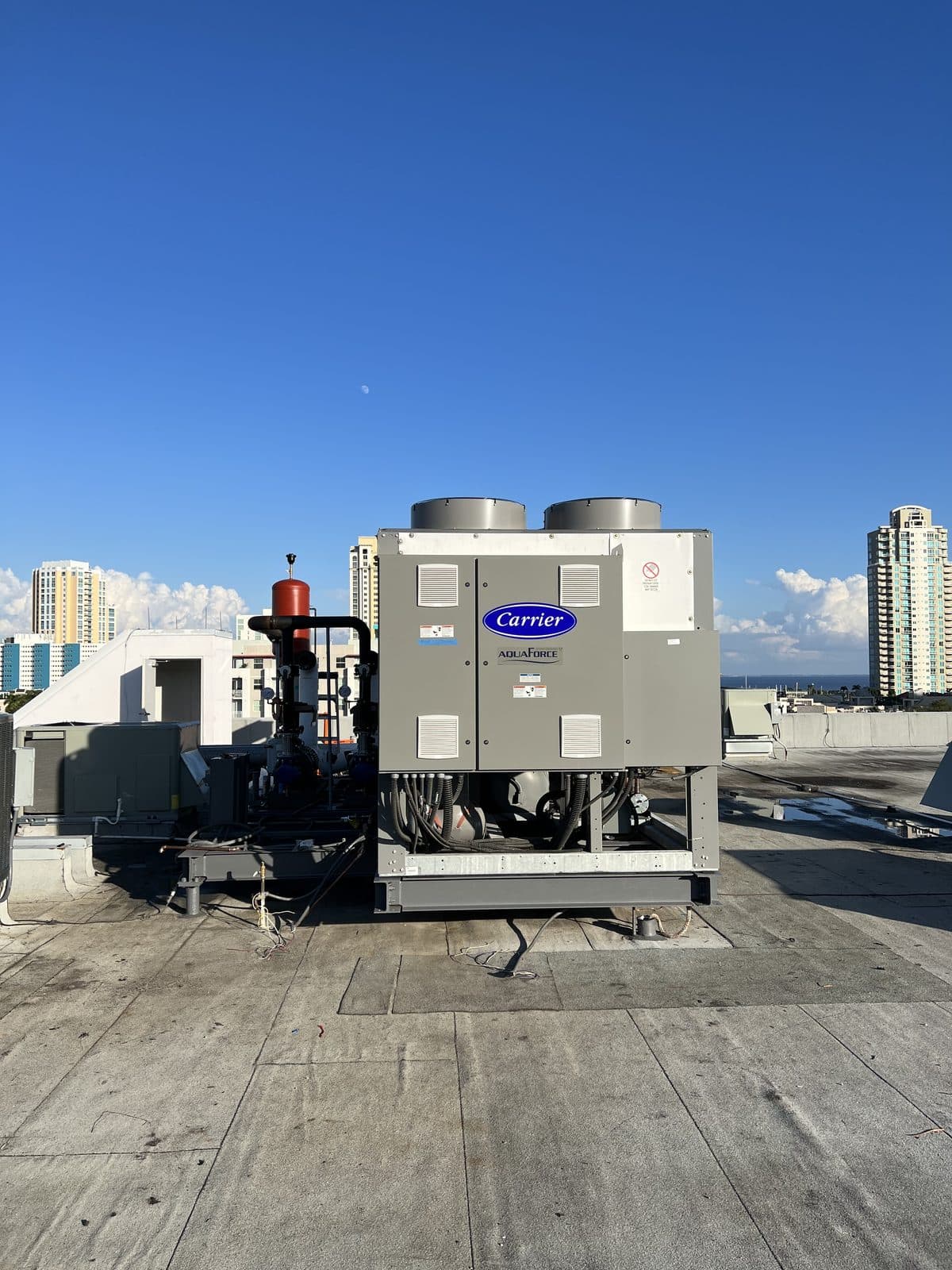
Blume works on commercial chiller plants across Tampa Bay, air-cooled and water-cooled, from a single rooftop machine to a basement plant with towers, pumps and building controls. This page is the starting point. It explains the plant types we work on, links to a page for each brand we service, and points to the related topics that decide whether a chiller plant runs well: cooling towers, pumps, controls, refrigerant rules and capital planning.
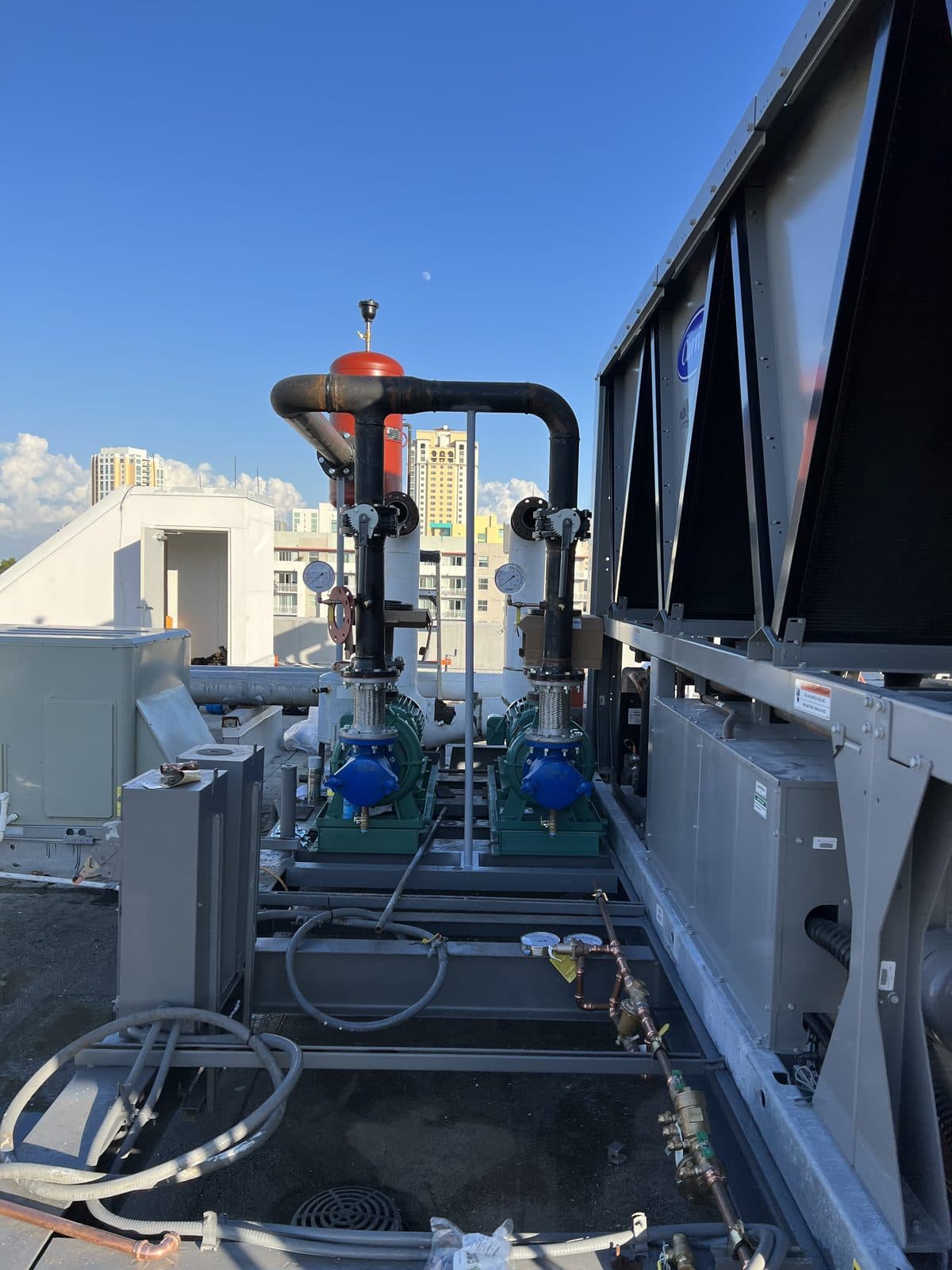
A chiller cools the water a building's air handlers use. The brand on the cabinet matters for parts and documentation, but the plant around it matters just as much. A chiller is only as dependable as the pumps that move its water, the tower or coils that reject its heat and the controls that sequence it.
The chiller plants we work on
Commercial chillers fall into two families. An air-cooled chiller rejects heat directly to outdoor air through condenser coils and fans. A water-cooled chiller rejects heat to a condenser water loop. Each family has its own service questions, so the first thing to establish about any chiller is which family it belongs to.
Within those families the compressor type changes how a machine behaves and what its service looks like. Scroll, screw and centrifugal compressors each call for their own maintenance scope. A plant with more than one kind of machine needs a scope for each machine, not one blanket scope for the whole plant.
What to ask for comes down to measurement: operating readings compared with the last visit and with the nameplate, whatever history the controller holds, and a written report of what the numbers say. See our chiller maintenance page for what a maintenance visit covers. The brand pages below describe what changes from one manufacturer to the next.
Chillers by brand
Each page below covers one manufacturer and is built from that manufacturer's own published pages, quoted in its words, followed by questions to ask about your own machine.
- See Carrier chiller service in Tampa Bay.
- See Trane chiller service in Tampa Bay.
- See Daikin chiller service in Tampa Bay.
- See York chiller service in Tampa Bay.
- See McQuay chiller service in Tampa Bay.
If your machine is a different brand, call us with the nameplate details anyway.
Chillers by service
For the work most plants need first, start with chiller maintenance service. It covers the readings, the seasonal timing and the questions to ask any maintenance vendor, and the same questions apply on every brand page here. For repair, replacement, emergency service or temporary rental, see chiller repair, chiller replacement, emergency chiller service or temporary chiller rental.
Chillers by city
Each page below is about the chillers in one city.
Brand-agnostic by design
Blume doesn't necessarily push one brand or another.
Blume has commercial accounts with Carrier, Trane and Daikin Applied.
Whatever the brand on the cabinet, the facts that decide a good service plan are the same: the load the machine serves, the water side, the controls, the refrigerant and the owner's budget. Ask any contractor who proposes a machine or a service plan to show how it follows from those facts, and ask for the reasoning in writing.
Questions to ask about your own plant
Ask how heat, humidity and salt exposure at your site are handled in the service plan. Air-cooled condenser coils and water-cooled condenser tubes both need a cleaning and inspection routine that matches where the building stands, and the answer should be written down.
NOAA's National Hurricane Center climatology page says: “The Atlantic hurricane season runs from June 1 to November 30.” (source). Ask what each chiller does when power returns, whether anyone has tested it and who is called when it does not restart.
Ask, too, when planned work can be done, and whether it can be scheduled outside the hottest months.
Ask which readings are taken at every visit. A useful minimum is leaving and entering chilled water temperature, evaporator and condenser pressures, approach on both barrels and compressor current against the nameplate. Ask where those readings are kept and whether the last several visits can be compared side by side.
EPA's leak-repair page and chillers
EPA's leak-repair page says: “Comfort cooling appliances include but are not limited to chillers, commercial split systems, and packaged roof-top units.” (source).
See that page for the requirements themselves. Read the refrigerant and charge from the nameplate, ask for them to be written on the equipment record, and ask which EPA requirements apply to your machine.
For newer refrigerant classes and what they change in a plant room, see our page on the refrigerant transition.
What to ask any chiller service vendor
Ask who will identify the machine from its nameplate, and ask for the model, serial number, refrigerant, charge and controller to be recorded before anything else. Ask who reads the controller history and what is done with it. Ask what is included in a visit, what is billed separately, and how findings are ranked, so that you can tell a repair from a recommendation from something to watch.
Ask how a part for your specific machine would be identified and ordered, who tells you the expected date, and what happens to the building while a part is on order. Ask what the plan is for the parts of the plant around the chiller: the pumps that move its water, the tower or coils that reject its heat, and the controls that sequence it.
Ask for a written record you can hand to whoever services the plant next.
Where to start
If you have a chiller and no maintenance history, start with the nameplate. Photograph it, record the model, serial number, refrigerant and charge, and note the controller. With that, ask for a service plan that fits the machine.
If you are weighing the chiller against another system, the chiller vs VRF page covers the decision. If a chiller is likely to need replacing in the next few budget cycles, capital planning shows how to schedule it as a dated expense. The related pages below cover the other parts of the plant.
Frequently asked
What chiller brands does Blume service in Tampa Bay?
See the brand pages here for Carrier, Trane, Daikin, York and McQuay. For any other make, call 727-330-9131 with the nameplate details.
Does Blume push a particular chiller brand?
Blume doesn't necessarily push one brand or another.
What should I know before calling about a chiller?
Have the model, serial number, refrigerant and charge from the nameplate, the controller type if you know it, and any recent service reports.
Which refrigerant rules apply to my chiller?
Start with the refrigerant and the charge on the nameplate. EPA's leak-repair page says: “Comfort cooling appliances include but are not limited to chillers, commercial split systems, and packaged roof-top units.” (source). Call us with the nameplate details.
Related
- Cooling tower maintenance
- Pumps and hydronic services
- Building automation controls
- Refrigerant transition and A2L
- Chiller vs VRF
- Capital planning
- How a chiller system works
Unit converter
Showing 1 therm in 4 other units
| Unit | Value |
|---|---|
| Btu | 100,000 |
| kWh | 29.31 |
| MMBtu | 0.1000 |
| Ccf (natural gas) | 0.9653 |
Used only for Ccf and therm conversions. Source: EIA, Heat Content of Natural Gas Consumed (U.S., 2025).
Sources: 1 therm = 100,000 Btu and 1 kWh = 3,412 Btu, from EIA. MMBtu from EIA. MBH from Wikipedia. 1 ton of refrigeration = 12,000 Btu/h from NIST. Ccf = 100 cubic feet from Wikipedia. — means no result for the current input.
Call with what is on the nameplate and describe the machine.
References: NOAA National Hurricane Center climatology page · US EPA stationary refrigeration leak repair requirements