
Pinellas, Hillsborough and Pasco Counties · Florida CAC-1822618
Chiller Repair in Tampa Bay
Chiller repair in Tampa Bay starts at the controller: alarms, temperatures and pressures read first, then confirmed with gauges and meters before any part is ordered. Blume is brand-agnostic.
A chiller is usually the largest single piece of cooling equipment a building owns, and when it stops, the whole building feels it. The useful questions in a repair are about cause, evidence and timing, not slogans.
What a chiller repair call is really answering
When a chiller stops cooling, the first question is not which part to order. It is why the machine stopped, and whether the thing that stopped it is still present. A chiller shuts itself down on purpose: its controller watches temperatures, pressures, currents and flows, and trips the machine when a reading leaves the safe range. The shutdown is a symptom. The fault behind it might be inside the chiller, in the water loop around it, in the electrical supply, or in the controls.
That is why a good repair call produces a diagnosis before it produces a parts list. Swapping a component that merely reported the problem is the most common way a chiller repair fails to hold: the high-pressure trip comes back in a week because a clogged condenser coil was never cleaned, or the low-temperature trip returns because water flow through the evaporator is marginal and the pump was never checked.
Repair work on a chiller also has a different pace from rooftop-unit service. The equipment is large, the parts are specialized, and the building depends on it. So a repair visit should answer four things in plain language: what failed, what caused it, what it takes to fix it, and whether the machine is worth fixing at all. The sections below take each of those in turn for air-cooled and water-cooled machines.
Diagnosis starts at the controller: alarms, temperatures, pressures
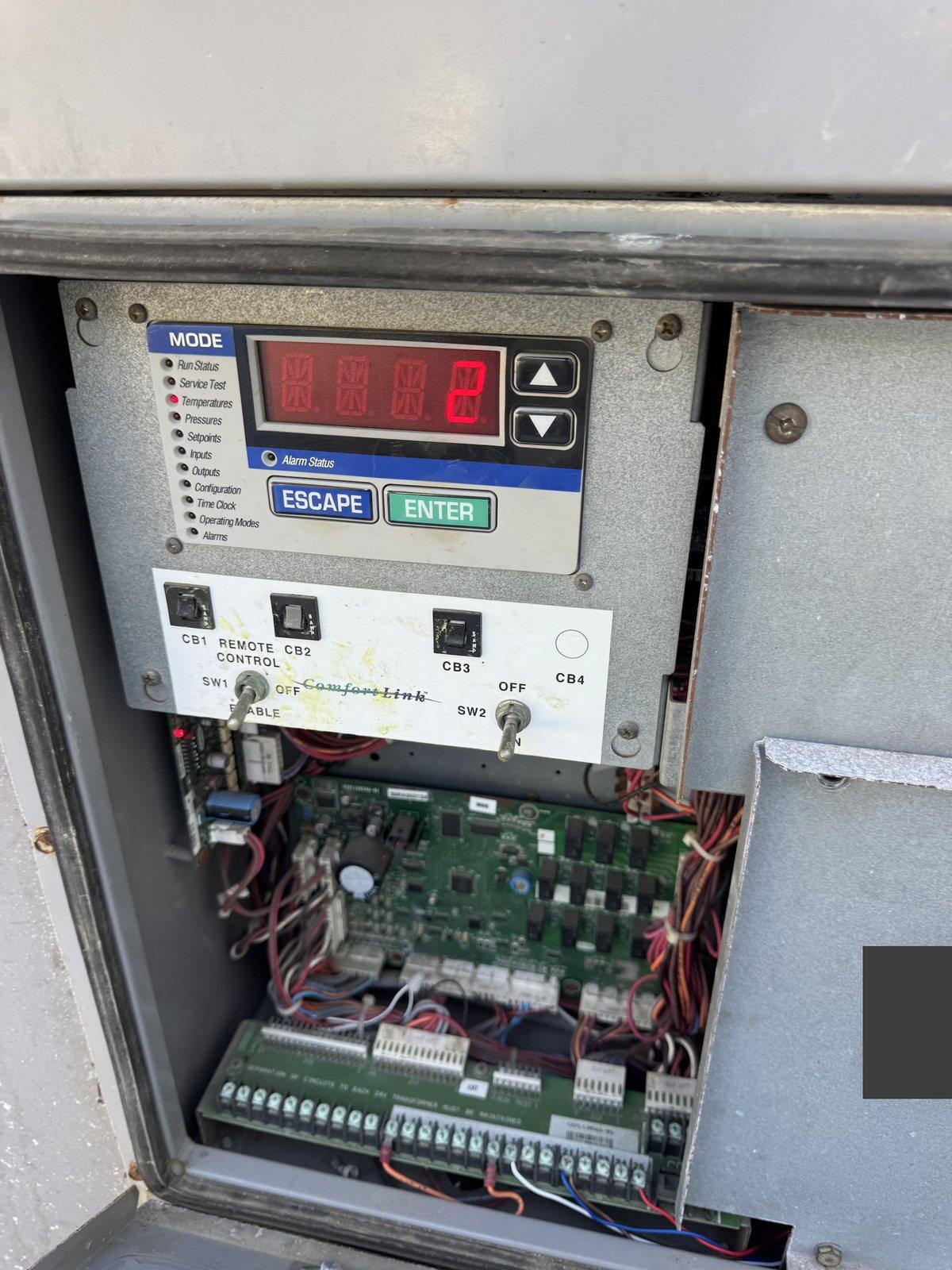
Modern commercial chillers carry a microprocessor controller that records far more than the technician can see by touching the machine. On a Carrier 30RAP chiller with ComfortLink controls, for example, the panel prints these mode labels down its side: Run Status, Service Test, Temperatures, Pressures, Setpoints, Inputs, Outputs, Configuration, Time Clock, Operating Modes and Alarms. The photo on this page shows that panel on one of our service calls, with the Temperatures mode selected. Menu layouts differ from one controller to the next, so ask the technician to show you which screens they are reading and why.
A diagnostic walk through those menus usually follows a set order. Alarms and alarm history come first, because the controller keeps a record of recent trips and the conditions around them. Temperatures come next: leaving and entering chilled water, outdoor air or condenser water, and the refrigerant temperatures the controller measures itself. Pressures follow, since suction and discharge pressure converted to saturation temperature tell you how hard the compressor is working and whether the refrigerant circuit is behaving. Inputs and outputs show what the controller believes is happening, such as whether a flow switch is made or a fan stage is commanded on.
Then comes the part software cannot do. A technician confirms the controller's story with instruments: gauges on the refrigerant circuit, a meter on the compressor and fan currents, a thermometer on the pipes, and eyes on the coil. A sensor that has drifted will show a believable but wrong number, and the only way to catch it is to compare it with an independent measurement. Controller data points to the right area quickly, and the meter confirms it. Once the cause is confirmed, the repair is a defined job.
Common failure areas on air-cooled and water-cooled chillers
Chiller faults cluster in a handful of areas, and knowing them helps you read a service estimate.
Heat rejection. On an air-cooled chiller, the condenser coil and fans reject the building's heat to the outdoors. A coil loaded with debris or residue raises discharge pressure and eventually trips the machine at peak load. Fan motors, capacitors and blades wear out after long running hours. On a water-cooled chiller the equivalent is the condenser tube bundle and the cooling tower: scale or biological film inside the tubes, a tower that is not shedding heat, or a condenser pump that has lost flow all look like a chiller fault from the controller's point of view.
Water flow and freeze protection. A chiller needs steady chilled-water flow through its evaporator. A closed valve, a clogged strainer or a failing pump can cause low-temperature or low-flow alarms that look like refrigerant problems. Freeze protection is taken seriously by controllers for good reason, because ice inside an evaporator can damage it.
Refrigerant circuit. Refrigerant does not wear out, so a circuit that needs recurring charge has a leak; the repair is to find the leak, correct it and then restore the charge. Expansion devices, filter driers, solenoid valves and service valves also fail and have characteristic signatures in suction pressure, superheat and subcooling.
Compressors and electrical. Compressor contactors, overloads, starters, drives and the motors themselves are common repair items. Windings can be tested with an insulation resistance meter. A compressor that has failed mechanically needs investigation into why, because a clean replacement into a system with a root cause still present will fail again.
Controls. Sensors, transducers, communication wiring and control boards fail too. A board replacement is only appropriate once power, wiring and sensor inputs have been checked, since an external fault often looks like a board problem.
What a chiller service call involves
A repair visit on a chiller is more structured than a typical equipment call, and the structure is what keeps a building owner informed.
The visit starts with context: what the building was doing when the machine stopped, which alarms displayed, whether anything changed recently such as a power event, a storm, a tower service or a controls update. The technician then reviews the controller's alarm and operating history, records the current readings and, where the machine can safely run, observes it under load. Electrical isolation and lockout come before any panel is opened or any component is touched.
From there the work narrows. The technician isolates the fault area, confirms the cause with instruments, and decides whether the repair can be completed on the spot or needs parts. Where a part has to be ordered, the owner should hear which part, why it is believed to be the cause, and what is known about the order. When a repair is completed, the machine is restarted and watched through a run cycle, with readings compared against what the controller reported before the repair, so the fix is proven by readings.
What you should receive at the end is a written account: the alarms found, the readings taken, what was repaired or recommended, and anything else noticed that deserves attention before it becomes the next call. That record also builds the machine's history, which makes the next diagnosis easier and supports the decision about when a machine should be replaced.
Repair or replace: a priced option beside the repair
Every chiller repair estimate carries an implicit question: is this machine worth the money? Blume prices a replacement option alongside the repair, especially when the machine is close to the end of its expected life. The point is not to push a replacement. A peripheral failure on a machine that otherwise measures healthy, such as a fan motor, a contactor or a sensor, is often an easy repair decision.
Several signals push the comparison the other way when they stack up: repeated failures within a short span, a compressor failure on a machine with other aging components, corroded or leaking heat exchangers, parts that are hard to find for the model, and operating cost that has crept up as efficiency fell. None of these alone settles the question. Together they change the arithmetic.
The practical benefit of seeing both options early is timing. A replacement planned in the cooler months can be scheduled, specified and procured with care. A replacement forced by a failure at peak load has to be arranged under pressure, usually with temporary cooling running at the same time. For the full replacement picture, including refrigerant, sizing and planning for the capital cost, see chiller replacement in Tampa Bay and HVAC capital planning.
Brand-agnostic repair
Blume is brand-agnostic and does not necessarily push one manufacturer. The machine on your roof or pad is what it is, and the repair is built around it. That matters most when a building has a mix of equipment from different eras and makers.
The diagnosis follows the same steps regardless of the name on the nameplate. For the manufacturer pages on this site, see Carrier chiller service, Trane chiller service and Daikin chiller service, and for how supplier accounts figure in choosing equipment, see chiller replacement. For the planned side of the work, see chiller maintenance service, where the trended readings that make repairs less frequent are described.
When the building needs cooling while the repair is underway
A chiller repair that needs parts, or a failure at peak load, can leave a building without cooling for longer than occupants can tolerate. In those cases temporary cooling is brought in to bridge the gap. Blume owns rental chillers: 120-ton chillers, along with smaller 20-ton and 40-ton chillers. For sizes in between, a rental partner supplies equipment. The details are on the page for temporary chiller rental.
The important point for repair customers is continuity. While temporary cooling runs, Blume keeps working on your chiller: if we can get it running or fixed, we are right there to do that. For outage situations, see emergency chiller service.
What to have ready when you call
A few details make the first conversation far more productive.
- The make, model and approximate size of the chiller, ideally from a photo of the nameplate.
- Whether the machine is air-cooled or water-cooled, and where it is located.
- Any alarm codes or messages shown on the controller, and what the display says right now.
- What happened just before the problem: a storm, a power blip, a recent service visit, a noise.
- How long the building can tolerate reduced cooling, and which areas matter most.
- Any recent service records or readings from a maintenance program.
If the controller is showing an alarm, a photo of the display is a good start. Please do not repeatedly reset a tripped chiller to try to get it running: resets can erase the evidence a technician needs and, if the cause is a real fault, can damage the machine. Turn the problem over to a technician instead. To discuss a chiller repair, call Blume at 727-330-9131 or use the contact page.
Frequently asked
What does a chiller diagnostic visit involve?
A technician reviews the controller's alarms, temperatures and pressures, then confirms them with gauges, meters and a visual check of the machine, its water loop and its heat rejection. The result is a written account of the cause, the repair and anything else worth attention.
Do you favor one chiller brand?
No. Blume is brand-agnostic and does not necessarily push one manufacturer. Tell us the make and model and what the controller is showing.
Will I be shown a replacement option?
Yes. Blume prices a replacement option alongside the repair, especially when the machine is near the end of its expected life.
What if my building needs cooling while the chiller is being fixed?
Temporary cooling can bridge the gap. Blume owns rental chillers in 120-ton, 20-ton and 40-ton sizes, and a rental partner supplies sizes in between.
Should I keep resetting a tripped chiller?
No. Repeated resets can clear useful alarm history and may stress the machine if a real fault is present. Note what the controller displays, take a photo if you can, and call a technician.
Related
- Commercial chillers in Tampa Bay
- Chiller maintenance service
- Chiller replacement
- Emergency chiller service
- Temporary chiller rental
- Carrier chiller service
Unit converter
Showing 1 therm in 4 other units
| Unit | Value |
|---|---|
| Btu | 100,000 |
| kWh | 29.31 |
| MMBtu | 0.1000 |
| Ccf (natural gas) | 0.9653 |
Used only for Ccf and therm conversions. Source: EIA, Heat Content of Natural Gas Consumed (U.S., 2025).
Sources: 1 therm = 100,000 Btu and 1 kWh = 3,412 Btu, from EIA. MMBtu from EIA. MBH from Wikipedia. 1 ton of refrigeration = 12,000 Btu/h from NIST. Ccf = 100 cubic feet from Wikipedia. — means no result for the current input.
Chiller tripped or running badly? Tell us the make, the model and what the controller is showing.
References: Blume Mechanical Service photograph of a Carrier 30RAP ComfortLink controller on a service call