
Hillsborough, Pinellas, Pasco, Manatee, Sarasota, Polk and Hernando Counties · Florida CAC-1822618
Carrier Chiller Service in Tampa Bay
Carrier chiller service in Tampa Bay comes down to four jobs: maintenance that records trended readings, diagnostics and repair that start from the controller's fault history, controls and BACnet integration, and replacement planning before a failure forces it. Blume Mechanical Service (Florida license CAC-1822618) services Carrier chillers, including the 30XV air-cooled screw chiller shown below.
A chiller is usually the largest and least redundant piece of mechanical equipment a building owns. When a chiller has a problem, the building has a problem, so the useful questions are about records, controls and planning rather than slogans.
Carrier commercial chiller lines
Ask which kind of chiller you have before anything else, air-cooled or water-cooled, and read the model number off the nameplate. Chillers reject heat either to outdoor air or to a condenser water loop, and each kind fails in its own ways.
For air-cooled machines, Carrier's own listing says: "With solutions from 10 through 500 tons, screw or scroll, Carrier air-cooled chillers & heat pumps" (Carrier air-cooled chillers). Two lines are worth naming. Carrier's page for the 30XV opens its overview this way: "The AquaForce® 30XV Variable Speed Air-Cooled Chiller is designed to elevate performance and efficiency for modern commercial environments" (Carrier 30XV page). The same page says of its compressors and refrigerant: "Equipped with advanced variable-speed screw compressors and the sustainable R-513A refrigerant". The 30RC is another line; its Carrier page says: "The AquaSnap® 30RC Air-Cooled Scroll Chiller delivers advanced, energy-efficient climate control with Greenspeed® Intelligence" (Carrier 30RC page).
For water-cooled machines, Carrier's page for that category gives this span: "water-cooled chiller types (scroll, screw, and centrifugal), capacities (16 to 5,500 Tons)" (Carrier water-cooled chillers).
For the wider picture of how chilled-water plants work, see how a chiller system works.
Maintenance: what a visit should leave behind
Maintenance on any chiller is worth paying for only if it produces records. A visit that ends with a checkmark and no numbers tells the next technician, and the next facility manager, nothing. A useful visit leaves a dated set of readings and a short list of what was found.
The readings that matter are the same ones the controller already measures: chilled water supply and return temperatures, evaporator and condenser pressures, saturated temperatures, compressor amperage against the nameplate, and for water-cooled machines the condenser approach. Trended visit over visit, a creeping condenser approach or a rising discharge temperature is the machine describing its own decline while it is still a scheduled repair. Our general method for this work is on the chiller maintenance page; this page covers what to ask when the machine is a Carrier.
Ask your technician to show you where the controller keeps its diagnostics and trends. On the 30XV, Carrier's page says the unit "Features over 15 diagnostic functions, permanently lubricated fan motors and intuitive trending capabilities for easy servicing." (Carrier 30XV page). Someone who knows where those functions live on the controller can read months of history in minutes, which is far faster than starting from a cold gauge set.
A visit on an air-cooled chiller should include a look at the condenser coil face, the fan motors and the condition of the cabinet and electrical enclosure. On a water-cooled machine the equivalent attention goes to tube condition, the condenser water loop and the cooling tower that feeds it, because a tower problem arrives at the chiller looking like a chiller fault. Our cooling tower maintenance page covers that side of the plant.
Ask which refrigerant is in your machine and where the nameplate says so, and have that answered before anyone opens the circuit.
Diagnostics and repair: start from the controller's history
When a chiller trips, the fastest honest diagnosis begins with what the controller recorded, not with replacing the part that seems most likely. A modern chiller keeps a fault log, alarm history and operating trends. Those records tell you whether the trip was a one-time event, a pattern that repeats at the same time of day, or the end of a slow decline.
Three habits separate a diagnosis from a guess. First, read the fault history and the operating readings at the moment of the trip before resetting anything. A reset clears the evidence along with the alarm. Second, check the plant, not just the machine: condenser water temperature and flow, chilled water flow, strainers, and whether the tower or the pumps changed. Third, confirm the repair by comparing readings afterward to the readings before; if the approach temperatures and pressures did not move, the repair did not address the cause.
Typical findings on a chiller that is losing capacity include a fouled air-cooled condenser coil driving up head pressure, a failing fan motor or fan contactor, a refrigerant circuit that has lost charge through a slow leak, scale or biological film in water-cooled condenser tubes, and sensor drift that makes the controller see a different machine than the one that exists. Each has a different fix and a different cost of waiting, which is why the reading comes before the repair.
Refrigerant needs a straight statement: a circuit that needs charge added has a leak, and adding charge without finding the leak is a recurring expense, not a repair. Finding the leak, repairing it and verifying the circuit holds is the job. Work on the refrigerant side is regulated.
If the diagnosis points toward the end of the machine's useful life, that is a separate conversation with its own numbers; see the replacement section below and the guide to chiller versus VRF.
Controls and BACnet: making the chiller visible to the building
A chiller that cannot be seen from the building automation system is a chiller whose problems are found by tenants. Integration lets the chiller's status, alarms and temperatures appear next to the air handlers and pumps on the same screen, and lets facility staff trend them.
For one Carrier example, the announcement of the AquaEdge 19DV says of its controls: "The control system can also be linked to the user’s building automation system, enabling remote access to the chiller’s running data in real time." (Carrier announcement). Ask for the points list for your unit's controller before planning building automation integration.
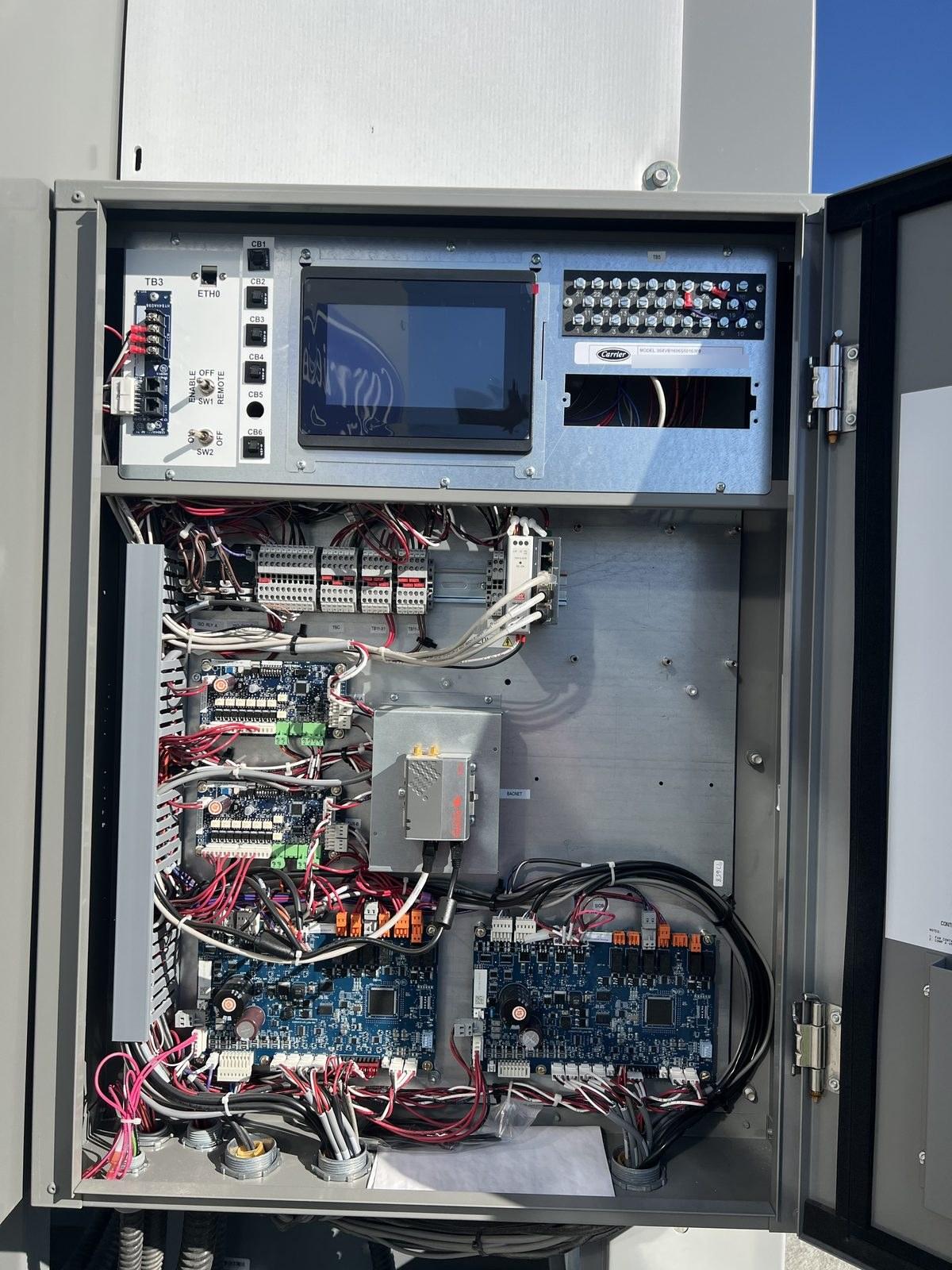
The control panel in the photo on this page, a 30XV on one of our service calls, shows one way this looks in the field: a Carrier controller with a touchscreen, terminal blocks and circuit boards, and a module labelled for BACnet mounted in the enclosure.
Carrier's announcement for the 30XV says: "With the addition of Carrier® SMART Service as an available, factory-installed option, building owners and facility managers can now experience an entirely new level of equipment connectivity solutions including: remote diagnostics, long-term performance trending, benchmarking, decision analytics and advanced notifications" (Carrier announcement). Ask whether any of that is enabled on your machine, because a connected chiller changes what a service visit can start from.
Good integration work is mostly unglamorous: confirming the points map, checking that alarms reach someone who will act on them, setting trend logs at an interval that shows real behavior, and documenting it so the next contractor does not have to rediscover it. Our building automation controls page covers the building side of that connection.
Operating conditions in Tampa Bay
The National Weather Service Tampa Bay office's rainy-season page says: "The rainy season runs from May 15 to October 15 for Southwest Florida and from May 25 to October 10 for the rest of West Central Florida." (NWS Tampa Bay, rainy season). The page adds that "the beginning of the rainy season is usually a transition period rather than a single date. Similar to hurricane season, the rainy season may occur before or after the aforementioned dates. In general, the rainy season is characterized by warm, humid conditions with frequent showers and thunderstorms."
The page says: "The rainy season usually has three phases: Late May through June is the period when severe storms are most likely. Hail, damaging winds, and waterspouts are common, in addition to heavy rainfall and frequent lightning." After a storm or a power outage, ask for the controller's alarm history before the chiller is restarted.
Across West Central and Southwest Florida, the same office's autumn cool-down page says: "High humidity, with dew points in the mid 60s to mid 70s, along with high temperatures in the mid 80s to lower 90s typically persists well into October. The first shot of cooler drier air is usually rather short lived - lasting only a day or two. The real cool down does not usually occur until November." (NWS Tampa Bay, when it cools off). Plan work that needs a machine taken offline around those dates.
Heat rejection depends on the air or water the chiller rejects into. For an air-cooled chiller, high ambient air means high condensing pressure and less margin on the hottest afternoons. For a water-cooled chiller, the condition of the air entering the tower limits how far it can cool the condenser water, which raises the approach and the lift the compressors must work against.
Sites near the water: coil condition
If your chiller is near the water, ask your technician to look at the coil for signs of corrosion.
Treat the following as an explanation of the mechanism, not as a chiller specification. Carrier's residential coastal guidance says "Carrier notes that salt water can be carried as far as two miles from the coast." and, in the same guidance, "Without specialized protection, standard copper-aluminum coils can suffer from galvanic corrosion" (Carrier coastal HVAC guidance). Ask when a unit is selected or replaced what its coil metals and coatings are.
Ask for a coil inspection that looks at fin condition, at the places where tube and fin metals meet, at the cabinet and fasteners for corrosion, and at whether the coil washes clean or shows pitting. Corrosion that has started can be hard to reverse, so catching it early matters more than any single cleaning. Put coil condition on the list for your next capital planning review so a replacement coil or replacement chiller is a plan, not a surprise.
When to call, and what to have ready
Some situations call for a technician now, and some are better handled at the next planned visit. Here is a working split.
Call promptly when:
- the chiller has tripped and will not restart, or has tripped more than once in a short period;
- you hear a change in compressor or fan sound, or see oil staining or frost on the refrigerant circuit;
- chilled water supply temperature will not reach setpoint during normal load;
- the controller shows alarms you cannot clear, or loses communication with the building automation system;
- there is visible water, refrigerant odor or electrical burning smell near the unit.
Raise it at the next planned visit when:
- condenser approach or discharge temperature is slowly creeping up;
- run hours or amperage have drifted from last season;
- coil fins show corrosion or damage but capacity is holding;
- the controller's history shows marginal trips that cleared themselves.
Have this ready when you call: the model and serial number from the nameplate, the controller's current alarm, what the chilled water supply and return temperatures are, what changed recently (storm, power event, tower or pump work), and who in your building can grant access to the roof or plant room. For a safety hazard such as burning smell or refrigerant odor, keep people away from the area and shut off power at the disconnect only if it is safe to do so. Blume's number is 727-330-9131.
Replacement and capital planning for an aging Carrier chiller
Every chiller eventually reaches the point where repair history, refrigerant availability, efficiency and parts for that model line argue for a plan. The decision belongs on a calendar a few years ahead, not in a July breakdown.
The inputs are concrete. Gather the repair log and the trended readings, the refrigerant type in the machine, the machine's age and size, how the building's load has changed since installation, and the condition of the rest of the plant: pumps, tower, piping and controls. A new chiller connected to a tired plant inherits the plant's problems. Ask for a load calculation rather than matching the old nameplate.
Questions worth putting to any contractor quoting a replacement: what load calculation supports the size, which refrigerant the new machine uses and what that means for future service, whether the existing controls and BACnet integration will carry over, and how the building stays cool during the changeover. Our capital planning page lays out how to build that plan, and the chiller versus VRF comparison helps when the building's loads are changing enough that a different system type is on the table.
Blume does not price replacements on a web page, since the numbers depend on the building. If you have a Carrier chiller you are watching, an assessment of its history and condition is the sensible first step, and our Carrier brand page covers the Carrier residential equipment we sell and service.
Frequently asked
Does Blume service Carrier chillers?
Yes. Blume Mechanical Service services Carrier chillers in Tampa Bay, including the 30XV air-cooled screw chiller shown on this page.
What is the difference between servicing an air-cooled and a water-cooled Carrier chiller?
An air-cooled machine rejects heat to outdoor air, so the condenser coil, fan motors and cabinet condition dominate. A water-cooled machine rejects heat to a condenser water loop and cooling tower, so tube condition, water treatment and the tower dominate. The reading that catches each machine's decline is different, which is why the visit is built around the machine type.
Can a Carrier chiller be connected to my building automation system?
Ask for the points list for your unit's controller before planning building automation integration. The control panel in the photo on this page shows a module labelled for BACnet.
Why does my chiller trip on the hottest afternoons?
High ambient temperature raises condensing pressure on an air-cooled machine, and the air entering a cooling tower limits what it can do for a water-cooled one. A fouled coil, a failing fan or fouled tubes make it worse. The controller's fault history will show whether the trips correlate with temperature.
How do I know if salt air is damaging my chiller coil?
Look at the fins and at the places where different metals meet for white or green deposits, pitting or flaking, and see whether the coil washes clean. Carrier's residential coastal guidance says: "Carrier notes that salt water can be carried as far as two miles from the coast." A technician can assess the coil during a maintenance visit.
When should I start planning to replace a Carrier chiller?
Start when repair frequency is rising, the refrigerant in the machine is becoming harder to service, or efficiency has fallen far enough to matter to your operating budget. Planning a few years ahead lets you choose the timing and the machine, instead of accepting whatever can be installed fastest after a failure.
What should I have ready when I call about a chiller problem?
The model and serial number from the nameplate, the controller's current alarm, the chilled water supply and return temperatures, anything that changed recently, and who can give access to the roof or plant room.
Related
- Chiller maintenance service
- How a chiller system works
- Chiller vs. VRF
- HVAC capital planning
- Carrier equipment we service
Unit converter
Showing 1 therm in 4 other units
| Unit | Value |
|---|---|
| Btu | 100,000 |
| kWh | 29.31 |
| MMBtu | 0.1000 |
| Ccf (natural gas) | 0.9653 |
Used only for Ccf and therm conversions. Source: EIA, Heat Content of Natural Gas Consumed (U.S., 2025).
Sources: 1 therm = 100,000 Btu and 1 kWh = 3,412 Btu, from EIA. MMBtu from EIA. MBH from Wikipedia. 1 ton of refrigeration = 12,000 Btu/h from NIST. Ccf = 100 cubic feet from Wikipedia. — means no result for the current input.
Running a Carrier chiller in Tampa Bay? Tell us the model and what the controller is showing.
References: Carrier commercial chillers: 30XV, air-cooled and water-cooled category pages (carrier.com) · Carrier news announcements: 30XV, 30RC, 19DV, SMART Service · Carrier coastal HVAC guidance (residential) (carrier.com) · NOAA National Weather Service Tampa Bay Area: rainy season and autumn cool-down pages