
HVAC, explained
Chiller System: How It Works and Whether It Fits a Building
A chiller system makes chilled water in a central plant and pipes it through the building. The water goes to air handlers, indoor units that blow air over a cold coil. The chiller at the center of the plant is a refrigeration machine that cools water. A 2002 Department of Energy guide says it cools by a vapor-compression or an absorption cycle, which the second section explains. Our reading: whether a chiller fits depends on how much heat must be removed, where it goes, the controls, the refrigerant and who may work on it. This page gives no prices.
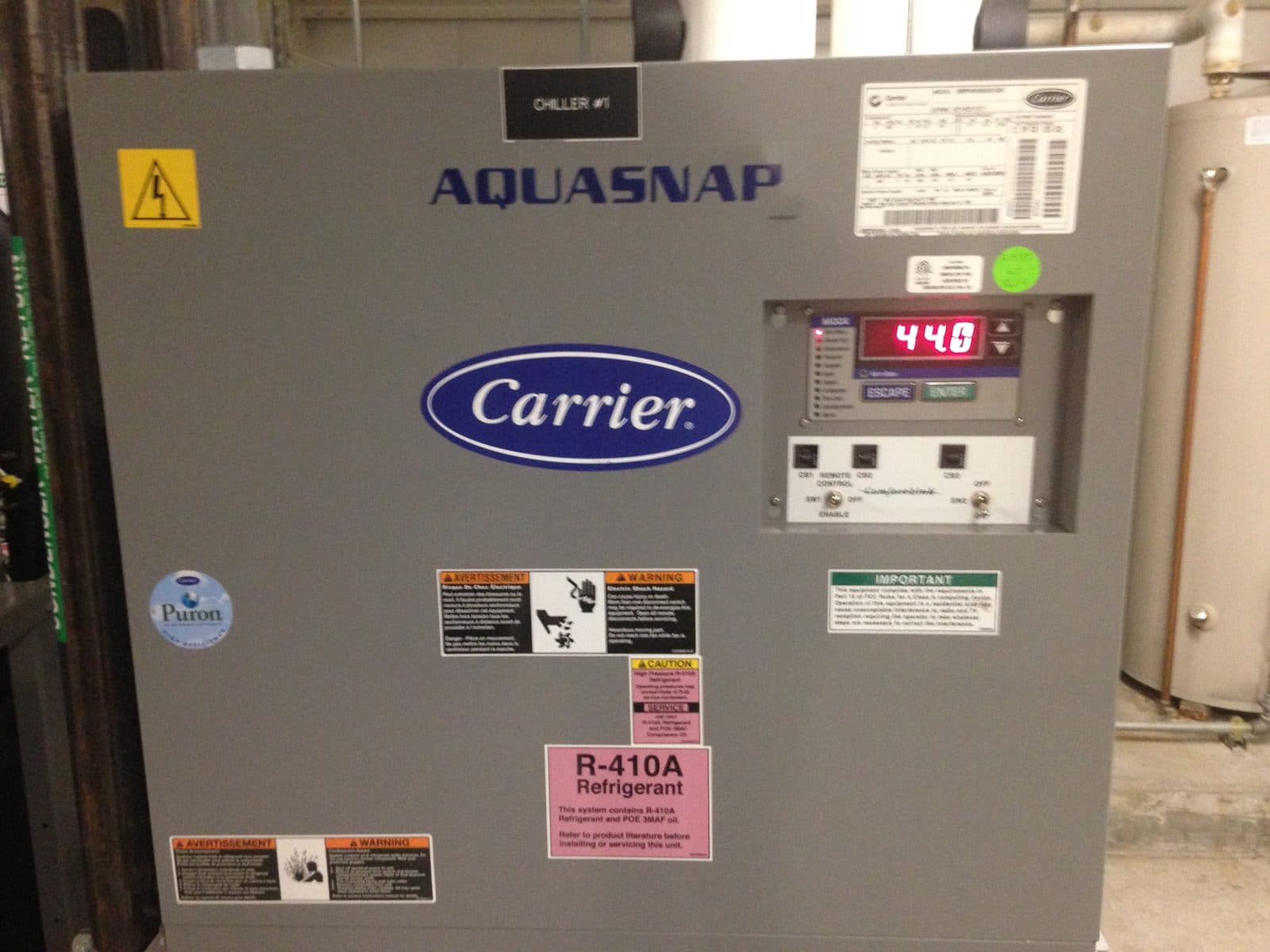
The facts below come from public documents, not from Blume field measurements. Two of the documents come from Energy Design Resources, a program funded by California utility customers. The photo at the top shows the front panel of one chiller. The number lit on its display is a snapshot of that machine at that moment, not a result or a recommendation for your building. This page gives no service steps, because EPA requires certification for technicians who service equipment that could release refrigerant, the fluid that carries heat.
What is in a chiller system
A typical chilled water plant has chillers, chilled water pumps, condenser water pumps (which move the cooling water), cooling towers and connecting piping, says an Energy Design Resources design brief. In an air handler, a cooling coil (tubing that heat moves through) takes heat out of the air and puts it into the chilled water. The warmed water returns to the chiller to be cooled again. In a water-cooled plant, the chiller passes its heat to cooling water, which is then sent to a cooling tower. The 2002 Department of Energy guide calls a cooling tower a specialized heat exchanger that brings air and water into direct contact so heat can transfer.
The brief says water is a more space-efficient way to move heat than air, so it works well in space-constrained buildings such as high-rises. It also says a chiller plant is a collection of separate components chosen to work together. The brief calls a plant more costly to install and more complicated to operate than a simple packaged unit. It lists greater energy efficiency, better controllability and longer life as benefits. For the choice between a chiller plant and a multi-head refrigerant system, see chiller vs VRF.
What happens inside the chiller
Refrigerant is the fluid that carries heat through the machine. Like an air conditioner, a chiller moves heat with a refrigerant, but what it cools is water rather than air. In a mechanical-compression chiller, the 2002 guide names four parts that the refrigerant passes through: the evaporator, the compressor, the condenser and the expansion valve. In the evaporator, liquid refrigerant evaporates and absorbs heat from the chilled water, which is where the water gets cold. The compressor raises the refrigerant's pressure, and so its temperature, and sends the vapor on to the condenser. In the condenser the refrigerant gives up its heat. The expansion valve then lowers its pressure to that of the evaporator, so the cycle can repeat.
The 2002 guide sorts mechanical-compression chillers by compressor type: reciprocating (piston-driven), centrifugal (spinning impeller) and screw (meshing helical rotors). An absorption chiller uses heat, usually steam, where a compression chiller uses a compressor's mechanical work.
Air-cooled or water-cooled: where the heat goes
Every chiller must reject its heat somewhere. The Department of Energy's Federal Energy Management Program (FEMP) says designers must choose between air-cooled and water-cooled chillers. FEMP says air-cooled systems eliminate the need for a cooling tower, which reduces installation and maintenance costs. It also says air-cooled chillers are substantially less efficient than water-cooled models. A 2009 Energy Design Resources guide adds that the water-cooled side must include the energy used by its condenser water pump and cooling tower. The same guide lists water shortages or quality problems, and less maintenance than cooling towers, among the reasons air-cooled chillers are used.
The 2002 Department of Energy guide's glossary says one ton of cooling is 12,000 Btu of heat removed per hour. A Btu is a unit of heat. The 2009 guide says air-cooled chillers are more often used in plants generally below 200 tons, because space, water treatment and tower maintenance outweigh the energy benefit. Air-cooled chillers can also recirculate their own warm discharge air, so the guide says to consult the manufacturer's location guidelines. Tower water treatment, and whose job it is, is covered on cooling tower maintenance.
What the chiller's controls do
The brief says most new chillers are microprocessor-controlled, meaning a small built-in computer runs them. It adds that modern control panels pull together a wealth of detailed operating data. The 2009 guide says virtually all new chillers come with factory-installed controls and instrumentation that can be tied into the building's computer-based direct digital control (DDC) system. It advises specifying a BACnet gateway between the chillers and that system. Its glossary calls BACnet a communication standard developed by ASHRAE, a heating and cooling engineering society. It calls start/stop, setpoint (the target) and summary alarm the three most critical points. It says it is prudent to consider hardwiring them, meaning a direct wire rather than a network link.
FEMP says many new chillers have network connectivity, and that security can almost never be networked in after the fact. It calls a chiller purchase or replacement a prime opportunity to evaluate the vulnerabilities of your network. Our reading: a number on a front-panel display, like the one in the photo, means little without its unit, what it measures and the setpoint. The building side of controls is on building automation and controls.
Does it fit your building? Six questions to settle first
These six questions are our reading of the documents above.
- What is the cooling load, and how does it change over the year? A 2009 design guide says an optimum plant needs both a design (peak) load and a cooling load profile showing how the load varies over time. It lists the climate, the hours of operation and base loads that run all day among the parameters that shape the profile. Examples of base loads are telecom closets and computer rooms.
- How big should the plant be, and what if the building grows? The 2009 guide says it is prudent not to oversize a plant. Where future growth is uncertain, it says provisions can be made to add pumps, towers and chillers later. It also lists changes in building occupancy over time as a source of uncertainty in the load profile. Our reading: tell the designer about planned additions and occupancy changes before the size is set.
- Where will it sit? The 2002 Department of Energy guide says large chillers are most commonly in mechanical equipment rooms inside the building they cool. It adds that if a hazardous refrigerant is used, the room must meet added requirements, typically including minimum ventilation airflows. Our reading: ask which refrigerant the machine holds and what the room or outdoor site must provide for it.
- How efficient is it at part load, not only at full load? The brief says chillers are usually selected on their efficiency at 100 percent of capacity but most rarely operate there. FEMP says a chiller can be efficient at full load or at part load, at the expense of the other. It therefore requires both figures, including the integrated part-load value (IPLV), a part-load rating. FEMP says performance must be measured under the Air-Conditioning, Heating, and Refrigeration Institute's 550/590 test procedures. Our reading: ask for both figures for the exact model, and the test procedure behind them.
- Which refrigerant rule applies to a new chiller? EPA's sector tables list comfort cooling chillers at a global warming potential (GWP) limit of 700. For stand-alone products the listed manufacture and import date is January 1, 2025, and for installed systems the installation date is the same. GWP rates how strongly a gas warms the climate compared with carbon dioxide. EPA calls its tables informational and says they should not be relied on for compliance purposes. Our reading: ask which refrigerant the quoted model uses and which rule covers it. The commercial page on the refrigerant transition explains the change.
- Will the plant be commissioned? The brief describes commissioning as functionally testing a chiller system under all anticipated operating modes to ensure that it performs as intended. It says commissioning can improve efficiency and reliability, and ideally starts early in the design process and is performed by an independent third party. Our reading: ask whether the quote includes commissioning and who performs it.
What Florida adds: license class and a long cooling season
Under the 2026 Florida Statutes, a Class B air-conditioning contractor's services are limited to 25 tons of cooling and 500,000 Btu of heating in any one system. The Class A definition has no such limit; it calls the contractor's services unlimited. Our reading: for a plant above the Class B limit, ask which license class the contractor holds and check the license number with the state. Plant hours matter, and the commercial HVAC page shows from National Weather Service normals that Tampa has cooling load in every month. That page also covers flood-hazard elevation, wind anchoring and outage timing for plant equipment.
Frequently asked
What is a chiller system?
It is a plant that makes chilled water in a chiller and pipes it through a building to air handlers. The plant also has pumps, piping and, in a water-cooled design, a cooling tower.
Is an industrial chiller the same as a building chiller?
A 2002 Department of Energy guide says chilled water has a variety of applications from space cooling to process uses. EPA's tables list comfort cooling chillers and industrial process chillers in separate rows, with different compliance dates. Our reading: an industrial chiller serves a process, so its load comes from that process and not from a building's occupants and weather. Industrial air conditioning is on the industrial air conditioner page.
Who can repair a chiller in Florida?
EPA requires certification for technicians who service equipment that could release refrigerant, and Florida licenses air-conditioning contractors by class. EPA says its Section 608 tests are specific to the type of equipment the technician seeks to work on, so ask which certification covers your machine. This page gives no repair steps, because chiller work is for certified, licensed professionals. What a chiller service visit covers is on chiller maintenance service.
What does kW per ton mean?
It is kilowatts of electrical input per ton of cooling produced, which the brief calls probably the most common way to express chiller efficiency. FEMP notes that a lower kW per ton value is more efficient.
Does every chiller need a cooling tower?
No, FEMP says air-cooled systems eliminate the need for a cooling tower, though air-cooled chillers are substantially less efficient than water-cooled models.
Do I need to call a pro for this?
Yes. Chillers are commercial plant, not home equipment: the work is done by licensed mechanical contractors under a service agreement, and even routine attention needs certified refrigerant handling. If you are reading this as a building owner, the useful question is not whether to call but what your service agreement actually covers.
Related
- Central Air Conditioning System Types
- What BTU means for an AC
- EPA 608 Certification and the Refrigerant
- Hurricane Season HVAC Prep in Florida
Blume Mechanical Service is a licensed commercial and residential HVAC contractor serving Florida's Tampa Bay region (CAC-1822618). Blume installs and services all major brands as a licensed contractor, and estimates on new systems and retrofits are no-cost.
Last updated: 2026-11-05
Sources: U.S. Department of Energy, Federal Energy Management Program, Purchasing Energy-Efficient Electric Chillers (acquisition guidance updated October 2024) · U.S. Department of Energy, Federal Energy Management Program, Operations & Maintenance Best Practices Guide (December 2002), prepared by Pacific Northwest National Laboratory · Energy Design Resources, Chilled Water Plant Design Guide (December 2009), PDF hosted at datacenters.lbl.gov · Energy Design Resources, Design Brief: Chiller Plant Efficiency, PDF hosted at datacenters.lbl.gov · EPA, Technology Transitions HFC Restrictions by Sector (updated August 28, 2026) · EPA, Section 608 Technician Certification Requirements (updated July 15, 2026) · The 2026 Florida Statutes, section 489.105, Definitions