
HVAC, explained
Industrial Air Conditioners: Types and How to Tell Them Apart
Federal law files commercial packaged air conditioners under “industrial equipment”. Federal rules sort that equipment by how it is cooled, how it is assembled and how many Btu per hour it removes. A Btu per hour measures how much heat a unit removes in an hour. Our reading: “industrial air conditioner” is a label, not a class. The useful question is which family of equipment a quote or a rooftop shows.
The facts below come from federal rules, Energy Information Administration (EIA) survey documents and Department of Energy (DOE) guides. None of it comes from Blume’s own jobs. No repair, wiring, refrigerant or cooling-tower water steps appear here. Licensed professionals do that work.
What “industrial” means in the federal rules
The federal energy-efficiency law for this equipment sits in a part of the United States Code titled “Certain Industrial Equipment”. That part lists small, large and very large commercial package air conditioning and heating equipment as covered equipment. It calls covered equipment a type of industrial equipment. DOE’s rule defines commercial package air-conditioning equipment as air-cooled, water-cooled, evaporatively-cooled or water-source units for commercial application. Neither the statute nor the rule defines an “industrial air conditioner”. Our reading: the phrase in a quote or a listing therefore does not tell you which family the equipment belongs to.
Two questions sort the families
Refrigerant is the working fluid that moves heat around a cooling system. EIA says a central chiller produces chilled water to cool the air. It says packaged units produce warm or cool air directly. Chilled water is water that a chiller has cooled. Our reading: the first question is what carries the cooling to the rooms, which can be air from a unit, refrigerant lines to indoor units, or chilled water in pipes.
The second question is where the heat goes, and DOE’s rule names four answers: air-cooled, water-cooled, evaporatively-cooled and water-source. In a water-cooled system, hot water leaves the chiller, a cooling tower cools it, and the water returns to the chiller. DOE’s guide, citing a 2001 Washington State University extension energy program report, says an open tower exposes the cooling water directly to the air. It says evaporation removes most of the heat. Our reading: those two questions, together with the rated size, help place a quote in a family.
Packaged units: one cabinet, usually on the roof
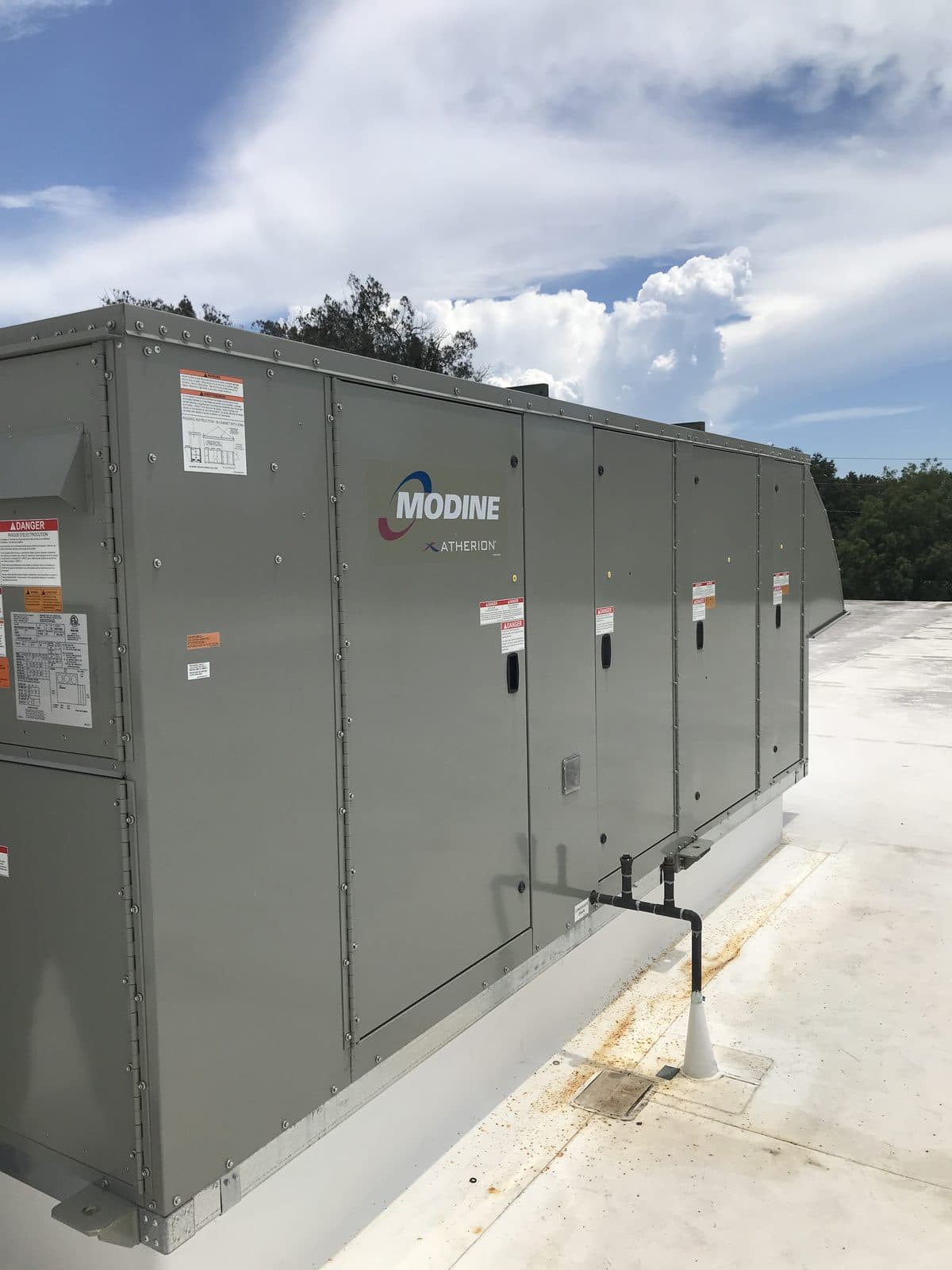
EIA defines a packaged unit as equipment assembled at a factory and installed as a self-contained unit. These are the opposite of units built up from individual components for a given building. EIA says packaged units are generally mounted on the roof, and sometimes on a slab outside. They send warm or cool air straight into the building through ducts or a similar system. DOE’s rule calls this a single package unit, one with all its major parts in one cabinet. EIA adds that some electric packaged units are called direct expansion, or DX, units. In a DX unit the refrigerant cools the air directly, with no chilled water between them. The photograph at the top of this page shows a rooftop unit: one cabinet on a flat roof, the shape this section describes.
The statute and DOE’s rule split commercial package equipment into three classes by cooling capacity. Small equipment is rated below 135,000 Btu per hour. Large equipment is rated from 135,000 up to 240,000. Very large equipment is rated from 240,000 up to 760,000. According to a glossary in DOE’s operations guide, one ton of refrigeration equals 12,000 Btu of cooling per hour. By our arithmetic, the three classes run below about 11 tons, about 11 to 20 tons, and 20 to about 63 tons.
Blume’s own commercial installation page covers commissioning, and its rooftop unit replacement page covers curbs, cranes and phasing.
Split systems and VRF: parts joined by refrigerant lines
DOE defines a split system as one in which one or more of the major assemblies are separate from the others. Blume’s own page on central air conditioning system types explains the house-scale version. DOE defines a variable refrigerant flow (VRF) multi-split system as a split system with a single refrigerant circuit and one or more outdoor units. It has multiple indoor fan coil units, which are indoor units with a coil and a fan. Each is controlled on its own and can operate independently in response to multiple indoor thermostats. DOE adds that a heat-recovery version can provide heating and cooling at the same time. A water-source heat pump is a separate DOE category that uses a circulating water loop as its heat sink for cooling.
Blume’s own chiller vs VRF page covers line-length limits, minimum room area and service access, so read it for those details.
Chilled-water plants: a chiller and a way to reject heat
DOE’s operations guide calls a chiller a refrigeration system that cools water. It says the chilled water has uses that run from space cooling to process uses. Our reading: “process uses” means cooling for equipment or production rather than for people. EIA says chillers are generally located in, or just outside, the building they serve. Chilled water piped in from a central plant, such as a hospital or university complex, is district chilled water in EIA’s survey.
A compressor is the pump of a refrigeration system. DOE’s guide says mechanical compression chillers are generally classified by compressor type: reciprocating, centrifugal and screw. The guide gives 100 to 10,000 tons as the typical capacity range for centrifugal chillers. The guide takes that passage from a 1995 publication of a private training firm. Our reading: a rated size above about 63 tons is outside the federal packaged classes, and below that, size alone does not settle the family.
Blume’s own chiller system page explains the plant, its chiller maintenance page covers how air- and water-cooled chillers fail differently, and its cooling tower page covers the tower’s water treatment.
Computer-room cooling
DOE defines a computer room air conditioner as commercial package equipment, packaged or split, marketed for computer rooms, data processing rooms or other information technology cooling. Such a unit may come with a humidifier, humidity control of the supplied air and a reheating function. DOE’s data center guide says packaged direct-expansion units, commonly described as CRAC units, are likely the most common cooling equipment for smaller data centers. The same guide describes a CRAH unit, short for computer room air handler, that uses chilled water. Our reading: a CRAC unit carries its own refrigeration, while a CRAH unit needs chilled water from a plant.
Evaporative and portable coolers
EIA describes a swamp cooler, also called an evaporative cooler, as equipment that cools air as sprayed water evaporates. It says the cooler does not use a refrigeration unit. EIA says this type of equipment is commonly used in warm, dry climates. DOE’s home-cooling guide says an evaporative cooler is only suitable for areas with low humidity. According to the National Weather Service, humidity typically rises in the Tampa Bay rainy season, with dew points that stay above 70°F. A dew point is a measure of the moisture in the air. Our reading: DOE’s guide is written for homes, but its low-humidity limit points the same way for a building in Tampa Bay in summer.
EIA treats portable air conditioners as individual air conditioners. These have no pipes or ductwork and directly cool only the room or area where they sit. Our reading: a portable or evaporative unit answers a spot-cooling need and is a different decision from a system that cools a whole building.
Which family serves buildings like yours
EIA’s 2012 survey table counts cooled floorspace by equipment type, in millions of square feet. More than one type may apply to a building, so the figures overlap. Packaged air conditioning units served 45,153 million square feet of the 79,294 million square feet with cooling. Central chillers served 17,041. In buildings of 25,001 to 50,000 square feet, packaged units served 6,466 million square feet and chillers 1,095. In buildings over 500,000 square feet, chillers served 4,145 and packaged units 4,039.
In one-story buildings, packaged units served 21,523 and chillers 2,072. In buildings of ten or more floors, packaged units served 2,466 and chillers 3,905. In the warehouse and storage category, packaged units served 6,472 and chillers 465.
The table has no Florida row. It does have a South Atlantic row, and EIA’s South Atlantic division includes Florida. That row shows 17,094 million square feet with cooling, of which packaged units served 9,119 and central chillers 3,884. The Hot-humid climate row shows 11,624 with cooling, of which packaged units served 6,449 and chillers 2,474. A footnote says the Building America program, sponsored by DOE’s Office of Energy Efficiency and Renewable Energy, created the climate regions. Our reading: in both rows packaged units served more than twice the floorspace that chillers did, but neither row counts Florida buildings alone.
EIA counts a building as commercial only if at least half of its floorspace is used for something other than housing, manufacturing or industrial work, or agriculture. Our reading: for that reason it says little about factories.
Questions to ask before you compare quotes
Ask every contractor the same questions. Get the answers on paper, with the model and capacity from the equipment nameplate, which is the label that lists them.
- Which family is this: a packaged unit, a split or VRF system, a chilled-water plant, a computer-room unit, or an evaporative or portable cooler?
- What is its rated cooling capacity in Btu per hour or tons, and which federal size class does that fall in?
- Where does the heat go: outdoor air, a cooling tower, a water loop or evaporation, and who looks after the water side if there is one?
- What carries the cooling to the rooms: ducted air, refrigerant lines to indoor units, or chilled-water pipes to coils?
- Is this a like-for-like replacement or a change of family, and what else changes with it, such as curbs, ducts, piping and controls?
- Does the building need humidity control as well as cooling, and how will the equipment provide it? Blume’s own commercial humidity control page explains why the two are different problems.
- Who holds the Florida contractor license for this work?
Florida’s licensing agency says you can check a license if you know the contractor’s name, the business entity’s name or the license number. Leave equipment cabinets closed, because refrigerant, electrical and gas-line work belongs to licensed professionals.
Frequently asked
Is an industrial air conditioner different from a commercial one?
Federal law lists commercial package air conditioners as industrial equipment. Neither the statute nor the rule defines a separate industrial class. Our reading: sort a quote by cooling method, assembly and size, not by the word “industrial”.
How big is a “very large” commercial air conditioner?
DOE’s rule puts it at 240,000 Btu per hour or more and below 760,000. By our arithmetic, that is 20 tons up to about 63 tons.
Do big buildings always use chillers?
No: in EIA’s 2012 table, packaged units served more floorspace than chillers in every size band up to 500,000 square feet where both figures are published. The table is national and from 2012, so it is a guide to the mix and not a count of Florida buildings.
Can an evaporative or portable cooler cool an industrial building in Tampa Bay?
DOE says an evaporative cooler is only suitable for areas with low humidity. EIA says a portable unit cools only the room or area where it sits. Our reading: that makes both a spot-cooling choice here, not a replacement for a building system.
Which question comes first when I compare contractors?
Ask which family the equipment is, how many Btu per hour or tons it is rated for, and where the heat goes. The question list above has the rest.
Do I need to call a pro for this?
No, if you are trying to work out what a piece of equipment is. That is identification, and the page is written for it. Anything on equipment at this scale is serviced under contract by licensed mechanical contractors - if you are responsible for a building rather than a house, the question worth asking is what your existing agreement covers.
Related
- Central Air Conditioning System Types
- What BTU means for an AC
- AC Tonnage and Sizing: What 3, 4 and 5 Tons
- EPA 608 Certification and the Refrigerant
Blume Mechanical Service is a licensed commercial and residential HVAC contractor serving Florida's Tampa Bay region (CAC-1822618). Blume installs and services all major brands as a licensed contractor, and estimates on new systems and retrofits are no-cost.
Last updated: 2026-11-05
Sources: Federal law, 42 U.S.C. 6311, Definitions (Certain Industrial Equipment), 2023 edition, U.S. Government Publishing Office · Department of Energy, 10 CFR 431.92, Definitions concerning commercial air conditioners and heat pumps (eCFR) · Energy Information Administration, Commercial Buildings Energy Consumption Survey (CBECS) Terminology · Energy Information Administration, CBECS 2012 Table B41, Cooling equipment, floorspace (revised January 2017) · Department of Energy, Operations and Maintenance Best Practices Guide, Release 3.0, prepared by Pacific Northwest National Laboratory for the Federal Energy Management Program (its chiller-type passage is taken from a 1995 publication of a private training firm, and its open-tower passage from a 2001 Washington State University extension energy program report) · Department of Energy, Best Practices Guide for Energy-Efficient Data Center Design (July 2024), written by the National Renewable Energy Laboratory for the Federal Energy Management Program · Department of Energy, Energy Saver 101: Everything You Need to Know About Home Cooling · National Weather Service Tampa Bay Area, Florida Thunderstorm Season (rainy season) · Florida Department of Business and Professional Regulation, Construction Industry business information · Blume Mechanical Service’s own pages linked in the text, written by the contractor and not independent sources: commercial installation, rooftop unit replacement planning, chiller maintenance, cooling tower maintenance, chiller vs VRF, commercial humidity control, and central air conditioning system types