
Pasco County · Florida CAC-1822618
AC Replacement in Wesley Chapel, FL
Blume Mechanical Service replaces residential air conditioning systems in Wesley Chapel, where Pasco County, not a city, issues the permit. We size the new equipment with an ACCA Manual J load calculation and Manual S selection, then commission it with measured static pressure, airflow and refrigerant charge. You get a written, upfront price before any work starts. Florida license CAC-1822618.
Wesley Chapel is a census-designated place, an unincorporated community, so Pasco County Building Construction Services handles the permit and inspection for a replacement. Census Bureau estimates count about 10,400 Wesley Chapel homes built from 2000 through 2009, and about 7,300 built before 2000. The Florida energy code marks Pasco as a warm-humid county. For cooling-only equipment, its sizing rules require the system's moisture-removal capacity to meet the home's calculated latent load.
Wesley Chapel homes from the 2000s are reaching replacement age
The Census Bureau's American Community Survey estimates for 2019-2023 count about 25,600 housing units in the Wesley Chapel CDP. About 10,400 of them were built from 2000 through 2009. About 4,200 date from the 1990s, and about 3,100 are older still.
A home finished in 2009 that still has its original air conditioner has equipment about 17 years old in 2026. ENERGY STAR advises having HVAC equipment evaluated by a professional HVAC contractor when it is more than 10 years old or not keeping the house comfortable. Carrier lists old age, saying systems over 10 to 15 years old lose efficiency.
Age alone is not a diagnosis. ENERGY STAR also says to deal with big air leaks in the house and the duct system before investing in a new system, because sometimes they are the real source of the problem. We show repair and replacement side by side, and we do not sell equipment a building does not need.
If you do not know what your system runs on, look for the nameplate on the unit. EPA says most air conditioners have a nameplate that identifies the refrigerant they contain. Our guide to how long AC units last in Florida covers age in more depth.
Refrigerant: what the federal changes mean for your replacement
Trane defines refrigerant as a chemical cooling compound that absorbs and releases heat at different points as it runs through an HVAC system.
Older R-22 systems
EPA says U.S. production and import of HCFC-22, commonly called R-22, ended on January 1, 2020. It also says you may keep using R-22 in your existing system for as long as necessary. Recovered and reclaimed R-22, along with R-22 produced before 2020, helps supply owners of existing systems. EPA warns that R-22a has been falsely marketed as an R-22 replacement and is highly flammable.
R-410A systems and the new-system rule
EPA's homeowner guidance says you can maintain and repair an R-410A system throughout its useful life. That includes replacing a faulty condensing unit or indoor coil with a similar R-410A component. EPA's homeowner guidance says a whole new split system installed after January 1, 2026 must use a refrigerant with a global warming potential (GWP) below 700. EPA published a final reconsideration rule on May 26, 2026, so ask which rule applies on your installation date. EPA says HFC refrigerants can have GWPs hundreds to thousands of times higher than carbon dioxide.
EPA counts it as a new system when the condensing unit and the indoor coil are replaced together, even if the refrigerant lines stay. Carrier says many new residential systems use lower-GWP refrigerants such as R-454B. It describes R-454B as an A2L refrigerant with different handling and safety requirements than R-410A.
EPA says it is illegal for anyone to knowingly vent refrigerant while servicing or disposing of air conditioning equipment. Blume has EPA Section 608 certified technicians. Our page on R-454B and R-32 explains the newer refrigerants.
Sizing by Manual J, as the Florida energy code requires
An air conditioner's size is its cooling capacity. Penn State's energy course explains that air conditioners are rated by the BTUs (British Thermal Units) of heat they can remove per hour. It adds that one ton of cooling is 12,000 BTU per hour, so a 3-ton system removes 36,000 BTU of heat an hour.
The Florida Building Code, Energy Conservation, says heating and cooling equipment shall be sized with ACCA Manual S. The sizing is based on loads calculated with ACCA Manual J or another approved method, for the direction the building faces. The code does not allow designer safety factors, provisions for future expansion or other factors that affect sizing.
For cooling-only equipment, the code sets a band. Total capacity must be at least the calculated total load and no more than 1.15 times it, or the closest size the manufacturer makes. The equipment's latent capacity must also be at least the calculated latent load. Trane defines latent capacity as a unit's capacity to remove moisture from the air.
The code's climate-zone table puts Pasco County in zone 2A and marks it as a warm-humid county. It also sets the indoor design temperature for cooling load calculations at no lower than 75°F.
Blume sizes replacement equipment with an ACCA Manual J load calculation and Manual S selection, not by copying the old unit's nameplate. Our guide to choosing an AC size in Florida explains the basics.
Matched indoor and outdoor units
A split system has two halves. EPA describes the condensing unit as holding the condenser coil and compressor, and the indoor coil as the evaporator. In its section on systems replaced in existing buildings, the Florida energy code states that matched systems are required.
The code lists four ways to verify the match: AHRI data, an accredited laboratory, a manufacturer's letter or a letter from a Florida registered engineer. AHRI is the Air Conditioning, Heating and Refrigeration Institute. ENERGY STAR says your contractor should provide an AHRI certificate to document that the system was properly matched. Pasco County's permit checklist also lists an AHRI certificate among the required documents.
Permits and inspection in unincorporated Pasco County
The U.S. Census Bureau describes census-designated places as unincorporated communities without an active, functioning governmental structure. Wesley Chapel has no city building department, so a replacement permit goes to Pasco County Building Construction Services.
The county's residential mechanical checklist covers the installation, replacement or major repair of any air conditioning system. Its examples include a new A/C system, a condenser move and an A/C changeout with duct work. Documents must be submitted electronically, and they include:
- An AHRI certificate for the new equipment.
- A site plan if the condenser is moving. It shows items such as property lines, setbacks, the finished floor elevation and flood zone identification where a property lies in a mixed region.
- A notarized Owner-Builder Disclosure Statement if the homeowner submits instead of a contractor.
- A Notice of Commencement for larger projects, notarized and recorded with the Clerk of Courts.
Applications go through PascoGateway, where inspections are also scheduled. Pasco offers VuSpex virtual inspections, which contractors can request for air conditioning change outs. Unless otherwise noted, a county building permit is valid for 6 months from the issue date and 6 months from the last passed inspection.
Skipping the permit puts the risk on the owner. The county lists a possible lien among the consequences of unpermitted work. It also says the current owner is responsible for unpermitted work, even work done before they bought the property. Our guide to HVAC permits in Florida explains the process statewide.
Flood zones and where the outdoor unit sits
Pasco's checklist says construction in a special flood hazard area must meet floodplain construction requirements. In those areas, the Florida Building Code, Residential, requires air conditioning equipment and duct systems to sit at or above the elevation its flood provisions set. It adds that replacing exterior equipment damaged by flood must meet the same requirement.
Pasco County's flood program points owners to its Flood And Evacuation Zone lookup to find their zone. Check it before the replacement is planned, so the condenser location is settled before the permit is filed.
What installation day involves
Carrier describes a professional installation as seven steps: site evaluation, permit, removal of the old system, installation of new equipment, ductwork connections, electrical wiring and final testing. It says the process, from first quote to completion, typically spans several days.
On removal, Carrier says technicians shut off power, recover the refrigerant as EPA regulations require and dispose of the old equipment. The new indoor and outdoor units are positioned for airflow, with clearances checked. The system is then connected to the ductwork, and Carrier notes that poorly fitted ducts can reduce efficiency. Licensed professionals handle the high-voltage and low-voltage wiring.
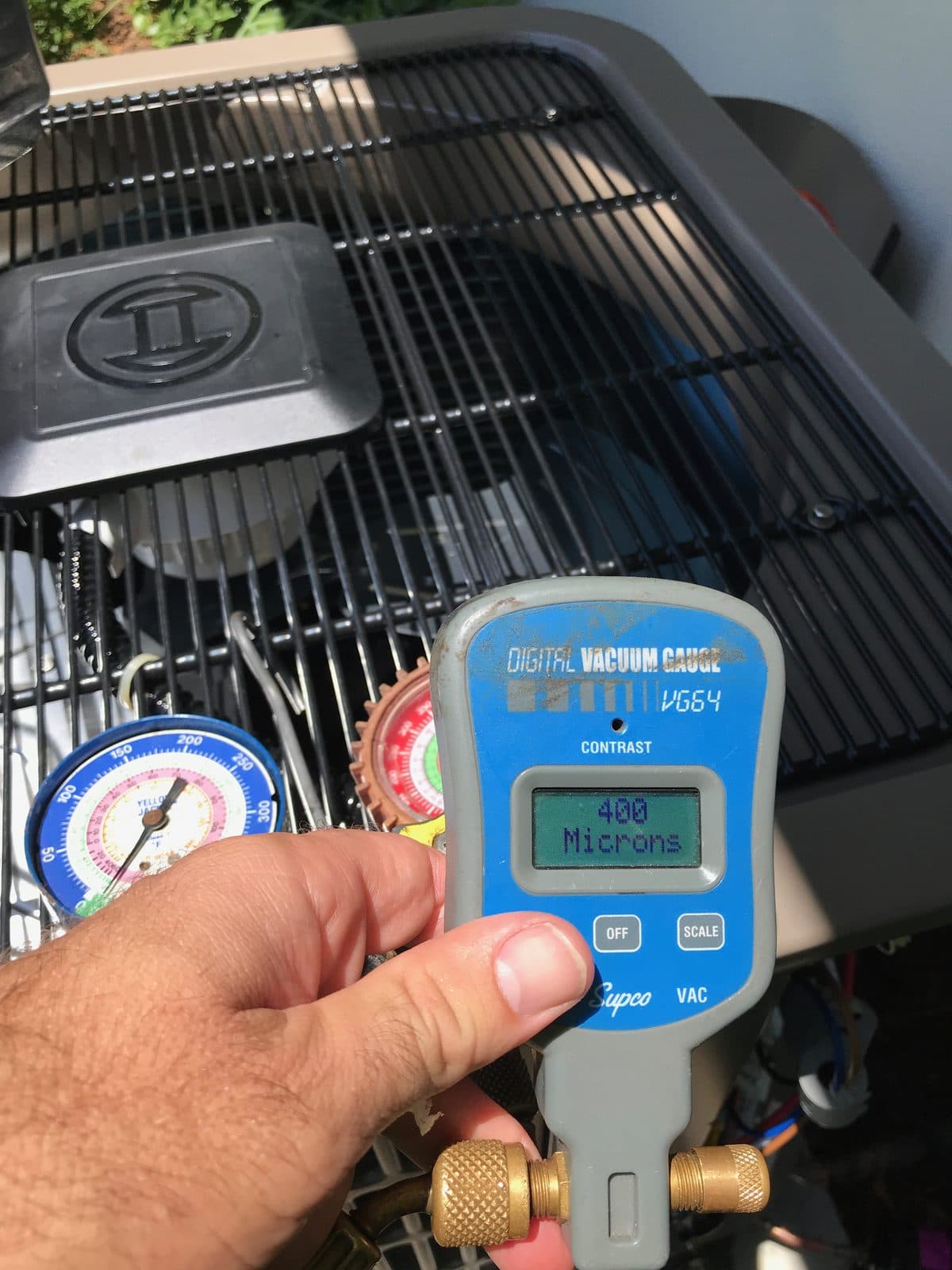
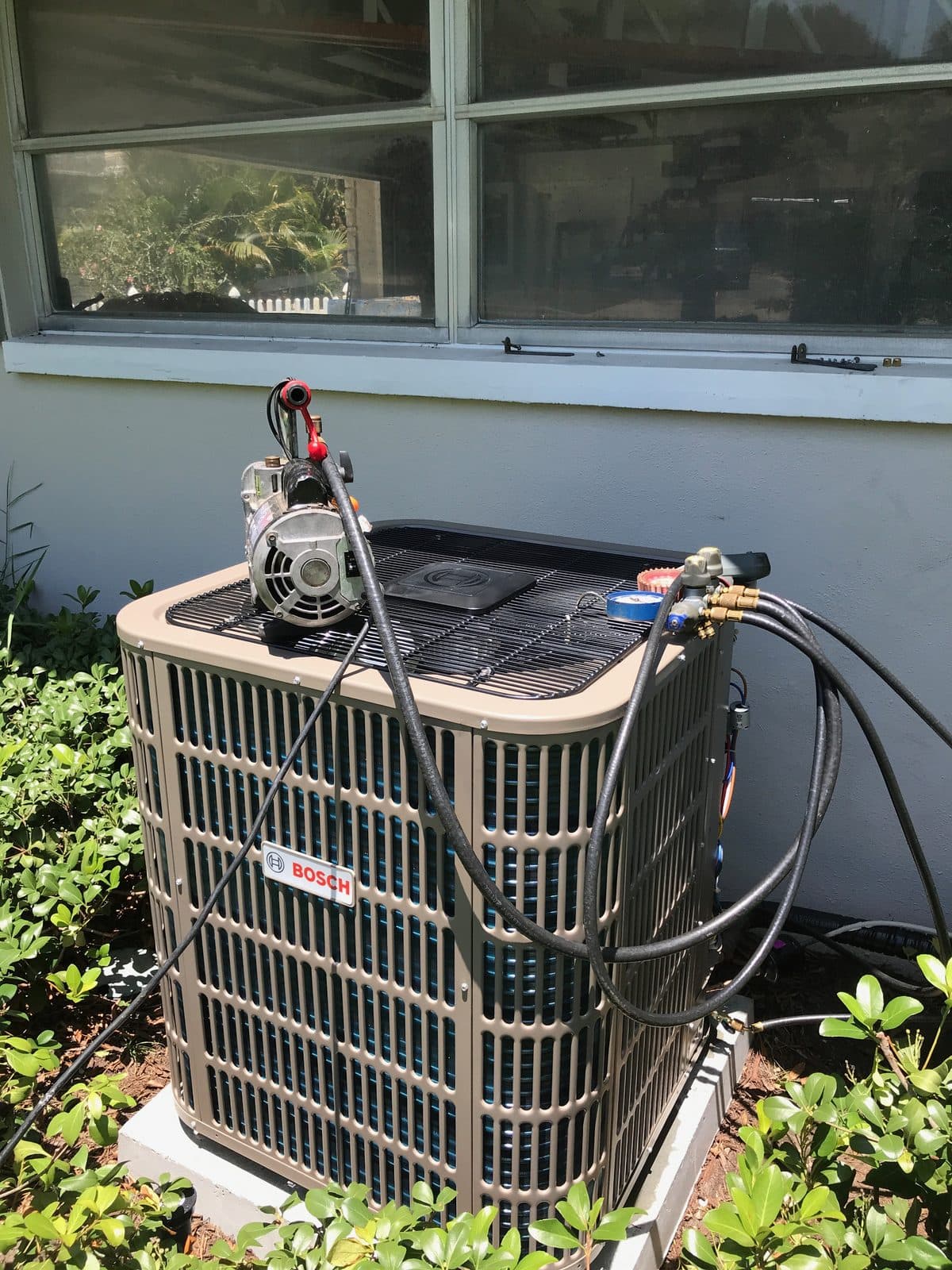
The last step is testing and startup. Carrier lists checking for leaks, verifying refrigerant charge, calibrating the thermostat and safety checks, along with airflow and static pressure. Blume commissions a new system with measured static pressure, airflow and refrigerant charge, and documents the results. Our guide to what to expect from an AC replacement walks through it step by step.
Questions to ask a contractor before you sign
ENERGY STAR publishes a bid comparison checklist for heating and cooling installations. These questions come from it and from Carrier's installer questions:
- Will you measure my home and calculate the size with Manual J?
- Will you install a properly matched indoor coil and outdoor unit, and give me the AHRI certificate?
- Will you check the existing ductwork for damage, and test duct leakage?
- Will you test to find the largest system size my existing ductwork can support?
- Which refrigerant does the new system use, and what installation requirements apply?
- Which permits and inspections are required for my address?
- Will you confirm refrigerant levels and airflow across the coil at startup?
- Will you leave the manuals and the Manual J calculation, plus records of any measurements or testing?
Confirm the license too. Pasco County directs reports of unlicensed contracting to the Florida Department of Business and Professional Regulation. Blume Mechanical Service holds Florida license CAC-1822618. Our guide to comparing HVAC replacement quotes covers more.
Blume Mechanical Service in Wesley Chapel
Blume Mechanical Service is a Class A licensed Florida air conditioning contractor (license CAC-1822618) and is fully insured. We are brand-agnostic and install and service all major manufacturers' equipment. You get a written, upfront price before any work starts. Our office is at 2840 W Bay Dr PMB 114, Belleair Bluffs, FL 33770, and our core service area is Pinellas, Hillsborough and Pasco counties. For other heating and cooling work, see our Wesley Chapel HVAC page.
Frequently asked
Do I need a permit to replace my AC in Wesley Chapel?
Yes. Pasco County's residential mechanical checklist covers the installation or replacement of any air conditioning system, and the county, not a city, handles it. Required documents include an AHRI certificate, plus a site plan if the condenser moves. A homeowner who submits must file a notarized Owner-Builder Disclosure Statement.
My system uses R-22. Do I have to replace it?
No. EPA says U.S. production and import of R-22 ended on January 1, 2020, but you may keep using it in your existing system for as long as necessary. Reclaimed R-22 and R-22 made before 2020 help supply existing systems. When the time comes to replace, EPA says many non-ozone-depleting alternatives are available. Do not let anyone add R-22a, which EPA says is highly flammable.
Can I replace only the outdoor unit on my R-410A system?
Yes. EPA says a homeowner can replace a faulty component, such as a condensing unit or indoor coil, with a similar R-410A component. If the condensing unit and indoor coil are replaced together, EPA counts it as a new system, which is subject to EPA's refrigerant limits for new systems; ask which rule applies on your installation date. The Florida energy code still requires a matched system.
Do I need to call a pro for this?
Yes. Replacing an air conditioner means recovering refrigerant and connecting high-voltage wiring, which belong to a licensed contractor, and the job needs a Pasco County permit. Before you call, check the air filter, confirm the thermostat is set to Cool below room temperature, and clear debris from vents, returns and the outdoor unit. If a breaker for the system has tripped, leave it off and call a licensed contractor.
Should the new system be the same size as the old one?
Not automatically. The Florida energy code says equipment shall be sized with ACCA Manual S, based on loads calculated with Manual J or another approved method. It does not allow safety factors or provisions for future expansion. The code bases sizing on the building's calculated loads, not on other factors, so the right size may differ from the old unit's.
Homeowner guides
- Repair or replace: how to decide
- AC replacement: what to expect
- How to compare replacement quotes
- How long AC units last in Florida
Replacing your AC in Wesley Chapel? Get it sized from a Manual J load calculation first.
References: US EPA — Regulatory Actions: Technology Transitions (final reconsideration rule, May 26, 2026) · U.S. Census Bureau, Census Designated Places · U.S. Census Bureau, American Community Survey 2019-2023 5-year estimates, Table B25034 Year Structure Built, Wesley Chapel CDP · Pasco County Building Construction Services, Permit Submittal Requirements: Residential Mechanical (rev. 11/8/2025) · Pasco County, Building Construction · Pasco County, Inspections · Pasco County, Building in a Special Flood Hazard Area · Florida Building Code, Residential, 8th Edition (2023), Section R322.1.6 · Florida Building Code, Energy Conservation, 8th Edition (2023), Section R403.7.1 · Florida Building Code, Energy Conservation, 8th Edition (2023), Table R301.1 and Section R302.1 · Florida Building Code, Energy Conservation, 8th Edition (2023), Section R501.7 · U.S. EPA, Frequent Questions on the Phasedown of Hydrofluorocarbons (last updated September 14, 2026) · U.S. EPA, Residential Air Conditioning and the Phaseout of HCFC-22: What You Need to Know (February 2020) · ENERGY STAR, Heat & Cool Efficiently · ENERGY STAR, Heating & Air Conditioning Installation Bid Comparison Checklist · Carrier, HVAC Installation Guide (October 1, 2026) · Penn State EGEE 102, 10.6 Air Conditioner Efficiency · Trane, Sensible Heat vs Latent Heat: Why It Matters · Trane, What Is an HVAC Refrigerant?
Also in Wesley Chapel: AC repair in Wesley Chapel · AC maintenance in Wesley Chapel · Heat pump repair in Wesley Chapel · Heating repair in Wesley Chapel
Residential AC Replacement nearby: AC replacement in Brandon · AC replacement in Clearwater · AC replacement in Dunedin · AC replacement in Largo