
HVAC, explained
AC Installation Done Right: Evacuation, Charging and Commissioning
A correct central air conditioning installation is proven by readings, not by cold air on day one. After the equipment is set, the lines should be pressure-tested with nitrogen, pulled into a deep vacuum measured in microns with a hold test, charged and verified by superheat or subcooling against the manufacturer's goal, and the airflow and static pressure measured. Manufacturers publish different evacuation targets in their own manuals, so the number that counts is the one for the model being installed. Ask for each reading in writing. Work on the refrigerant circuit, such as evacuation and charging, is for a technician certified under EPA Section 608, and the pressure and airflow readings are a technician's job too; none of it is a homeowner task.
When the crew drives away, a new system looks the same whether it was installed carefully or quickly: cold air, a clean pad, tidy copper. The differences sit inside the sealed refrigerant circuit and inside the ducts, where moisture, air, a wrong charge or a restricted blower do their damage out of sight. This guide follows the order of work after the equipment is set, names the three readings that make that hidden work visible, and shows what manufacturers' own installation manuals say about each. It is written so a homeowner can ask for the numbers. Taking them is a technician's job.
Installation day: the condenser and lines you can see, and the work you cannot
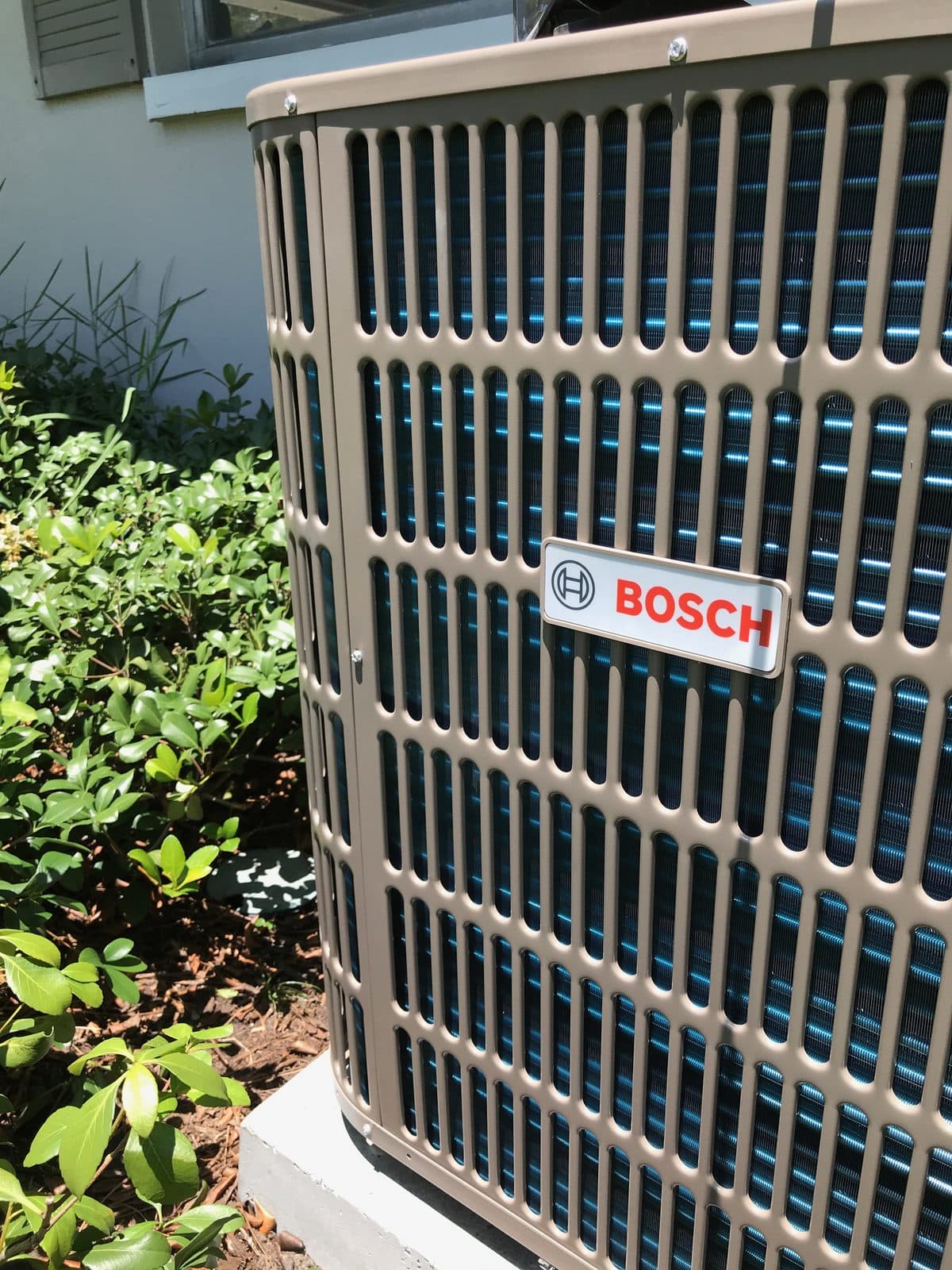
The visible part of the job is the old equipment coming out, the new outdoor condenser set on a level pad, the indoor coil or air handler placed, copper lines run between them, and the wiring and condensate drain connected. The permit and inspection that normally accompany that work are covered in HVAC permits in Florida, and whether the equipment is the right size is a separate question, covered in how to choose the right AC size.
The work that decides how the system performs happens after the lines are connected, and it is invisible once the crew leaves. A manufacturer's manual, such as Bosch's installation instructions for its split heat pumps, has the technician braze the lines while dry nitrogen flows through them, pressurize the lines and indoor coil with dry nitrogen to check for leaks, and then evacuate them. The manual's rule is explicit: do not open the service valves until the leak check and evacuation are complete. Only then is the charge set, and the system started and measured.
None of that is visible on installation day, and a system with moisture in the circuit, a slow leak, a wrong charge or a starved blower can still cool. A guideline written for the Department of Energy's Building America program notes that defects common in existing systems can appear in newly installed ones when airflow and charge procedures are not followed. Three readings turn the hidden work into something a homeowner can ask about: the evacuation reading and its hold, the charge verification, and the static pressure and airflow.
Evacuation: the micron reading and the hold
Evacuation pulls the air, nitrogen and moisture out of the lines and indoor coil before refrigerant goes in. Moisture does lasting harm: the DOE-sponsored guideline explains that the heat of compression makes moisture react with refrigerant and form hydrochloric and hydrofluoric acid, which erodes machine surfaces and can lead to compressor failure. The depth of the vacuum is measured in microns of mercury with a dedicated micron gauge.
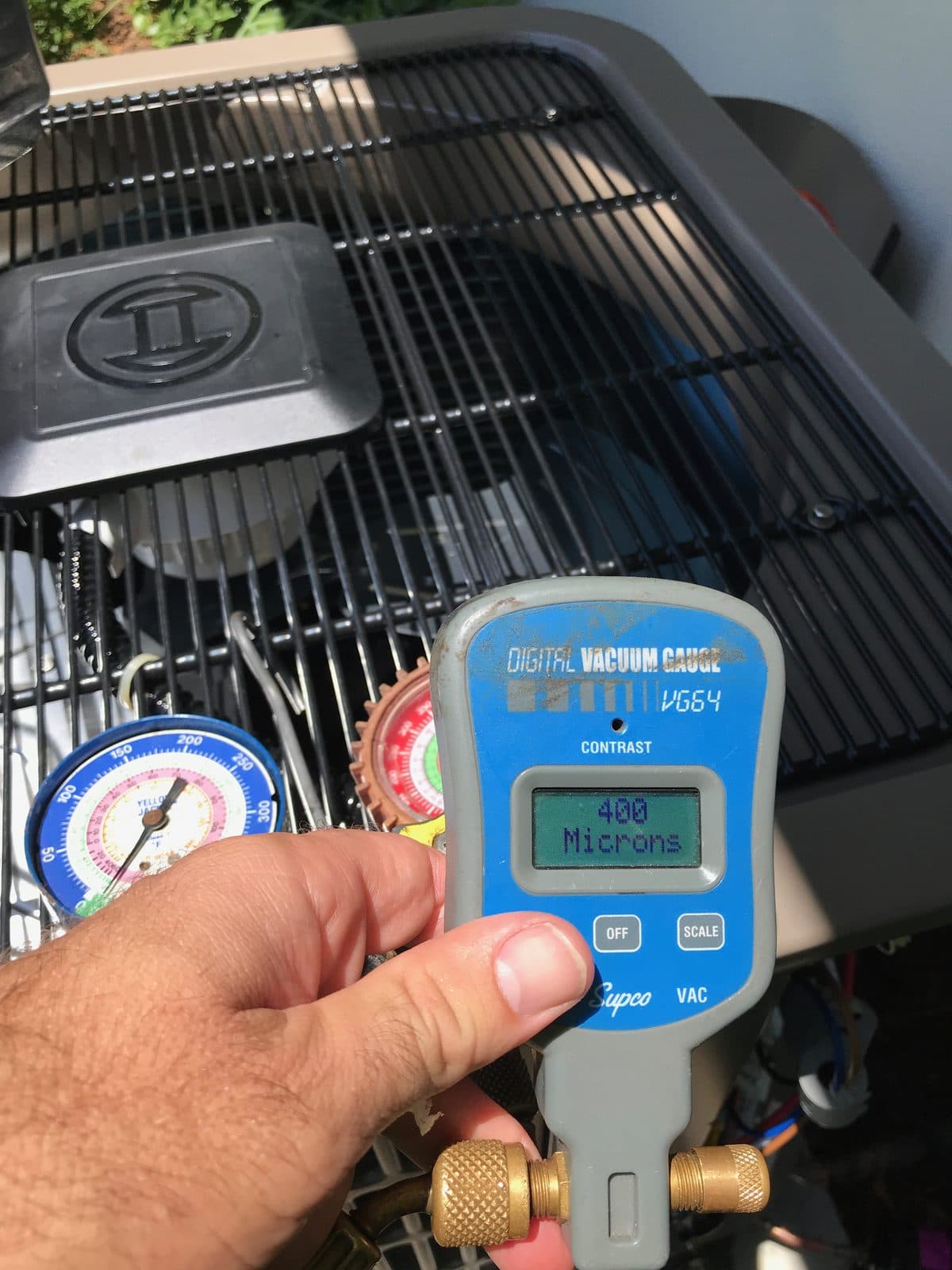
The photo on this page shows a digital vacuum gauge on a Blume job reading 400 microns. It shows what the instrument looks like. It does not prove a finished evacuation: a single frame shows neither how long the reading was held nor which manufacturer's target applied, and it cannot say whether the number was a stopping point or a moment during the pull-down. The target itself is not one universal figure. Four documents read for this page give three different figures:
- Bosch, IDS BOVA20 and BOVC20 split heat pump installation instructions (12.2023): evacuate until the gauge reads no higher than 350 microns, close the valve to the pump, and the evacuation is complete if the gauge does not rise above 500 microns in one minute.
- Trane, 4TTR3 condensing unit installer's guide (18-AC79D1-8-EN, 07/16): the same 350-micron target and one-minute check against 500 microns.
- Rheem, RP13, RP14 and RP15 heat pump installation instructions (8/15): evacuate to 500 microns and hold 500 microns or less for at least 15 minutes.
- The DOE-sponsored guideline: evacuate to 240 microns and hold for 10 minutes before opening the service valves.
Each one pairs a number to reach with a hold to prove it, and the targets run from 240 to 500 microns. A reading means something only beside the target in the manual for the equipment being installed. So the first request is for three items: the final gauge reading, the target in that manual, and the hold result with the time it was watched.
Refrigerant charge: measured against the manufacturer goal
After evacuation the service valves are opened and the system takes its charge. An outdoor unit ships with a factory charge for a stated length of line set. The Bosch manual's factory charge, for example, is sufficient for 15 feet of standard-size liquid line, and the manual gives a per-foot adjustment beyond that, so the length of the run changes how much refrigerant belongs in the system. The manual has the installer weigh in the charge on an initial installation and adjust it by subcooling when the outdoor temperature allows.
A charge set by weight is a starting point; the check is a measurement. According to the DOE-sponsored guideline, the most accurate way to verify proper refrigerant charge is to measure subcooling and superheat using manifold gauges. Subcooling is how far the liquid refrigerant leaving the outdoor coil sits below its condensing temperature. Superheat is how far the vapor returning to the compressor sits above its boiling temperature. Which one is used depends on the metering device: the ENERGY STAR commissioning checklist uses subcooling for a system with a thermal expansion valve and superheat for a fixed-orifice system, compares each with the manufacturer's goal, and records the deviation.
That checklist's pass item is a deviation within 3°F for subcooling or 5°F for superheat. The band belongs to ENERGY STAR's new-homes program rather than to every installation, and the manufacturer's goal is what the reading is measured against. So the charge reading to ask for is three numbers: the manufacturer's goal, the measured subcooling or superheat, and the outdoor air temperature at the time.
A charge check also depends on airflow being right. The same guideline says airflows below 350 cfm/ton (cubic feet of air per minute for each ton of cooling capacity) render standard tests for determining refrigerant charge invalid and can lead to improper charging.
Airflow and static pressure: the reading behind the charge
Static pressure is the resistance the blower works against as it pushes air through the filter, the grilles and the ducts, measured in inches of water column at small test holes in the duct system. The ENERGY STAR checklist asks the contractor to confirm that the test holes exist and are well marked and accessible, to measure return and supply external static pressure and add them into a total, and to use that total with the fan-speed setting to find the measured airflow, which is then compared with the design airflow.
Low airflow is the problem the reading is meant to catch. The DOE-sponsored guideline says airflows below 200 cfm/ton can lead to coil icing and greatly shorten compressor life. It also summarizes field data from 62 California homes built around 2007, where about two-thirds had airflow below the recommended minimum of 350 cfm per ton and filters were responsible for the majority of the return-side pressure loss. Those are California homes, not Tampa Bay ones. They show how common low airflow was in that sample, not what any Florida house will read.
The reading to ask for is the measured total external static pressure next to the limit the equipment's manufacturer publishes, with the measured airflow. High static pressure can be a duct or filter problem, and two guides cover that ground: duct sealing versus duct repair and a return air vent that is too small.
What the permit and the checklists do and do not cover
A permit inspection and a checklist are not the same thing as the installer's own readings. The ENERGY STAR checklist discussed here belongs to the program for new homes, applies to ducted air conditioners and heat pumps up to 65,000 Btu per hour, and exempts mini-split and multi-split systems. ENERGY STAR itself notes that the checklist does not promise proper HVAC performance. It is useful as a neutral list of what a commissioning record can contain, not as a rule for your job.
For installations in existing homes, EPA ended the ENERGY STAR Verified HVAC Installation program effective August 31, 2025. That makes the installer's own readings the record to ask for.
Ask the installer and the building department whether the permit for your job calls for a duct-leakage test. Check the contractor's license as well: the Florida Department of Business and Professional Regulation explains on its construction pages how to verify one.
What to ask for before you sign off
Five items cover the hidden work. Ask for them in writing, with the date, before you sign off:
- The micron-gauge reading at the end of evacuation, the target in the manual for this model, and the hold: any rise, and the time it was watched.
- How the charge was set and verified: the manufacturer's goal, the measured subcooling or superheat, and the outdoor temperature.
- The measured total external static pressure and airflow, beside the equipment's published limit.
- The make, model and serial number of the equipment installed, and the installation manual followed.
- The permit number and the inspection result.
These are readings a technician takes in the course of the work, so asking for them is an ordinary request; if one was not taken, you know which one is missing. Taking the readings and correcting what they show is a technician's job. For the refrigerant circuit, EPA requires technicians who maintain, service, repair or dispose of equipment that could release refrigerant to be certified under Section 608. Its venting rules prohibit intentionally venting refrigerant while maintaining, servicing, repairing or disposing of air-conditioning equipment. The nitrogen pressure test, the brazing and the charging all carry risk, so do not attempt any of it yourself.
Frequently asked
What if the installer runs the vacuum pump for a set time instead of reading a gauge?
The DOE-sponsored guideline describes that as a common installation practice: the pump is left on for a given period, typically four hours, with no vacuum gauge installed. It calls the approach problematic because vacuum pumps rarely receive recommended maintenance; with no gauge installed, the elapsed time does not show how deep the vacuum got. A micron gauge is what turns the time into a measurement. Without one there is no reading to ask for.
Can an air conditioner be installed in cooler weather?
The manufacturer's manual decides. The Bosch manual calls subcooling the only recommended method of charging above 55°F outdoor temperature and directs the weigh-in method below it, with a return visit in spring or summer to charge accurately in cooling mode. On a cool installation day, ask which method the installer will use and whether a return visit is planned.
Why does the installer put in a new filter drier?
The DOE-sponsored guideline says a liquid line filter drier is required for all systems and that a new one must be installed properly whenever a system is opened. The Bosch manual has the installer braze the filter drier into the liquid line. Ask whether a new one was installed.
Does reusing the existing line set change anything?
The Bosch manual's leak check and evacuation cover the refrigerant lines and the indoor coil, and its caution for existing lines is to make certain all joints are brazed, not soldered. Ask whether the lines were reused and how they were checked.
Do I need to call a pro for this?
Yes. Evacuation, charging and commissioning are the steps that decide whether a new system performs like the one you bought, and all three take certified handling and instruments. Your part is not labour, it is insistence: ask for the commissioning readings in writing. A new system installed without them can look fine for a season and still be running wrong.
Related
- HVAC permits in Florida
- What size AC you need in Florida
- Duct sealing vs duct repair
- Return air vent too small
Blume Mechanical Service is a licensed commercial and residential HVAC contractor serving Florida's Tampa Bay region (CAC-1822618), with EPA Section 608 certified technicians. If you are comparing installation quotes, ask every contractor for the readings listed above. We offer no-cost estimates on new systems.
Last updated: 2026-11-05
Sources: ENERGY STAR — Single-Family New Homes National HVAC Commissioning Checklist, Version 3 / 3.1 / 3.2 (Rev. 13), revised 12/01/2023 · ENERGY STAR — notice that the ENERGY STAR Verified HVAC Installation program ended effective August 31, 2025 · U.S. Department of Energy, Building America program (prepared for NREL) — Measure Guideline: Air Conditioner Diagnostics, Maintenance, and Replacement (March 2013) · Bosch — IDS BOVA20 & BOVC20 Split System Heat Pump Installation Instructions, BTC 761703107 A (12.2023) · Trane — 4TTR3 Condensing Units Installer's Guide, 18-AC79D1-8-EN (07/16) · Rheem — R-410A Heat Pump Outdoor Units Installation Instructions, RP13, RP14 and RP15, 92-105074-04-03 (8/15) · US EPA — Stationary Refrigeration: Prohibition on Venting Refrigerants (updated December 8, 2025) · US EPA — Section 608 Technician Certification Requirements (updated July 15, 2026) · Florida DBPR — Construction Industry business information (contractor license verification)
Search Google for how to install central heating and air conditioning