
HVAC, explained
Ductless Mini-Splits: How They Work and When They Fit in Florida
A mini-split is an air conditioner that needs no ducts. An outdoor unit holds the compressor, and thin refrigerant lines carry heat to one or more indoor units on a wall or ceiling. Heat-pump models also heat in winter. A mini-split fits best where ducts are missing or hard to extend. In Florida, ask how the system will handle humidity before you buy.
This page explains how mini-splits work and when one fits a home. Putting one in has its own page, mini-split installation, and fixing one has another, mini-split repair. The facts below come from public documents, not from Blume field measurements. The sources include ENERGY STAR, two reports prepared for the US Department of Energy and a field study of Florida homes.
The parts of a mini-split: outdoor condenser and indoor heads
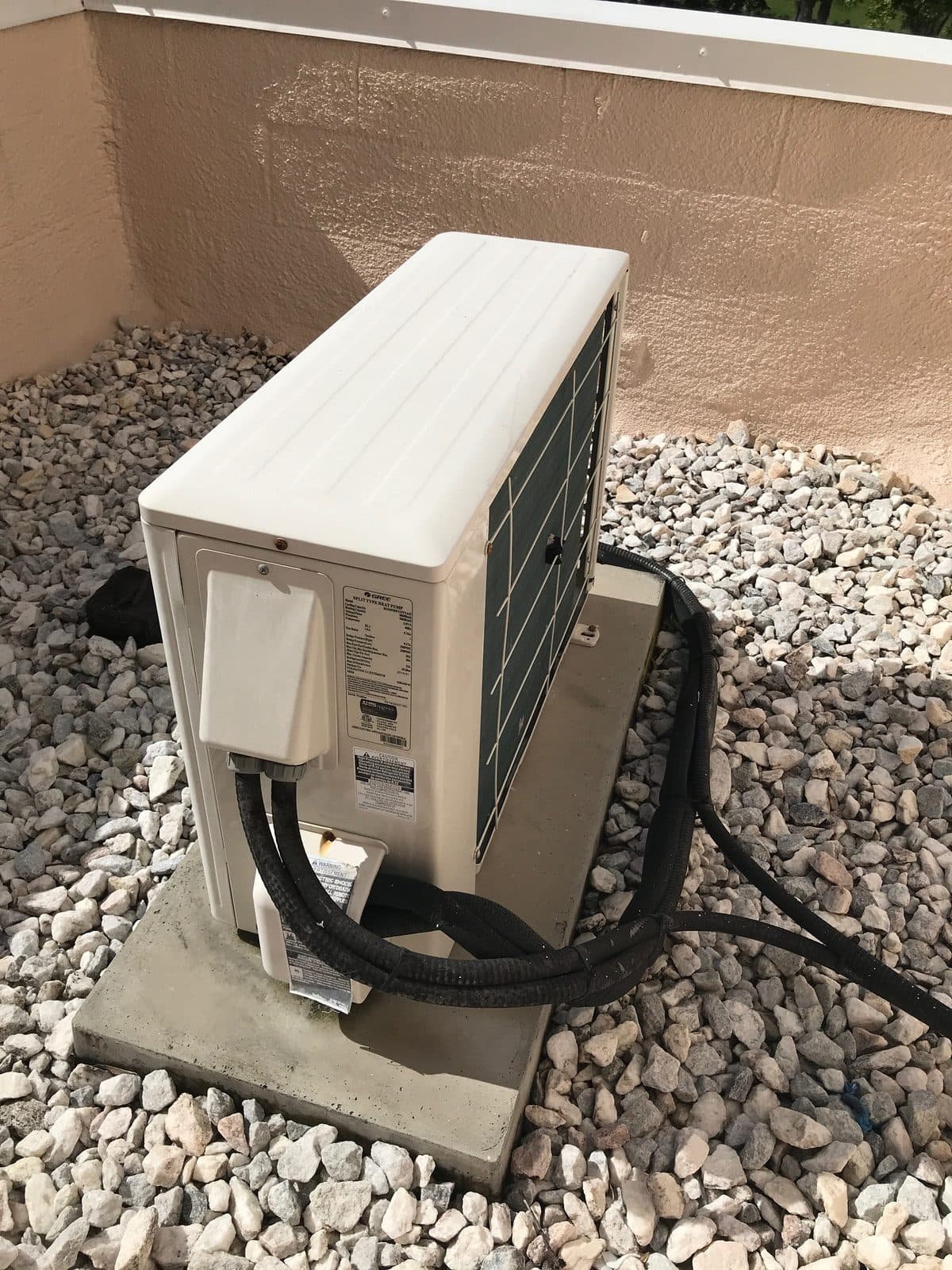
A mini-split has two main parts joined by thin refrigerant lines. The outdoor unit holds the compressor, a fan and a coil. The compressor is the pump that moves refrigerant, the fluid that carries heat. A 2013 review by the Pacific Northwest National Laboratory (PNNL), written for the US Department of Energy, calls the outdoor unit the condenser. The indoor units, often called heads, each hold a coil and a fan.
ENERGY STAR describes heating this way. The outside unit takes heat from the air, and refrigerant carries it to the heads inside. In warmer months the system works in reverse, which is how it cools. Heat pump vs straight-cool air conditioner explains the reversing step.
On a ductless unit, nothing is blown through ductwork. A system with several heads can hold a different temperature in each room.
The review also says the outdoor unit of a ductless mini-split has an inverter-driven compressor. An inverter compressor changes speed with the load instead of switching fully on and off. Single-stage, two-stage and variable-speed compressors covers the idea for central systems.
Ask whether the model in your quote is cooling-only or a heat pump. Carrier's ductless page says a ductless air conditioner cannot heat, while a ductless heat pump can both heat and cool.
Indoor unit styles, and how many you need
ENERGY STAR lists four styles: wall mounts, floor mounts, ceiling cassettes, and ducted options that can be concealed. A ceiling cassette is set into the ceiling. A concealed ducted unit hides in an attic, a dropped ceiling or a similar space and feeds short runs of duct. The 2013 review says the concealed versions cost more to install than wall-mounted units.
The number of heads depends on the floor plan. A 2020 PNNL report says one head per floor, about 1,000 square feet, is typical when the plan is open or the doors stay open. It adds that installers might recommend more heads, even on one floor, if the plan is not open or the doors stay closed. ENERGY STAR says it can be challenging for heat to move through an open doorway and impossible to move through a closed one.
The 2013 review reports that in a home with only a downstairs head, warm air rises but cool air does not, leaving the upstairs hot in summer. Why the upstairs is always hotter covers the same problem in ducted homes.
A system with several heads on one outdoor unit is called a multi-split.
When a mini-split fits a home
ENERGY STAR lists where mini-splits are increasingly used. One case is an older home with no ductwork. Another is an addition or outbuilding, such as a garage, where extending ductwork or capacity is difficult. A third is a room next to unconditioned space, where ducts would face harsher temperatures. A fourth is a home with hot or cold spots, including rooms used as home offices. ENERGY STAR also calls a mini-split a replacement for window units for cooling.
Our reading for Tampa Bay: the same logic applies to an enclosed lanai, a converted garage room, a room over a garage and a new addition.
A 2016 Florida field study describes how mini-splits are used in the South. Its authors wrote that sparse data suggested they were mostly installed to replace noisy window units or to serve a previously unconditioned space.
The study then tested a different use: a mini-split added next to an existing central system. It put a one-ton mini-split in the main living area of ten central Florida homes that kept their central air conditioners. Cooling energy use fell in all ten homes, by very different amounts, and in one home it barely changed. This is a small study, not a prediction for your house.
When a mini-split is a weaker fit
ENERGY STAR says that if a home already has ductwork, a ducted air-source heat pump may be the right system. Our reading: where sound ducts already reach every room, a mini-split is usually a way to add or adjust one zone, not a reason to give up the ducts.
Many closed rooms work against a mini-split. Our reading: each room that needs its own control may need its own head, so a house of small closed rooms can need many heads.
The 2013 review says the issues homeowners report most, besides temperature, are the look and the fan noise of wall-mounted indoor units.
Replacing a whole central system is the hardest case. In the Florida study, one home swapped its central system for a multi-split. One outdoor unit fed a wall unit in the main living area and a ducted ceiling unit for the bedrooms and office. The occupants reported comfort problems. The authors add that a full-sized house would need two or three ducted mini-splits, depending on room layout, to match the result in a small home that used one.
Mini-split, central air or window unit: three questions
Three questions sort most choices. They are our reading of the sources above, not a rule.
- Do usable ducts already reach the space? If they do, central air or a ducted heat pump may serve it. If they do not, or extending them is hard, a mini-split is a candidate.
- Is the need one room or the whole house? One room, an addition or a hot spot points toward a mini-split. A whole house of closed rooms needs a head count first.
- Are you replacing a window unit? ENERGY STAR and the Florida study both name that as a use for a mini-split.
Humidity in Florida: what a field study measured
A mini-split cools by pulling heat out of the air, and its indoor coil also pulls out water. Whether that is enough in a humid climate is a separate question. In 2013 the PNNL review said limited information existed on how well ductless mini-splits dehumidify homes in extremely humid climates, such as the southeastern United States.
A 2016 study of Florida homes added field data. It monitored 53 Florida homes, and ten central Florida homes in it got a mini-split beside their central systems. On average, the authors saw no apparent moisture-removal advantage from the added unit. They saw lower long-term average indoor humidity in some homes, but inconsistently.
The multi-split replacement had problems. In the rooms served by its ceiling unit, humidity was higher and more variable after the retrofit. The occupants also had temperature imbalances: the office was too cool, and the master bedroom was often too warm.
The authors point to one limit of that design. An inverter compressor can run longer at low speed, which may help remove moisture. But it can only slow down so far. The paper calls that limit the turn-down ratio, the span from the highest to the lowest output. It says a multi-split with one outdoor unit is less capable of running when the temperature load is low than two independent mini-splits of the same total capacity would be.
One ducted mini-split in a small Florida home showed sharply lower humidity in every room after it replaced the central system. The authors say much of that was likely due to dropping leaky attic ducts for an interior duct system. They also say these are single case studies and that more field evaluation is needed.
Our reading: do not assume a mini-split fixes damp air. Size it by room load, ask for its lowest output, and treat humidity as its own question. Why your house feels humid with the AC running and how to choose the right AC size for a Florida home explain oversizing and moisture.
Adding a mini-split to a central cooling system
If a home already has central air, a mini-split added to it gives two systems serving the same space, each with its own thermostat. A 2020 PNNL report, based on lab-home tests in Washington State, notes that several field studies found the expected energy gains were not being achieved because of the interaction with existing equipment.
The Florida study raised a similar worry. Its authors wrote that two systems with potentially competing thermostats serving a single zone added speculation about how the setup would work out. The team also advised owners not to run the central fan constantly, so that moist air from the coil is not blown back into the house.
Our reading: if you add a mini-split to a central system, ask who sets the two thermostats and how the two units will share the work.
What changes in Tampa Bay
The Florida study places its homes in central Florida and Cocoa Beach. It does not name Tampa Bay, so treat the results as a guide, not a local measurement.
If the outdoor unit will sit near salt water or in a flood zone, ask where it will be placed. Coastal coil protection and hurricane season HVAC prep in Florida cover those conditions.
For permits, see HVAC permits in Florida.
Who should do the work
Refrigerant, charging and the electrical supply are work for licensed or certified professionals. For the certification, see EPA 608 certification and the refrigerant rules. Do not connect refrigerant lines or power yourself.
Questions to ask before you choose
Ask for the answers in writing.
- Is the size based on a Manual J load calculation for each room or zone? ENERGY STAR says the contractor should verify the proper size with Manual J, a calculation of the heating and cooling a home needs.
- How many indoor units will there be, which rooms does each serve, and what happens in a room with the door closed?
- Is this a cooling-only model or a heat pump?
- What is the lowest output of the outdoor unit, and what is the plan for humidity?
- If a central system stays, how will the two thermostats work together?
- Where will the outdoor unit sit, and how will it be anchored and protected from salt air, wind and flood water?
- Who will pull the permit, and what is the contractor's license number for a check with the state?
Frequently asked
Do mini-splits work in Florida's humidity?
They cool and remove some moisture like any air conditioner, but humidity control is not automatic. A Florida field study saw no apparent moisture-removal advantage from adding one beside a central system, and a multi-split replacement had humid rooms. Sizing, head count and a humidity plan matter.
Can one mini-split cool a whole house?
In an open plan, sometimes. A 2020 PNNL report says one head per floor, about 1,000 square feet, is typical when the plan is open or the doors stay open. Closed doors may call for more heads.
Is a mini-split an air conditioner or a heat pump?
It can be either. Carrier's ductless page says a ductless air conditioner cannot heat, while a ductless heat pump can heat and cool. Heat pump vs furnace and heat pump vs straight-cool compare the choices.
Can a mini-split replace a window unit?
ENERGY STAR describes a mini-split as a replacement for window units for cooling, and the Florida study names window-unit replacement as a use.
Can I install a mini-split myself?
Refrigerant and electrical work is for licensed professionals, so this page gives no do-it-yourself steps. Mini-split installation covers what a correct installation includes, and mini-split repair covers problems with a running unit.
Do I need to call a pro for this?
Yes for installing one. The refrigerant lines, the electrical supply and the wall penetration all need a licensed contractor, and the manufacturer's warranty generally depends on it. Deciding whether a ductless system suits the house is yours, and worth doing carefully, because the common mistake is one oversized unit trying to serve rooms it cannot reach.
Related
- Heat pump vs straight-cool AC
- Single, two-stage & variable-speed
- House humid with the AC running
- What size AC you need in Florida
- Two-story uneven cooling
Blume Mechanical Service is a licensed commercial and residential HVAC contractor serving Florida's Tampa Bay region (CAC-1822618). Blume installs and services all major brands as a licensed contractor, and estimates on new systems and retrofits are no-cost. If you are comparing mini-split proposals, take the questions above with you.
Last updated: 2026-11-05
Sources: ENERGY STAR, Ductless Heating & Cooling (energystar.gov) · ENERGY STAR, Mini Split Heat Pumps fact sheet (2025) · PNNL for the US Department of Energy, Review of Residential Low-Load HVAC Systems (PNNL-23017, September 2013) · PNNL for the US Department of Energy, Experiments to Maximize the Use of Ductless Mini-Splits in Homes with Existing Central or Zonal Heating and Cooling Equipment (PNNL-29531, May 2020) · ACEEE Summer Study on Energy Efficiency in Buildings (2016), Evaluation of Mini-Split Heat Pumps as Supplemental and Full System Retrofits in a Hot Humid Climate · Carrier, Ductless Mini Split Systems (carrier.com)