
Hillsborough County · Florida CAC-1822618
AC Repair in Temple Terrace, FL: Air Conditioning and HVAC Service
Professional AC repair and HVAC service available 24/7
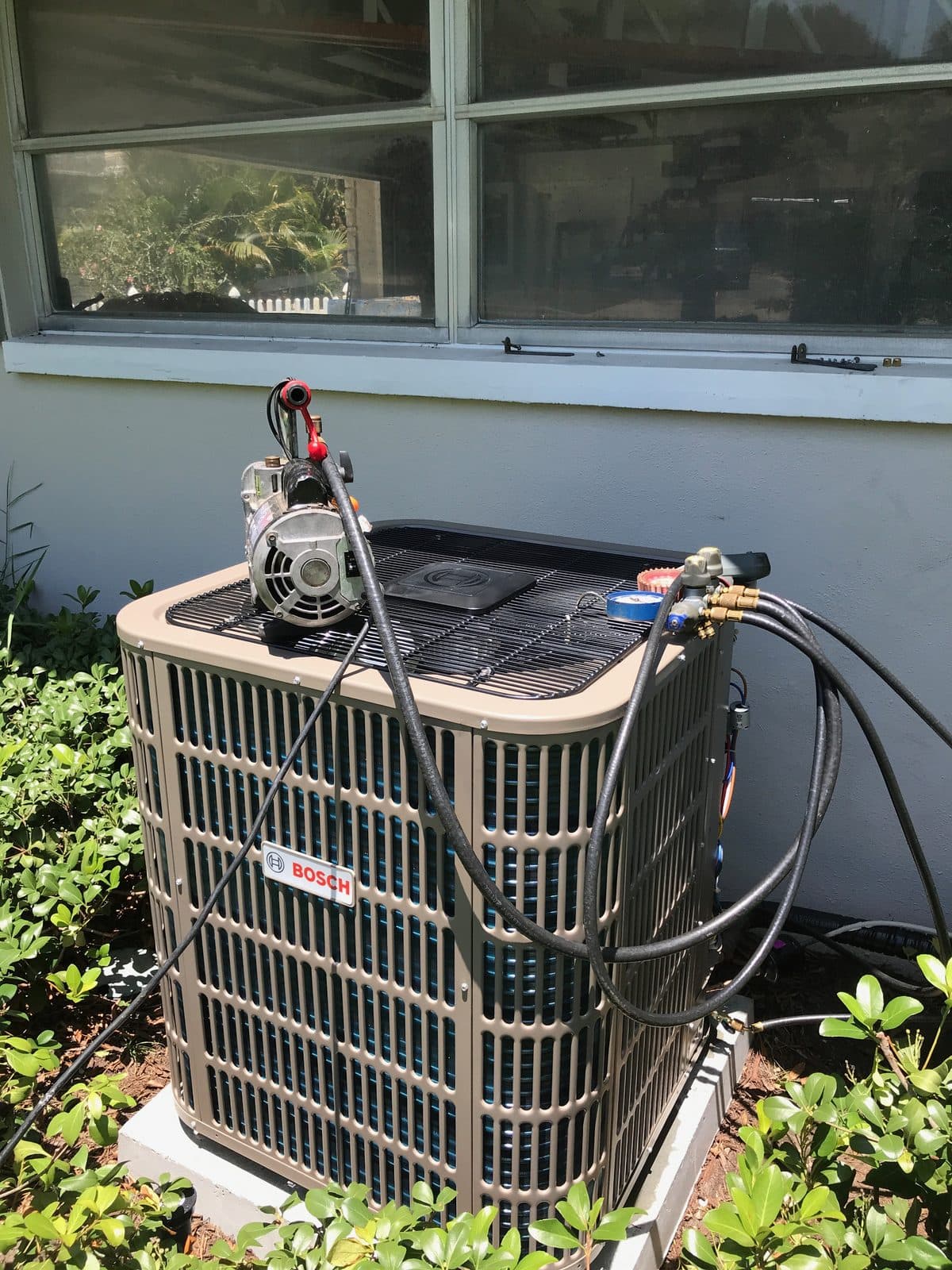
When an air conditioner in Temple Terrace stops cooling or the heat won't come on, AC repair should start with a licensed contractor who explains what is wrong before anything is replaced.
Blume Mechanical Service is a Class A licensed Florida mechanical contractor, license CAC-1822618, and fully insured. We work on residential and commercial systems. Our office is at 2840 West Bay Drive #114 in Belleair Bluffs, and our core service area is Pinellas, Hillsborough and Pasco counties. Temple Terrace is in Hillsborough County.
What Makes Temple Terrace Different for HVAC
Temple Terrace has a few local conditions that change how equipment should be placed, repaired and replaced.
The Hillsborough River and the storm drains
The potential flooding source in Temple Terrace is the Hillsborough River, and storm drain systems are also susceptible to annual flood events. So the risk is not only a river rising. Heavy rain can overwhelm drains on streets far from the water.
The Tampa Bypass Canal, with its concrete control structures, and a dam downstream provide some defense against flooding, but a potential for a flood disaster remains. For an HVAC owner, that means flood exposure is a planning question for the equipment, not something to dismiss because nothing has happened in a while.
Whether your particular address sits in a flood zone is a separate question. The city's Engineering Department will help determine flood zones for specific properties within the city. Ask them before you decide how much to invest in the location of a new outdoor unit or air handler.
Why equipment elevation matters
An air conditioner has parts that are built to sit outside in rain, and parts that are not. The outdoor condenser tolerates splashing and wet weather. It does not tolerate standing water around its electrical components. Indoors, an air handler or furnace in a garage, a closet at slab level or a ground-floor utility room has its blower motor, control board and wiring low to the floor.
Home elevation, constructing floodwalls or berms, and protecting utilities are permanent flood retrofitting methods. HVAC equipment is one of the utilities in that category. When we replace a system, we look at where the condenser, air handler, electrical disconnect and condensate drain sit relative to the ground and the floor. If a better position is practical, we raise it with you before the equipment is ordered.
The 50 percent rule
Under the National Flood Insurance Program, if the cost of reconstruction, rehabilitation, addition or other improvements to a building equals or exceeds 50 percent of the building's market value, the building must meet the same construction requirements as a new building.
Why does an HVAC page mention this? Because a replacement system is one cost among others when a property is being renovated. If you are doing a larger project, such as an addition, a major rehab or storm repairs, the HVAC cost may count toward the total. We are not the authority on how the rule applies to your building, and we don't calculate it for you. The city's Building & Permitting Department and Engineering Department are the right places to ask.
What Hurricane Milton showed
The City of Temple Terrace was under a Boil Water Notice due to widespread power outages caused by the storm. Power outages matter for air conditioning because of what happens when power returns. Compressors and control boards are exposed to surges and repeated restarts, and a system that sat in humid, closed-up air for days may have moisture problems inside the home.
Hillsborough County was also preparing to launch a Community Development Block Grant – Disaster Recovery program to assist residents impacted by Hurricanes Helene and Milton, expected to provide funding to eligible homeowners for repairs. If you are repairing a storm-damaged home, check with the county about eligibility and what documentation it requires before you commit to work.
Salt and coastal exposure
Salt exposure is mostly a concern for properties near open water and the coast. If you want to know how coil protection works and when it is worth considering, our guide to coastal coil protection explains it, and we will tell you honestly whether it makes sense for your address.
The housing mix: older homes, apartments, condos and rentals
Temple Terrace is not a single housing type, and the equipment varies with it.
As captured in 2012, more than 33 percent of the community's dwelling units were constructed between 1980 and 1989, the largest proportion of the housing stock. In 2012 there were 10,946 housing units, of which 57.7 percent were single-family homes and 42.4 percent were multi-family dwellings, and mobile homes and other types of housing were non-existent. These figures are from 2012, so treat them as a picture of the housing stock's character rather than a current count.
For HVAC, the age of a house matters because it tells us what to look for. When an older system is swapped without checking the ducts, the new unit inherits problems such as undersized returns, leaks and poor airflow. This is why we measure static pressure and airflow instead of assuming the ducts are fine.
Association rules and building access can shape what is possible, so check them before scheduling a replacement.
The city's historic preservation program ensures that changes to designated historic structures are performed in an architecturally appropriate manner that preserves their character. If your home is a designated historic structure, ask the city's Historic Preservation Office before planning visible changes, such as where an outdoor condenser will sit. We don't know which individual properties are designated, so please check yours.
Heat, humidity and the storm season
Temple Terrace's climate puts load on air conditioning for much of the year. The rainy season runs from May 15 to October 15 for Southwest Florida and from May 25 to October 10 for the rest of West Central Florida. The season is typically accompanied by an increase in humidity with persistent dew point values above 70°F, daily low temperatures in the 70s to around 80°, and high temperatures in the upper 80s to middle 90s.
That matters because an air conditioner has two jobs: lowering temperature and removing moisture. When nights stay in the 70s, the system gets little relief, and runs long cycles. Small problems such as a dirty coil, a weak capacitor, a partly clogged condensate drain or low refrigerant charge show up as higher indoor humidity and longer run times before they show up as a complete breakdown.
Conditions are most favorable for dangerously high heat indices across West Central and Southwest Florida when winds are out of the west and thunderstorms are unable to form. On those still, hot days a failed air conditioner is more than an inconvenience, especially for older residents, young children or anyone with a health condition. If your system fails on a day like that, call right away.
Hurricane season begins June 1 and continues through November 30.
Permits for AC Replacement in Temple Terrace
Replacing an air conditioner is not only a purchase. In Florida it is regulated work, and in Temple Terrace the city handles the permitting directly. Our general guide to HVAC permits in Florida covers the statewide picture.
Who issues the permit
The City of Temple Terrace has its own Building & Permitting Department, which provides permitting, inspection services, zoning reviews, construction and site plan reviews, and contractor registration for the community.
Does your job need one
Anyone who wants to install, alter, repair, remove, convert or replace a mechanical system regulated by the technical codes must first apply to the city's Building Department and obtain the required permit. An air conditioner is a mechanical system, so a replacement is the kind of work this rule addresses.
Air Conditioner Replacement is among the examples of permits that will be processed by email.
Work that does not require a permit includes any portable cooling appliance, portable evaporative cooler, portable heating appliance, portable ventilation equipment and self-contained refrigeration system. A window unit or a portable room air conditioner is an example of a portable cooling appliance. A central system or a ducted split system is not in that category. If you are unsure whether your job falls under the exceptions, ask the Permit Office before work begins.
Codes and inspections
The Florida Building Code, Temple Terrace Code Chapter 8, the Florida Fire Prevention Code and the National Electrical Code are the adopted and referenced codes. The 8th Edition (2023) of the Florida Building Code is listed, with a draft 9th Edition (2026) also listed. Code editions change, so a contractor should confirm which one applies to your permit date rather than rely on memory.
The energy-code changes between the eighth and ninth editions include removal of the duct testing exception for Section R405 (performance) compliance. That item comes from a draft edition.
Checking a contractor and following your permit
Check that a contractor's license is current and valid by calling the Temple Terrace Permit Office at (813) 506-6460 or the Hillsborough County Licensing Office. That is good advice for any contractor, including us. You can check it with the state licensing authority, the Florida Department of Business and Professional Regulation.
Temple Terrace offers online permitting options where residents and contractors can check permit application status, pay permit fees, check inspection results, and schedule or cancel an inspection. If we are installing your system, ask us how the permit is being handled and when the inspection is expected, and you can follow the progress online.
HVAC Services We Offer in Temple Terrace
We install, repair, maintain and replace residential and commercial heating and cooling systems, and we also do design-build work. We are brand-agnostic: Blume installs and services all major brands as a licensed contractor, so our recommendation is not tied to one manufacturer.
AC repair
Common causes of a system not cooling well or stopping include a failed capacitor or contactor, a clogged condensate drain that has tripped a float switch, a dirty or frozen evaporator coil, a failing fan motor, restricted airflow, or low refrigerant charge caused by a leak. A float switch is a safety device that shuts the system off when the drain pan backs up, so a unit that suddenly stops on a humid day is sometimes protecting your ceiling, not broken.
If a refrigerant leak is the problem, topping off the charge without finding the leak is only a temporary measure. Refrigerant work is done by EPA Section 608 certified technicians, the federal refrigerant-handling credential.
Heating service
Heating systems include heat pumps, which heat and cool by moving heat, electric furnaces with strip heat and gas furnaces. We service the type you have. A heat pump that is not heating often has a problem with the reversing valve, the defrost control, the charge or the thermostat settings, and a technician can sort these from a simple stuck setting.
System replacement and installation
When a system is at the end of its useful life, we size the replacement for homes using an ACCA Manual J load calculation and select equipment using Manual S, not a like-for-like swap by rule of thumb. Manual J is the residential method for working out how much heating and cooling a home actually needs. An oversized unit cycles on and off without removing humidity, which is a particular problem in a humid climate. An undersized one runs constantly.
After installation, we commission the system with measured static pressure, airflow and refrigerant charge, and we document the results.
We also give you repair-versus-replace numbers side by side, and we don't sell equipment a building doesn't need. If a repair is the sensible choice, we say so. Financing approved through Synchrony Bank is available if you decide on a replacement.
Maintenance
Regular maintenance catches the small problems that cause failures on the hottest days. A visit includes inspecting the coils, drain, electrical components, airflow and refrigerant condition, and cleaning where needed. Our AC maintenance checklist for Florida lists the items worth checking, including some you can do yourself between visits.
Paid priority scheduling is available if you want your maintenance or service visits to be put first in line.
Condos, rentals and commercial buildings
For condo owners, we can work with your association's rules about equipment placement. For landlords, we can inspect and service units on a schedule you set. For commercial buildings, we handle service, installation and design-build work. Commercial load calculations use methods suited to commercial buildings, not the residential Manual J.
How a Service Visit Works
You should know what will happen before a technician arrives.
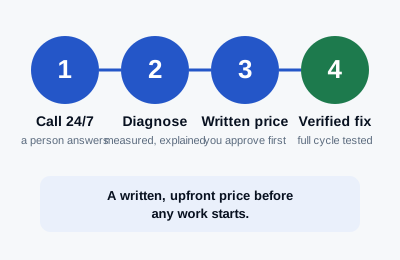
- You call and describe the problem. A person answers the 24/7 dispatch line. Tell us what the system is doing, whether it is running, whether the air is warm, and whether you see water, ice or tripped breakers.
- We schedule the visit. We offer 24/7 emergency HVAC service, with same-day response available based on location and technician availability. We don't promise a specific arrival time, and we will tell you plainly what we can do.
- The technician inspects the system. We check the thermostat, power, airflow, coils, drain, electrical parts and refrigerant side, and measure what can be measured rather than guess.
- We explain what we found. You get the cause in plain language, and what your options are, before any work begins.
- We give you a written, upfront price before any work starts. If a repair makes sense, we fix it. If replacement makes more sense, we lay out repair and replacement options side by side.
What you can do before the visit
A few checks may save time. Make sure the thermostat is set to cool and the fan is on auto. Check that the breaker has not tripped. Look at the air filter, since a badly clogged one restricts airflow. If water has overflowed from the indoor unit, turn the system off at the thermostat and let us know. Don't keep running a system that is icing up, because that can damage the compressor.
Emergency floodproofing includes clearing debris from gutters and downspouts, moving valuables to a safe, waterproof place, and shutting off all electricity and gas. Do not restart HVAC equipment that has been in water. Have it inspected first, because water can leave hidden damage in motors, boards and wiring.
When to Call
Call us promptly if any of these apply:
- The system is not cooling, or air from the vents is warm during a hot, humid stretch.
- Ice has formed on the indoor coil, refrigerant lines or outdoor unit.
- Water is leaking near the indoor unit or the drain line is overflowing.
- The breaker keeps tripping when the system starts.
- There are burning smells, grinding, squealing or loud banging. Turn the system off and call.
- The system runs constantly but the house will not reach the set temperature.
- Equipment has been exposed to flooding or storm damage. Do not power it up until it is inspected.
- Your system is old and repairs are becoming frequent. That is the time to compare repair and replacement.
Schedule maintenance before hurricane season or the hottest months rather than waiting for a failure. If you aren't sure whether a symptom is urgent, call and describe it. We will tell you whether it can wait for a regular appointment or needs a technician now.
Frequently Asked Questions
Should I repair or replace my air conditioner?
It depends on the problem, the equipment's condition and what else is going on with the home. A single failed part on a system that is otherwise sound is often worth repairing. A compressor failure, a leaking coil or repeated breakdowns on older equipment point toward replacement. We put the repair and replacement options side by side so you can compare them.
What should I expect for my AC when power comes back after a storm?
Large outages are part of the local storm picture. At its peak, TECO saw about 600,000 outages from Hurricane Milton. When power returns, the grid can be unsettled for a while. A sensible habit is to set the thermostat to off, let the supply steady, and then restart cooling rather than cycling the system repeatedly. If the system does not start normally, or equipment was wet, call for an inspection before trying again.
Do most Temple Terrace homes get used year-round?
Largely, yes. Seasonal housing is less than 1 percent of total housing units.
For AC or heating service in Temple Terrace, call Blume Mechanical Service at 727-330-9131.
HVAC Services in Temple Terrace
Every service we offer in Temple Terrace — each link covers scope, pricing factors, and scheduling.
AC Repair & Installation (Residential)
AC Repair & Installation (Commercial)
HVAC Repair & Installation (Residential)
HVAC Repair & Installation (Commercial)
HVAC Service Guides for Temple Terrace Homeowners
Start with the symptom or service you need — every guide connects to the same 24/7 dispatch serving Temple Terrace.
More: all HVAC services · commercial HVAC
Homeowner guides: AC troubleshooting · Florida AC maintenance checklist · how long AC units last here
Local resources
Official sites, including where to check permitting. A city issues permits for addresses inside its limits; the county covers unincorporated addresses.
HVAC Service in Temple Terrace
Blume Mechanical Service provides comprehensive HVAC repair, maintenance, and installation for residents and businesses throughout Temple Terrace, Hillsborough County. With 24/7 emergency response, licensed technicians, and a written, upfront price before any work starts, we're your trusted partner for all air conditioning and heating needs.
Why Choose Blume for Temple Terrace HVAC Service?
✓ Licensed & Insured
Florida HVAC License #CAC-1822618
✓ 24/7 Emergency Service
Available anytime, day or night
✓ Same-Day Response
Available based on location and technician availability
✓ Written, Upfront Price
Before any work starts
Emergency AC Repair in Temple Terrace
Your air conditioning stopped working? Our emergency HVAC team responds quickly to get your home or business comfortable again. Call us immediately at (727) 330-9131.
Call Now: (727) 330-9131Our HVAC Services
Air Conditioning Repair
AC unit diagnosis and repair services
Emergency AC Service
24/7 emergency HVAC response
Maintenance Plans
Preventative HVAC maintenance
Installation
New HVAC system installation
Other Cities in Hillsborough County
Hillsborough County · 24/7 dispatch
Need AC Repair in Temple Terrace?
A person answers the 24/7 dispatch line, so call now. Same-day response is available based on location and technician availability.