
Hillsborough County · Florida CAC-1822618
AC Repair in Plant City, FL: HVAC Service for a Flood-Aware Inland City
Professional AC repair and HVAC service available 24/7
If you are searching for AC repair in Plant City, you probably want three things: someone licensed, someone who understands why Plant City is not the same as a beach town or a new suburb, and a clear idea of what happens when you call.
Blume Mechanical Service, LLC is a Class A licensed Florida mechanical contractor, license CAC-1822618, and is fully insured. We work on residential and commercial systems. Our office is at 2840 West Bay Drive #114, Belleair Bluffs, FL 33770, and our core service area is Pinellas, Hillsborough and Pasco counties. Plant City is in Hillsborough County.
What makes Plant City different for HVAC
Plant City is an inland setting, and that changes how an air conditioning system should be installed, protected and repaired.
An inland city east of Tampa
Plant City is geographically in the middle of the west coast of Florida, about 25 miles east of Tampa, immediately west of Lakeland and 70 miles west of Orlando. That puts Plant City well away from the open Gulf. If you want to understand how salt damages outdoor coils and what protective coatings do, our guide on coastal coil protection explains it. For a Plant City home, the bigger exposures are water, humidity and storms, not salt.
Water is the main exposure
The city's floodplain represents the area that will flood in a 100-year storm event, and you may still flood in lesser events, because the floodplain is determined only for the 100-year storm. For an AC owner, the practical meaning is that a map line does not settle the question either way. A home outside the mapped floodplain can still have water around its outdoor unit in a heavy rain, and a home inside it faces extra rules when equipment is replaced.
The recent storm record shows why this matters locally:
- Heavy rain from Hurricane Milton led to flooding that Plant City officials called unprecedented, along with dozens of rescues.
- Almost a month after Milton made landfall, some far-inland Plant City residents were still flooded and unable to enter their homes.
Many Plant City families who received a disaster relief grant after Milton had damage to their air conditioning ducts. Ducts matter here because in slab-on-grade homes and some manufactured homes they can sit low, where floodwater and wet insulation reach them.
Flood zones and where the equipment sits
Heating, ventilating and air conditioning equipment, along with duct systems, must be located at or above the elevation required in section R322.2 or R322.3. That is the code's way of saying that, in a flood hazard area, the condenser and air handler should not sit where the water will be.
Section R322.1.6 was modified so that replacement of exterior equipment and exterior appliances damaged by flood must meet the requirements of that section. In plain terms, if a flood destroys your outdoor unit in a flood hazard area, you may not be able to set a new one on the same low pad. The replacement may need to be raised or relocated to meet the elevation requirement.
Which elevation applies to a specific property depends on its flood zone and the building's situation. The city points owners to the Hillsborough County flood zone viewer to find out whether they are in a hazard flood area. The city's Engineering Department also provides GIS mapping and FEMA elevation determinations. We do not decide your flood zone, and we do not guess at it. Before we plan a replacement in a flood-prone area, we want you to know what the maps say for your address.
The 50 percent rule
For properties located in a flood zone, the 50 percent rule applies. The state's flood provisions define a substantial improvement as any repair, reconstruction, rehabilitation, alteration, addition or other improvement of a building whose cost equals or exceeds 50 percent of the market value of the structure before the work starts.
City inspectors may assess damaged structures as Affected, Minor, Major or Destroyed, and structures assessed as Major or Destroyed are deemed to have possible substantial damage.
Why does a heating and cooling contractor care? Because after a flood, an HVAC replacement can be one line item in a much larger set of repairs. We can tell you what is wrong with the equipment and what a replacement involves. Whether the whole project crosses the 50 percent threshold is a question for the city, not for us. If your home was flooded, ask the city how your property was assessed before you plan major work, and bring us in for the equipment side.
Humidity and long cooling seasons
Hillsborough County sits in the Department of Energy's Hot-Humid region, climate zone 2, moisture regime A. The rainy season, which runs from May 25 to October 10 for the rest of West Central Florida, typically brings persistent dew points above 70°F, daily lows in the 70s to around 80°, and highs in the upper 80s to middle 90s. The rainy season peaks from July through early September, when heavy rainfall, seasonal river flooding and frequent lightning remain significant hazards.
July averages 8.65 inches of precipitation, 0 heating degree days and 577 cooling degree days. January shows 3.00 inches, 150 heating degree days and 70 cooling degree days. Cooling dominates the year, but heating is not zero, which is why we look at both sides of a system, including the heat strips or heat pump mode that carry you through the cold mornings.
For an AC system, those conditions mean long run times, a lot of moisture to remove from the air, and a condensate drain that works hard for most of the year. Clogged drains, weak airflow and dirty coils show up as water in the pan or on the ceiling, or as a house that is cool but clammy. Lightning is also a real hazard in the peak months, and it can damage control boards and compressors without any visible sign outside.
The housing mix and a growing city
Housing here includes mobile home communities, and at least one was devastated by Milton's flooding. We mention that not to single out any community but because equipment in low, ground-level installations has different exposure than equipment on a raised slab or a roof, and it affects how we approach a repair or replacement. We look at the actual system.
Permits for AC replacement in Plant City
Repair versus replacement
Repair of an HVAC unit does not require a permit, and replacement of an HVAC unit requires a permit.
A permit is required to erect, install, enlarge, alter, repair, remove, convert or replace electrical, gas, mechanical or plumbing systems whose installation is regulated by the Florida Building Code. The two statements are not identical in scope, which is a good reason to confirm the requirement for your specific job before work begins. For a general explanation of how Florida HVAC permits work, see our guide to HVAC permits in Florida.
Who issues the permit
Plant City's own Building Department reviews construction plans, issues permits and performs inspections. The permit process is managed through the Maintstar portal, where applicants can apply and upload the required documentation. The city works under the 2023 Florida Building Code and the 2020 National Electric Code.
Plant City address, county jurisdiction
If you are within the incorporated city limits, you apply for your permit with the city, but you may have a Plant City address and be in the county, in which case you must go to the Hillsborough County Building Division for any permits you need. A mailing address does not tell you which office issues your permit. If you are not sure whether you are inside the city limits, find out before anyone files.
Owners, landlords and licensed contractors
Under Florida Statutes 489.103.7, if the property you are building or improving is for your own personal use and occupancy, an owner can act as their own contractor. For landlords, the rule is different: you must hire a licensed contractor for any work done on rental or income-producing property. If you own a rental house, duplex or small commercial space in Plant City, that applies to your HVAC work.
Florida also licenses air-conditioning contractors in a category limited to 25 tons of cooling and 500,000 BTU of heating in any one system. Our Class A licence is the unrestricted category, but when you hire anyone, confirm that the licence on their paperwork matches the size of the system being worked on, and check it on the state's licensing site.
Historic districts
If your home is in one of Plant City's historic districts, a Certificate of Appropriateness is required for any and all exterior changes to historic structures, including painting, roof repairs and changes, window or door replacement and siding. If you live in a historic district and your equipment is visible from outside, ask the city's planning staff before ordering a replacement.
Power after a flood
If a building's electrical equipment was flooded or damaged by a hurricane, or the electric company has said an inspection is required to obtain power, the city requires owners to follow its steps so that the city can notify TECO. The city also requires a licensed Florida electrical contractor or a design professional to provide an inspection and approval of the existing electrical equipment before power is restored to structures that were energized due to flooding or other damages. That is electrical work, and it comes before anyone can bring an air conditioner back to life. Do not try to run a flooded system before power has been properly cleared.
Services we offer in Plant City
Blume's scope is design-build, maintenance, repair, installation and replacement, for residential and commercial buildings. We are brand-agnostic: Blume installs and services all major brands as a licensed contractor. In practice, that means your system's brand does not limit who can look at it.
AC and heat pump repair. No cooling, weak cooling, a unit that short-cycles, a frozen coil, water in the air handler pan, or a system that trips a breaker. The cause might be electrical, a refrigerant leak, an airflow restriction or a drain blockage.
Heating repair. Plant City winters are mild, but the January normals above show real heating demand. A heat pump that will not switch into heat or a strip heater that is not working is a problem on a cold morning.
Replacement and installation. When equipment cannot reasonably be repaired, or when it is time to replace a system, we size and select it properly rather than swapping in whatever fits the old slot. For homes, that means an ACCA Manual J load calculation and Manual S equipment selection, not a rule of thumb. Manual J is the load calculation for homes only; commercial load calculations are done differently, and we do not call those Manual J.
Commissioning. After installation, we measure static pressure, airflow and refrigerant charge and document them. A system that is just switched on and left is not the same as one that has been commissioned.
Maintenance. Seasonal tune-ups catch problems like a dirty coil or a slow drain before a hot week turns them into a no-cool call. Our AC maintenance checklist for Florida lists what a good visit covers and what you can do yourself between visits. Paid priority scheduling is also available for customers who want it.
Design-build. For larger or more complex projects, including commercial buildings, we can handle design and installation together.
Financing is approved through Synchrony Bank, and we can explain how that works when you are weighing a replacement.
How a visit works
A service visit is meant to be predictable. Here is what you can expect.
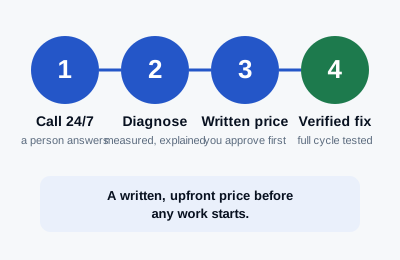
- You call. A person answers the 24/7 dispatch line. We ask what the system is doing, how old it is, and whether anything unusual happened first, such as a storm, a power surge or a flood.
- We schedule the visit. We offer 24/7 emergency HVAC service, with same-day response available based on location and technician availability. We do not promise an arrival time, because location, traffic and technician availability change from day to day, and we would rather say that honestly than promise a window we cannot keep.
- We look at the system. The technician checks the thermostat, electrical supply, airflow, coils, drain and refrigerant side, and tells you what they find in plain language.
- You get the options in writing. Before any work starts, you get a written, upfront price. If repair and replacement are both realistic, we put the numbers side by side so you can compare them. We do not sell equipment a building does not need.
- We do the work and test it. After the repair, we confirm the system is actually cooling or heating properly rather than just running.
- We handle the permit question. If the job is a replacement, we address the permit with the right jurisdiction, city or county, as described above.
When to call
Some HVAC problems can wait for a normal appointment, and some cannot.
Call right away if:
- The system is not cooling at all during a hot, humid stretch, especially if someone in the home is elderly, very young or medically fragile.
- You smell burning or see smoke or sparks from the unit or the air handler.
- The breaker trips repeatedly when the system starts.
- Water is pooling around the indoor unit or dripping from the ceiling.
- The unit was under water, or the ground around it was flooded. Keep it switched off until the electrical equipment has been inspected, as the city's guidance requires for flooded buildings.
- Lightning struck near the home and the system has stopped responding.
Book a visit soon if:
- The house is cooling, but slowly, or some rooms are noticeably warmer than others.
- The indoor air feels sticky even when the thermostat reads the right temperature. That points to a moisture problem, which is a concern in a hot-humid climate.
- The system runs almost constantly during the rainy season and still falls behind.
- The outdoor unit is noisy, or ice is forming on the lines.
Plan a maintenance visit when:
- You are heading into the long cooling season and the system has not been looked at in a year.
- You are buying a home and want an independent view of the equipment.
- You manage a rental and want to avoid emergency calls.
If you are unsure which category you are in, calling is a reasonable way to find out. We can talk through what you are seeing and tell you whether it needs immediate attention.
Repair or replace?
There is no single age at which every system should be replaced. We look at whether the failure is a minor, isolated part or a sign of a larger problem, how the system performs overall, and what the repair would cost compared with replacement. When replacement is the answer, the flood-elevation rules above can affect where the new equipment goes, along with the permit requirement.
Frequently Asked Questions
Why does my house feel clammy even though the AC is running?
Cooling air and removing moisture are two separate jobs, and in a humid summer the second one is easy to lose. Causes include a dirty evaporator coil, weak airflow, a blower speed that moves air too fast for the coil to pull moisture out, or a system that is too large for the house and shuts off before it has dried the air. A drain that is partly blocked can also leave water sitting in the pan. A technician can measure airflow and coil condition to tell these apart, which is more reliable than lowering the thermostat further.
What should I do while I wait for a technician if my outdoor unit sat in floodwater?
Leave the system off at the thermostat, and do not try to restart it to see whether it still works. If you can reach the breaker safely, switch the system's breaker off, but stay out of standing water around electrical equipment. Take photographs of the unit, the pad and any water lines on the walls before anything is moved, since you may want them for an insurance claim or when you talk to the city. Wet duct insulation and a submerged air handler generally cannot be dried in place, so expect the technician to look at those as well as the outdoor unit.
Can lightning damage an air conditioner without any visible sign?
Yes. A nearby strike or a power surge can damage a control board, capacitor or compressor without leaving a mark on the cabinet. The usual symptoms are a system that will not start, one that hums without running, or one that trips its breaker right away. Ask about surge protection for the outdoor unit if your area gets frequent storms.
What should I have ready when I call for AC repair?
It speeds things up to know what the system is doing and when it started, the age and brand if you can read them from the data plate on the outdoor unit, and whether the problem followed a storm, a power outage or a flood. Note whether the thermostat is blank, whether the indoor fan runs, and whether the outdoor unit is spinning. If you rent the property out, say so, along with whether a tenant will be there to give access. With that information, we can tell you whether the situation needs an urgent visit or can wait for a regular appointment.
For AC or heating service in Plant City, call Blume Mechanical Service at 727-330-9131.
HVAC Services in Plant City
Every service we offer in Plant City — each link covers scope, pricing factors, and scheduling.
AC Repair & Installation (Residential)
AC Repair & Installation (Commercial)
HVAC Repair & Installation (Residential)
HVAC Repair & Installation (Commercial)
HVAC Service Guides for Plant City Homeowners
Start with the symptom or service you need — every guide connects to the same 24/7 dispatch serving Plant City.
More: all HVAC services · commercial HVAC
Homeowner guides: AC troubleshooting · Florida AC maintenance checklist · how long AC units last here
Local resources
Official sites, including where to check permitting. A city issues permits for addresses inside its limits; the county covers unincorporated addresses.
HVAC Service in Plant City
Blume Mechanical Service provides comprehensive HVAC repair, maintenance, and installation for residents and businesses throughout Plant City, Hillsborough County. With 24/7 emergency response, licensed technicians, and a written, upfront price before any work starts, we're your trusted partner for all air conditioning and heating needs.
Why Choose Blume for Plant City HVAC Service?
✓ Licensed & Insured
Florida HVAC License #CAC-1822618
✓ 24/7 Emergency Service
Available anytime, day or night
✓ Same-Day Response
Available based on location and technician availability
✓ Written, Upfront Price
Before any work starts
Emergency AC Repair in Plant City
Your air conditioning stopped working? Our emergency HVAC team responds quickly to get your home or business comfortable again. Call us immediately at (727) 330-9131.
Call Now: (727) 330-9131Our HVAC Services
Air Conditioning Repair
AC unit diagnosis and repair services
Emergency AC Service
24/7 emergency HVAC response
Maintenance Plans
Preventative HVAC maintenance
Installation
New HVAC system installation
Other Cities in Hillsborough County
Hillsborough County · 24/7 dispatch
Need AC Repair in Plant City?
A person answers the 24/7 dispatch line, so call now. Same-day response is available based on location and technician availability.