
Why Is My AC Not Working?
Tampa Bay, Florida · Blume Mechanical Service · FL CAC-1822618
Understanding ac not working
"AC not working" covers two very different situations: the system won't power on or run at all (no fan, no hum, dead thermostat), versus the system runs but blows warm air and won't cool the house. Separating those two is the first diagnostic step, because a dead system usually points to power, a control, or a tripped safety, while a running-but-not-cooling system points to airflow, a dirty coil, drainage, or refrigerant. Most cases start with simple, homeowner-checkable causes before anything inside the sealed refrigerant circuit is involved.
Common causes, most likely first
- Thermostat setting or power — The thermostat may be off, set above room temperature, in the wrong mode, or have dead batteries so it never calls for cooling.
- Tripped breaker or blown fuse — Air conditioners draw heavy current, so a tripped circuit breaker or blown fuse can leave the system completely dead.
- Dirty or clogged air filter — A clogged filter sharply reduces airflow, making the system work harder, cool poorly, and in some cases freeze up.
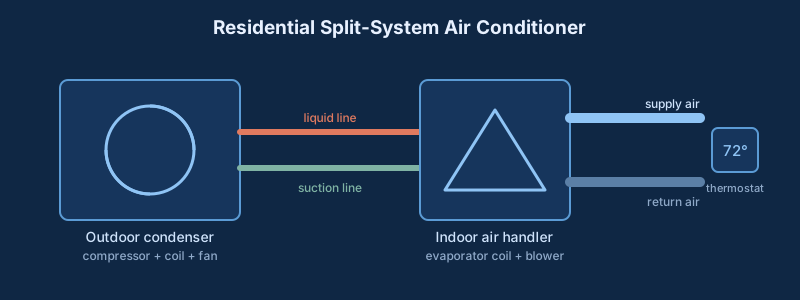
- Dirty evaporator or condenser coils — Dirt-covered coils reduce the system's ability to absorb and reject heat, so it runs longer while cooling less.
- Airflow / blower problems — Blocked returns, closed dampers, or a fouled blower restrict air movement and cut comfort and efficiency.
- Plugged condensate drain — A clogged condensate drain can back up water, trip a safety float switch, and shut the system down.
- Improper refrigerant charge or leak — Too little or too much refrigerant reduces cooling capacity and efficiency and must be handled by a technician.
- Faulty electrical controls or sensors — Failed contactors, capacitors, relays, or a misplaced thermostat sensor can stop the system or make it cycle wrong.
What to check, in order
- Confirm the thermostat is set to COOL and the setpoint is several degrees below the current room temperature; replace thermostat batteries if the display is blank.
- Check your electrical panel for a tripped AC breaker or blown fuse and reset it once; if it trips again, stop and call a technician.
- Inspect the air filter and replace it if it looks dirty (check monthly during heavy-use summer months, and change at least every 3 months).
- Make sure all supply registers and return grilles are open and unblocked by furniture, rugs, or curtains.
- Look at the outdoor condenser unit: clear leaves, grass, and debris away from the coil so air can move freely.
- Check the condensate drain line for standing water or clogs, which can trigger a safety shutoff.
- Look for ice on the refrigerant lines or indoor coil; if present, turn the system off (fan on) to let it thaw, since a frozen coil signals airflow or refrigerant issues.
What the numbers should read
| Reading | Normal range |
|---|---|
| Summer thermostat setpoint (comfort/efficiency reference) | About 78°F when home is a common efficiency guideline; set higher when away or asleep |
| Indoor relative humidity | Below 60% RH, ideally 30-50% |
| Air filter replacement interval | Inspect monthly; change at least every 3 months |
Ranges are general and vary by equipment; confirm against the unit’s own documentation before acting on them.
When to stop and call a licensed technician
Stop and call a licensed HVAC technician if the breaker trips repeatedly, if you see or suspect a refrigerant leak or low refrigerant, if the coil keeps freezing after a filter change, or if the problem is in the sealed refrigerant circuit or electrical controls (contactors, capacitors, wiring). Refrigerant handling and electrical repairs require proper training, tools, and licensing and are not safe DIY tasks.
In Tampa Bay specifically
In the Tampa Bay area's hot, humid climate, air conditioners run long hours and carry a heavy latent (humidity) load, so clogged condensate drains and iced-up coils are especially common; keeping indoor humidity below 60% is important for both comfort and mold control per EPA guidance. Coastal salt air can also accelerate corrosion on outdoor condenser coils and components, and summer hurricane-season storms and power fluctuations can trip breakers or damage electrical controls.
How a licensed technician diagnoses it
A licensed technician starts by confirming the thermostat is actually calling for cooling and that the low-voltage control signal is reaching the equipment, then checks the electrical supply and resets or investigates any tripped breaker rather than repeatedly forcing it back on. Next they inspect the outdoor unit's electrical components, using a meter to test the contactor and the run capacitor that start the compressor and fan motor, since a failed capacitor can leave the system humming, starting slowly, or not blowing cold air. They then measure the temperature difference between return and supply air and check refrigerant pressures with gauges, because low refrigerant from a leak drops pressure and can trigger a safety shutoff that protects the compressor. Finally they inspect the evaporator and condenser coils and overall airflow, looking for a clogged filter, a dirty or ice-covered coil, or a blocked condensate drain, all of which restrict cooling. This sequence isolates whether the fault is electrical, refrigerant-related, or an airflow problem before any repair is quoted.
Preventing it in the first place
- Inspect, clean, or change the air filter about once a month and replace it at least every three months, because a dirty filter slows airflow and forces the system to work harder (ENERGY STAR, Trane).
- Have a contractor clean the evaporator and condenser coils during service, since buildup on the coils reduces the system's ability to absorb and reject heat (ENERGY STAR, DOE).
- Keep the outdoor condenser clear of dirt, grass clippings, pollen, and vegetation, keeping plants roughly two feet away so airflow to the coil is not restricted (Trane).
- Keep the condensate drain clear by occasionally passing a stiff wire through the drain channels, preventing clogs that can back up water and shut the system down (DOE, Trane).
- Inspect the evaporator coil each year and straighten any bent coil fins with a fin comb so airflow across the coil is not obstructed (DOE).
- Schedule an annual pre-season professional tune-up in spring, during which the contractor checks the refrigerant level, tightens electrical connections, measures motor voltage and current, lubricates moving parts, and verifies thermostat operation (ENERGY STAR).
Frequently asked
My AC is running but only blowing warm air. What should I check first?
Confirm the thermostat is set to 'cool,' the fan is on 'AUTO' rather than 'ON' (the 'ON' setting circulates air even when the system is not cooling), and the target temperature is below the current room temperature. Replace the thermostat batteries if the screen is blank. Then check the air filter, since a clogged filter is a leading cause of poor cooling (Carrier, Trane).
I see ice on my AC's copper lines or coil. Is that dangerous?
Visible frost or ice usually means restricted airflow or a refrigerant problem. Turn the system off immediately to prevent damage to the compressor, and have a professional inspect it, since running a frozen system can cause costly failures (Carrier, Trane).
The breaker for my AC keeps tripping. Can I just keep resetting it?
No. If the breaker trips again immediately after you reset it, stop and contact a professional rather than repeatedly flipping it back on. A breaker that trips right away signals an electrical fault that needs to be diagnosed safely (Carrier).
Why does low refrigerant require a professional instead of a DIY top-off?
Low refrigerant is almost always caused by a leak, and handling refrigerant requires certified training and equipment. A technician must find and repair the leak, then properly recharge the system; simply adding refrigerant without fixing the leak does not solve the problem (Carrier, Trane).
How often should I have my air conditioner professionally serviced?
ENERGY STAR recommends an annual pre-season check-up, ideally in spring before cooling season. During this visit the contractor cleans coils, checks and adjusts the refrigerant charge, inspects electrical connections and the condensate drain, and verifies thermostat operation to keep the system running efficiently (ENERGY STAR).
Talk to a licensed Blume technician
For federal efficiency ratings and rebate eligibility we point homeowners to ENERGY STAR heating & cooling rather than making those claims ourselves.
Call (727) 330-9131Related HVAC Guides
Browse all HVAC guides · find your city