
AC Fan Not Working
Tampa Bay, Florida · Blume Mechanical Service · FL CAC-1822618
Understanding ac fan not working
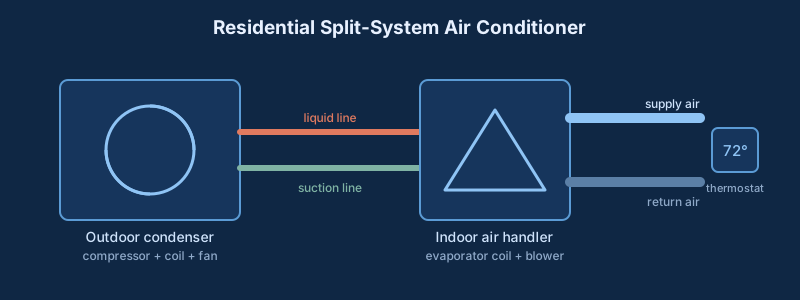
First identify which fan is dead: the outdoor condenser fan (on the big unit outside) or the indoor blower (inside the air handler or furnace). An outdoor fan that won't spin usually points to a failed run capacitor, a burnt-out fan motor, or a contactor problem, while an indoor blower that won't run usually traces to the thermostat fan setting, a control board, a blower motor, or a tripped safety from restricted airflow. The two share almost no parts, so the correct fix is completely different depending on which fan stopped.
Common causes, most likely first
- Failed run capacitor (outdoor) — The most common cause of a stalled condenser fan; the capacitor that energizes the fan motor loses its charge and the motor can hum but not turn.
- Burnt-out or seized fan motor (outdoor) — A condenser fan motor that fails to spin, or spins slowly, has usually worn out or overheated and needs replacement.
- Contactor or compressor fault (outdoor) — A malfunctioning contactor or a non-functioning compressor can stop the outdoor unit from operating altogether.
- Thermostat fan set to AUTO/OFF vs ON (indoor) — On AUTO the indoor blower only runs during an active cooling call, so what looks like a dead blower may just be a setting or no cooling demand.
- Restricted airflow / clogged filter (indoor) — A blocked filter restricts airflow and can trigger a safety shutdown or freeze the evaporator coil, seizing or stopping the blower.
- Frozen evaporator coil (indoor) — Ice on the coil can physically block the blower wheel or seize the motor until the system thaws.
- Broken fan blade or debris (outdoor) — A cracked or loose blade, or leaves and debris in the unit, can jam the fan; do not run it in this state.
- Control board or blower motor failure (indoor) — A failed control board or blower motor stops the indoor fan even when the thermostat is calling correctly.
What to check, in order
- Confirm the thermostat is set to COOL and, to test the indoor blower directly, switch the fan setting to ON — the blower should run continuously; if it does, the blower and control side are working.
- Check the main electrical panel and the disconnect box next to the outdoor unit for a tripped breaker, and reset once.
- Inspect the air filter; a clogged filter restricts airflow and can shut the system down, so replace it if dirty.
- Look (do not reach) into the outdoor unit for leaves, sticks, or debris around the fan blade, and clear obstructions only with the power off.
- Never stick a screwdriver, stick, or your hand into a running unit to 'help' the fan start — this is dangerous and can damage the motor.
- If the outdoor fan hums but doesn't turn, or the motor is hot, stop and call a licensed technician rather than repeatedly cycling power.
What the numbers should read
| Reading | Normal range |
|---|---|
| Air filter replacement interval | Inspect/clean or change monthly; replace at minimum every 3 months |
| Filter change during cooling season | Clean or replace every month or two when in constant use; a clean filter keeps airflow up and the system running efficiently |
Ranges are general and vary by equipment; confirm against the unit’s own documentation before acting on them.
When to stop and call a licensed technician
Capacitor discharge, fan or blower motor replacement, contactor work, and any electrical testing require a licensed HVAC technician. Capacitors hold a high-voltage charge even after power is off — OSHA requires that stored capacitor energy be discharged before servicing because it can endanger personnel — so a homeowner should never open or handle them.
In Tampa Bay specifically
In a hot climate, a stalled outdoor condenser fan is urgent: running the system without a working fan causes the compressor to overheat and the coil to freeze, leading to expensive damage, so shut the system off until it is serviced.
How a licensed technician diagnoses it
A technician first confirms which fan is dead: the outdoor condenser fan or the indoor blower. A common test is the run capacitor, since Carrier notes that a fan humming but not spinning has likely lost its capacitor; the tech checks it with a meter and inspects the contactor and wiring that feed the motor. They also spin the fan by hand to feel for a seized bearing and check the motor windings, and for a stalled indoor blower they verify the control board and its signal. Capacitors are dangerous even after the power is off: OSHA requires them to be discharged because the stored charge can pass through a person, so only a trained AC technician should handle them.
Preventing it in the first place
- Keep the outdoor condenser unit clear: the U.S. Department of Energy advises removing debris and trimming foliage back at least two feet so the fan has adequate airflow (DOE).
- Inspect, clean, or change the air filter about once a month, and at least every few months, since ENERGY STAR notes a dirty filter forces the system to work harder and can lead to early equipment failure (ENERGY STAR).
- Have a qualified contractor tighten all electrical connections and measure voltage and current on the motors during annual service, per the ENERGY STAR maintenance checklist (ENERGY STAR).
- Have the contractor lubricate all moving parts during the seasonal tune-up, as listed on the ENERGY STAR checklist (ENERGY STAR).
- Have the evaporator and condenser coils cleaned and the blower components cleaned and adjusted for proper airflow, which ENERGY STAR includes in its cooling maintenance list (ENERGY STAR).
- Schedule professional service ahead of the cooling season; ENERGY STAR and DOE recommend a spring checkup of the cooling system so problems are caught before peak use (ENERGY STAR).
Frequently asked
Can I keep running my AC if the outdoor fan isn't spinning?
No. Carrier warns that running the AC without the fan causes the compressor to overheat and the coils to freeze, leading to expensive damage, and advises turning the system off immediately (Carrier).
My fan hums but won't turn. What does that usually mean?
Carrier states that if the AC fan is not spinning but making a humming noise, the capacitor has likely failed (Carrier).
Why shouldn't I try to test or replace the capacitor myself?
A capacitor holds a charge after the power is off; OSHA requires capacitors to be discharged because the stored energy can pass through a person, and only a trained AC service technician should handle them (OSHA, Carrier).
The indoor air handler runs but the outdoor unit doesn't. Is that the same problem?
Not necessarily. The outdoor condenser fan and the indoor blower are separate motors with separate controls, so a technician diagnoses each independently before deciding what failed (Carrier).
Can regular maintenance help prevent fan and motor failures?
Yes. ENERGY STAR's maintenance checklist includes tightening electrical connections, measuring motor voltage and current, and lubricating moving parts during annual service, which help the system run reliably (ENERGY STAR).
Talk to a licensed Blume technician
For federal efficiency ratings and rebate eligibility we point homeowners to ENERGY STAR heating & cooling rather than making those claims ourselves.
Call (727) 330-9131Related HVAC Guides
Browse all HVAC guides · find your city