
AC Blowing Warm Air
Tampa Bay, Florida · Blume Mechanical Service · FL CAC-1822618
Understanding ac blowing warm air
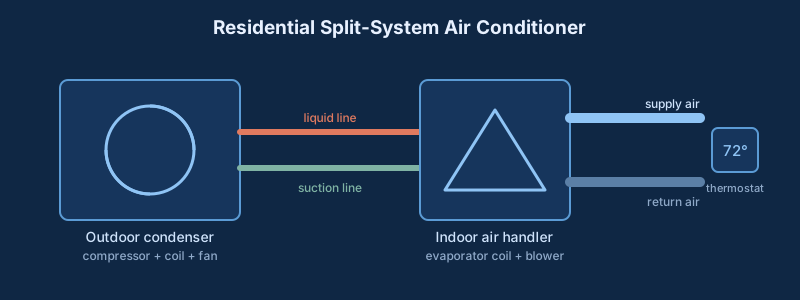
Warm air from the vents almost always means one stage of the cooling cycle has stalled: either the system isn't actually running the compressor, or it's running but can't move heat. The most common non-mechanical cause is a thermostat left on 'fan ON' (the blower circulates unconditioned air between cooling cycles). Mechanical causes include a tripped breaker at the outdoor condenser, restricted airflow from a clogged filter, a frozen indoor (evaporator) coil, a dirty outdoor condenser coil, or low refrigerant from a leak.
Common causes, most likely first
- Thermostat fan set to ON, not AUTO — With the fan on ON, the blower runs continuously and pushes room-temperature air through the vents whenever the compressor is between cycles, which feels like warm air.
- Tripped breaker or lost power to the outdoor unit — If the indoor blower runs but the outdoor condenser is off, no heat is being rejected and only unconditioned air circulates.
- Clogged air filter restricting airflow — Dirty, clogged filters reduce airflow and system efficiency and can starve the coil enough to hurt cooling.
- Frozen evaporator coil — Restricted airflow or low refrigerant can drop coil temperature below freezing so ice blocks airflow, leaving the air warm and often accompanied by a stopped or weak airstream.
- Dirty outdoor condenser coil — Dirt on the condenser coil reduces the system's ability to shed heat, so it runs longer and delivers warmer air.
- Low refrigerant from a leak — Too little refrigerant makes the system less efficient and unable to absorb heat; because refrigerant is not consumed, low charge signals a leak that a technician must find and repair.
What to check, in order
- Set the thermostat to COOL and the fan to AUTO (not ON), then lower the setpoint several degrees below room temperature and listen for the outdoor unit to start.
- Check the electrical panel for a tripped breaker serving the air handler and the outdoor condenser; reset once if tripped.
- Inspect the air filter and replace it if it is dirty or clogged, since restricted airflow reduces cooling and can freeze the coil.
- Look at the indoor coil / refrigerant lines for ice or frost; if present, shut the system off and let it fully thaw before running again.
- Confirm the outdoor unit's fan is spinning and the coil fins are not caked with grass, leaves, or dirt; clear debris and gently rinse fins with a garden hose on a low setting.
- Make sure supply and return vents are open and unobstructed so the system has adequate airflow.
What the numbers should read
| Reading | Normal range |
|---|---|
| Air filter replacement interval | inspect, clean, or change monthly during the cooling season; at a minimum change every 3 months (more often with constant use, dusty conditions, or pets) |
Ranges are general and vary by equipment; confirm against the unit’s own documentation before acting on them.
When to stop and call a licensed technician
Anything involving refrigerant (a small temperature split, ice on the lines, or suspected leak) requires an EPA Section 608-certified technician, because handling and recharging refrigerant is regulated and low charge means a leak that must be located and repaired, not simply topped off. Electrical faults beyond a single breaker reset, a condenser that won't start, or a repeatedly freezing coil also warrant a licensed HVAC professional.
In Tampa Bay specifically
In Florida's hot, humid climate, air conditioners run in near-constant use for much of the year, and the Department of Energy notes that systems in constant use or dusty conditions need filters checked and replaced more frequently than the typical every-1-2-month guidance.
How a licensed technician diagnoses it
The technician first confirms whether the outdoor unit and compressor are actually running, since warm air often means the outdoor half of the system has stopped while the indoor blower keeps moving air. They check the outdoor disconnect, breaker, contactor, and start/run capacitor, because a failure there prevents the condenser from operating. Next they measure the temperature split between the return air and the supply air at the vents to gauge whether the system is removing heat at all. If cooling is weak, they connect gauges and evaluate the refrigerant charge using superheat and subcooling readings, since both an undercharge (often from a leak) and reduced airflow show up here. Finally they inspect the evaporator coil and filter for ice or dirt, because a frozen or blocked coil chokes airflow and produces warm output until it is corrected.
Preventing it in the first place
- Inspect the air filter every month during heavy cooling season and replace it when it looks dirty, since a clogged filter restricts airflow and reduces cooling capacity (ENERGY STAR).
- Keep return grilles and supply vents clear of furniture, rugs, and debris so air can move freely across the evaporator coil and the coil is less likely to ice over (DOE).
- Have a qualified contractor clean the evaporator and condenser coils, because dirt on the coils reduces the system's ability to absorb and reject heat and forces longer run times (ENERGY STAR, DOE).
- Keep the outdoor condenser unit clear of leaves, grass clippings, and vegetation so the coil can shed heat properly (DOE).
- Have a professional straighten bent condenser and evaporator coil fins with a fin comb during maintenance to restore airflow across the coil (DOE).
- Schedule professional maintenance in the spring, including a refrigerant-charge check, so charge and controls are verified before the peak cooling season (ENERGY STAR).
Frequently asked
Why is my AC running but only blowing warm air?
A common reason is that the indoor blower is still moving air while the outdoor condenser or compressor has stopped, so no heat is being removed. Problems with the outdoor filters, coils, fins, or refrigerant lines all reduce the system's ability to cool, which is why the Department of Energy stresses keeping those components maintained (DOE).
Can a dirty air filter make my AC blow warm?
Yes. A dirty, clogged filter reduces airflow and system efficiency, and that restricted airflow can let the evaporator coil get cold enough to frost or freeze, which chokes off cooling until the coil thaws and the filter is replaced (DOE).
If I think my AC is low on refrigerant, can I just add more myself?
No. Adding refrigerant requires connecting gauges and handling refrigerant, and EPA regulations under Section 608 of the Clean Air Act require that technicians who service equipment that could release refrigerant be certified. Low charge usually means a leak that should be found and repaired rather than simply topped off (EPA).
Should I keep running the system if the coil looks frozen?
Continuing to run a system with a frozen coil worsens the airflow blockage and can keep it blowing warm. Because ice on the coil is typically driven by restricted airflow or a refrigerant issue, the fix is to restore airflow and have the underlying cause checked; the DOE notes both dirty coils and clogged filters undermine heat absorption (DOE).
Does my thermostat setting affect whether the air feels warm?
It can, especially if the fan is set to 'on' instead of 'auto,' because the blower then keeps circulating air even during periods when the system is not actively cooling, so the air at the vents feels warmer. Adjusting setpoints so the system is not overworked is part of efficient operation described by ENERGY STAR (ENERGY STAR).
Talk to a licensed Blume technician
For federal efficiency ratings and rebate eligibility we point homeowners to ENERGY STAR heating & cooling rather than making those claims ourselves.
Call (727) 330-9131Related HVAC Guides
Browse all HVAC guides · find your city