
AC Compressor Not Working
Tampa Bay, Florida · Blume Mechanical Service · FL CAC-1822618
Understanding ac compressor not working
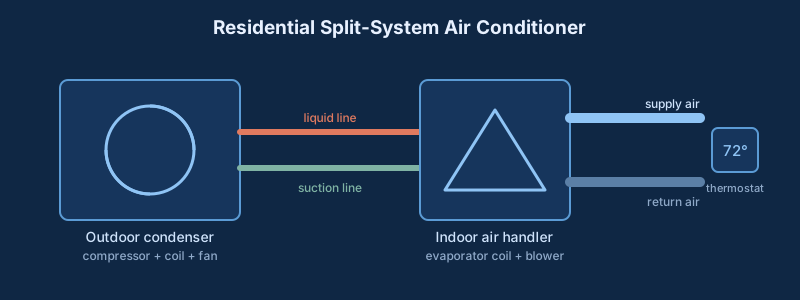
The compressor is the heart of your air conditioner, pressurizing refrigerant so the system can move heat out of your home; when it won't start, the cause ranges from cheap and simple to serious and expensive. A humming outdoor unit whose fan and compressor won't spin frequently points to a failed start/run capacitor, one of the least costly parts, rather than the compressor itself. Because most compressor diagnosis involves lethal-voltage components and sealed refrigerant systems, this is largely professional territory, but a few safe checks can rule out the simplest causes first.
Common causes, most likely first
- Failed start/run capacitor — The most common and cheapest culprit; the capacitor delivers the jolt the motor needs to start, and when it fails the compressor often just hums without spinning.
- Bad contactor — The electrical relay that switches power to the compressor can pit or stick, so the unit clicks or does nothing when it should turn on.
- Tripped breaker or blown fuse — A tripped breaker or the fuses in the outdoor disconnect can cut power to the condenser entirely.
- Thermostat or control issue — A thermostat set wrong, with dead batteries, or a wiring/control-board fault may never send the call for cooling.
- Failed hard-start components — On systems with a hard-start kit, a failed start capacitor or potential relay can stop an aging compressor from getting over its starting hump.
- Overheating / thermal overload — A compressor that runs hot can trip its internal overload and refuse to restart until it cools, often signaling a deeper electrical or refrigerant problem.
- Seized or electrically failed compressor — The worst case: internal mechanical seizure or a shorted/open winding, which usually means compressor or system replacement.
What to check, in order
- Check your electrical panel for a tripped breaker to the AC and reset it once; if it trips again immediately, stop and call a pro.
- Confirm the thermostat is set to COOL and several degrees below room temperature, and replace the batteries if it is blank.
- Check the outdoor disconnect box (the pull-out switch near the condenser) is fully seated, without touching internal wiring.
- Replace a clogged indoor air filter, which can cause pressure and overheating cut-outs.
- Listen at the outdoor unit: a steady hum with no fan or compressor motion is a classic failed-capacitor sign to report to your technician.
- Give the unit time: a compressor on thermal overload may restart after cooling for a while, but repeated cut-outs need service.
- Do NOT open the electrical access panel or test/discharge capacitors yourself; that is not a homeowner-safe step.
What the numbers should read
| Reading | Normal range |
|---|---|
| Typical annual compressor run-time, hot-humid climate (36,000 Btu/h unit) | About 1,705 hours per year under federal test methods, versus about 1,599 hours nationally |
Ranges are general and vary by equipment; confirm against the unit’s own documentation before acting on them.
When to stop and call a licensed technician
Most compressor diagnosis requires a licensed HVAC technician. Capacitors store a lethal electrical charge even after the power is off, and contactor, hard-start, sealed-refrigerant, and compressor-winding work all demand professional tools and training. The practical fork is this: a unit that hums but won't start is often a failed capacitor a technician can test and replace relatively inexpensively, whereas a compressor that is mechanically seized or electrically shorted may mean replacing the compressor, or the whole system if it is older. A qualified tech can tell the two apart safely; guessing at the panel can be dangerous and can turn a cheap fix into an expensive one.
In Tampa Bay specifically
Florida's hot, humid climate drives some of the longest AC run-times in the country; U.S. Department of Energy federal test data assumes a central AC in a hot-humid climate runs about 1,705 hours per year versus roughly 1,599 hours nationally, and real Florida use is often higher, which adds cumulative stress to compressors and their start components.
How a licensed technician diagnoses it
A technician first cuts power at the disconnect and treats the unit as live, because the run capacitor can hold a dangerous stored charge that must be safely discharged before any component is touched. With the capacitor and contactor confirmed dead, the tech tests those first, since a failed capacitor or pitted contactor is a common, less-costly cause of a compressor that hums but will not start; hard-start components are checked next to see whether the motor simply needs help getting off the line. If the compressor still will not turn, the tech measures the motor windings with a meter, looking for an open winding, a shorted winding, or a winding shorted to ground, and listens for a locked rotor that trips on start. Findings drive the decision: a bad capacitor, contactor, or hard-start part is a straightforward repair, while an electrically failed or seized compressor is a major component that pushes the choice toward compressor replacement versus replacing the whole system, weighed against the age and overall condition of the equipment. Because servicing exposes stored electrical energy, this diagnosis is work for a qualified technician, not a homeowner.
Preventing it in the first place
- Schedule annual professional maintenance so a qualified contractor can inspect electrical connections, controls, and the refrigerant system before small faults grow into compressor damage (DOE).
- Replace or clean the air filter regularly during the cooling season, since a clogged filter restricts airflow, forces the system to run longer, and shortens equipment life (DOE).
- Keep the indoor evaporator and outdoor condenser coils clean, because dirty coils reduce the system's ability to shed heat and make it run harder for longer periods (ENERGY STAR, DOE).
- Keep the outdoor condenser unit clear of leaves, grass clippings, and debris so it has adequate airflow to reject heat efficiently (DOE).
- Have the refrigerant charge verified and leaks addressed by a qualified technician, since an incorrect charge reduces efficiency and stresses the system (DOE).
- Address failing capacitor, contactor, or other electrical issues promptly during a service visit, as these controls directly affect whether the compressor starts and runs correctly (ENERGY STAR).
Frequently asked
Is it worth replacing just the compressor, or the whole system?
It depends on the age and overall condition of the equipment. A compressor is a major component, so a technician weighs its cost and the remaining life of the system against installing new equipment; an older or already-inefficient system often favors full replacement, while a newer unit may justify a compressor repair. A qualified contractor should assess the specific unit before you decide (DOE).
My compressor hums but won't start — is that always a dead compressor?
Not necessarily. A compressor that hums or buzzes without starting is frequently caused by a failed run capacitor, a worn contactor, or a missing hard-start assist rather than the compressor itself. A technician tests those relatively inexpensive parts before concluding the compressor has failed (ENERGY STAR).
Can I open the outdoor unit and check the capacitor myself?
No. The capacitor can store a dangerous electrical charge even after power is switched off, and it must be safely discharged by someone trained to do so before any part is handled. This work should be left to a qualified technician (OSHA).
Could poor maintenance be why my compressor failed?
It can contribute. Dirty coils, restricted airflow from a clogged filter, a blocked condenser, or an incorrect refrigerant charge all make the system run longer and harder, which reduces equipment life over time. Regular maintenance is intended to prevent that added strain (DOE, ENERGY STAR).
How often should the system be serviced to protect the compressor?
Have a qualified contractor perform maintenance annually, and clean or replace the filter every month or two during the cooling season. Refrigerant charge is typically verified periodically or whenever there is evidence of a leak (DOE).
Talk to a licensed Blume technician
For federal efficiency ratings and rebate eligibility we point homeowners to ENERGY STAR heating & cooling rather than making those claims ourselves.
Call (727) 330-9131Related HVAC Guides
Browse all HVAC guides · find your city