
HVAC, explained
AC Condenser: What the Outdoor Unit Does and How It Fails
An AC condenser is the outdoor unit of a central air conditioner or heat pump, and its job is to release the heat the system collected inside your house into the outdoor air. Our reading of the documents below: four kinds of trouble recur. They are blocked airflow, worn electrical or moving parts, a failed compressor or refrigerant leak, and corrosion. The Department of Energy's Building America guideline lists four conditions that point toward replacing the outdoor unit, and says a contractor should assess replacing only the compressor when it fails. Our reading: before you accept the word condenser in a quote, ask which part failed and which part the quote replaces.
This page reports what public agencies and equipment makers have published, and it reports no Blume field measurement. The page gives no repair, cleaning or testing steps, because opening the outdoor cabinet is work for a licensed contractor.
Condenser, condensing unit, outdoor unit: one box, three names
Carrier defines an AC condenser unit as the outdoor component of a central air conditioning or heat pump system. The University of Florida's UF/IFAS Extension gives a shorter definition: the condenser is the outdoor unit that keeps the refrigerant cool. Refrigerant is the fluid that picks up heat indoors and carries it outside. EPA uses a more exact name, the condensing unit, and says it contains the condenser coil and the compressor. The condenser coil is the bundle of metal tubes and thin fins where the refrigerant gives up its heat, and the compressor is the pump that pushes refrigerant around the loop. Carrier's FAQ separates the two directly: the compressor is a pump inside the unit, and the condenser is the overall unit, including the coils and fan. Our reading: the word condenser is used for the coil and for the whole unit, so the word alone does not tell you which part a quote means.
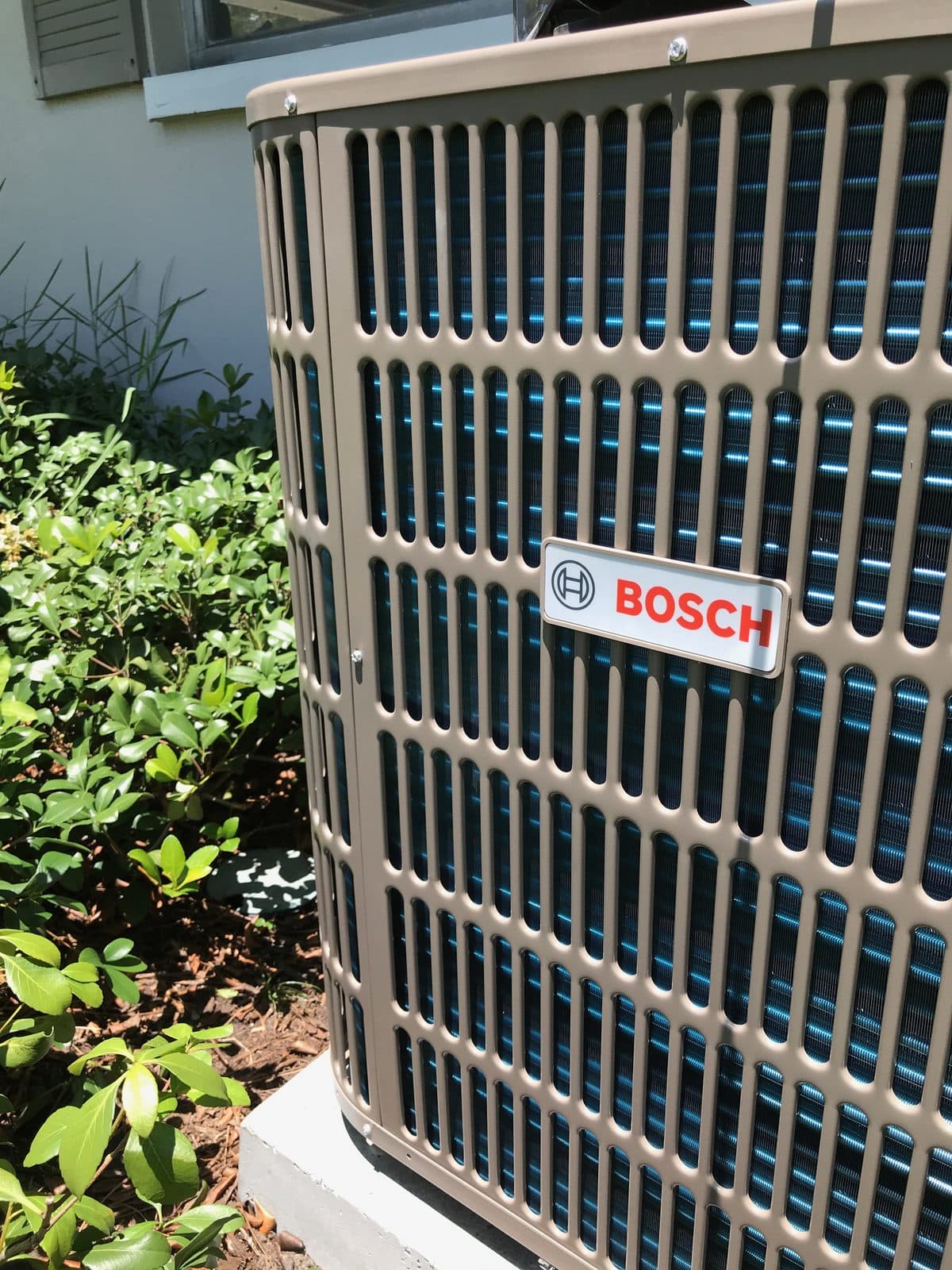
In Carrier's description, the compressor pumps hot refrigerant gas into the condenser coils, and a fan blows outdoor air over them. As the refrigerant loses heat, it condenses from a gas into a liquid, and the cooled liquid flows back to the indoor coil to pick up more heat. Carrier adds that the process relies on airflow, which is why the unit sits outdoors and needs clearance from debris. A heat pump is a cooling system that can also move heat the other way, to warm the house in winter. Carrier says a heat pump acts like a standard AC condenser in summer. The photo at the top of this page shows a heat pump's outdoor unit. Central air conditioning system types shows how the outdoor unit pairs with a furnace or an air handler.
Four kinds of trouble an outdoor unit runs into
The first is blocked airflow. Carrier says dirt and debris on the coils block airflow, which reduces heat transfer and forces the system to work harder. It also says shrubs, fences or debris too close to the unit can trap heat and make the system overheat. The Department of Energy's guideline lists condenser and evaporator fouling among the typical faults of an air conditioner's refrigerant system. Fouling means dirt and lint collecting on the coil surface. ENERGY STAR's maintenance checklist lists cleaning the condenser coil among the items for a contractor's check-up.
The second is worn electrical or moving parts. Carrier names the capacitor, relay switch and motor as parts whose failure can stop the fan or the compressor from running. A capacitor stores a small electrical charge that helps motors start, and a contactor is the switch that sends power to the outdoor unit. What these parts do, and why a licensed technician replaces them, is in AC capacitor and fan failures. Why your outdoor unit is loud covers the sounds these parts can make.
The third is a failed compressor or a refrigerant leak. Carrier says low refrigerant levels prevent the condenser from releasing enough heat, and that a professional must locate the leak, repair it and recharge the system. AC refrigerant leak repair explains how leaks are found and fixed.
The fourth is corrosion. Coastal coil protection explains how salt attacks the coil and when a coated coil is worth specifying, so this page covers the warranty side instead.
Room to breathe: clearance, mulch, the dryer vent and shade
The University of Florida's guidance says to follow the maker's recommended clearance distances to the letter, so that nothing blocks the unit's airflow. It adds that a clothes dryer should not vent within 10 feet of the outdoor unit, because lint clings to the condensing coil and lowers the system's efficiency and service life. Trane's landscaping page says to keep plants at least 2 to 3 feet from the unit on all sides, and to trim anything overhead to keep a 5-foot clearance. Trane also advises rock rather than shredded wood mulch or pine straw around the unit, because organic matter can get sucked in and create problems. Our reading: clearing plants and debris back from the unit is yard work, not equipment work, and the cabinet itself stays closed.
The Florida Solar Energy Center asked whether shading an outdoor unit helps, because shade might lower the temperature of the air entering the condensing unit. It ran before-and-after tests on three occupied Central Florida homes, each with an unshaded outdoor unit on the west side, using landscaping or a wooden trellis. Its measurements could not show a consistent reduction in cooling energy use, and its authors wrote that the risk of interrupting airflow to the condenser may outweigh shading considerations. The paper also warned that planting trees and shrubs close by a condenser may actually reduce system efficiency by getting in the way of air movement. As a long-term strategy, it suggested placing outdoor units in an unobstructed spot on the shaded north side of the building.
The tests ran in 1993 and 1994 on three homes on Merritt Island, Florida. Our reading: the tests are more than three decades old and from one island, so they are a caution about blocking airflow, not a measurement of your yard.
Salt air and the warranty fine print
Two maker documents give salt corrosion its own line: a 2012 Bryant warranty for standard air conditioner and heat pump condensing units, and a 2019 Carrier warranty for its coastal condensing units. Both define seacoast corrosion as corrosion on an outdoor unit that affects unit performance and is caused by repeated exposure to sodium chloride and other compounds commonly found in ocean water. Sodium chloride is table salt. Both add that corrosion on coils must exceed 3 inches above the bottom of the base pan of the unit. The base pan is the tray at the bottom of the unit's cabinet.
In the Bryant chart for owner-occupied homes, parts and the compressor carry a ten-year period for the original owner, or five years if the product was not registered within 90 days. Parts failure due to seacoast corrosion has its own row in that chart, at five years. The Carrier coastal document shows the same pattern, with ten-year parts and compressor periods and a five-year line for seacoast corrosion. Both list damage from corrosive environments, such as rust, and from seacoast corrosion in years 6 through 10, among the things the warranty does not cover. Both also say the warranty does not cover labor or other costs for diagnosing, repairing, removing or installing parts. UF/IFAS gives the same warning in plain terms: ask about warranties for labor and parts, because the warranty for parts often lasts longer than the one for labor.
Carrier's current coastal page says cosmetic corrosion does not constitute part failure, and it refers readers to the warranty certificate for each product's terms and limitations. Our reading: these two documents are from 2012 and 2019 and describe one maker's terms, so they show where to look, not what your unit's warranty says. Our reading: on a unit near salt water, read the corrosion, labor and registration terms in the warranty certificate before deciding between repair and replacement. How AC warranties work and transfer in Florida explains how a warranty passes to a new owner.
What a condenser problem means for repair or replacement
The Department of Energy's Building America guideline, dated March 2013, has a section on whether to repair or replace an air conditioner. It says that in some cases replacing the condensing unit and the indoor coil is necessary to restore proper function or to head off an impending equipment failure. It lists these other indications that the condensing unit should be replaced:
- The system is more than 15 years old.
- The condensing unit is oversized, from incorrect initial sizing or from reduced loads after improvements to the building enclosure.
- Compressor amps are higher than rated, or the compressor is noisy or failing.
- The condenser coil is damaged, with fins compressed or corroded.
The building enclosure means the walls, roof, windows and insulation, and amps measure how much electric current the compressor draws. Our reading: these are indications for a contractor to weigh, not rules, and the guideline dates from 2013. On the compressor, the guideline says that when one fails the contractor generally replaces the entire condensing unit, but should assess replacing only the compressor. The same guideline calls it typical to replace the evaporator coil, the indoor coil, at the same time as the condenser. The evaporator coil guide covers that coil.
EPA's FAQ says a homeowner can replace a faulty component, such as a condensing unit, with a similar R-410A component. It lists the factors to weigh when deciding between repair and a new system: availability of components, energy efficiency and total maintenance costs. Carrier's page recommends replacing the indoor and outdoor units together to ensure compatibility, maximum efficiency and valid warranty coverage. UF/IFAS gives a narrower rule: replace both units for maximum efficiency and reliability if the units do not match in age, refrigerant or efficiency. Our reading: EPA allows replacing only the outdoor unit, Carrier leans toward replacing both, and neither knows your system, so ask which job a quote is for. EPA's FAQ also says that its Significant New Alternatives Policy (SNAP) Program and industry standards prohibit flammable or mildly flammable refrigerants such as HFC-32 or R-454B in systems not designed to use them. Our reading: that is a reason to ask which refrigerant a replacement outdoor unit uses and whether it is built for your indoor coil. R-410A after 2025 covers what the federal rules allow for installing and repairing systems. AC repair or replace covers the wider decision, so this page stays with the outdoor unit.
What to ask and check before the outdoor unit is repaired or replaced
These questions turn the sources above into answers a contractor can give on paper.
- Which part failed, and how was it confirmed? Ask to see the part. AC capacitor and fan failures explains why one symptom can have several causes.
- Is the condenser coil damaged, and where? The Department of Energy lists compressed or corroded fins as one indication for replacing the unit.
- Is this a replacement of the outdoor unit only, or of the outdoor unit and the indoor coil together? Which refrigerant does the new unit use?
- What does the warranty certificate say about corrosion, labor and registration? Ask for a copy before you decide.
- Where will the unit sit, what clearance does the maker require on all sides, and is a dryer vent or mulch nearby? Heat pumps in Florida covers the outdoor unit's height, stands and anchors.
- Can I have your Florida contractor license number in writing? The Florida Department of Business and Professional Regulation says that verifying a license takes the license number, the contractor's name or the business name.
Get each answer on paper in the proposal, because a spoken answer is hard to check later. The outdoor cabinet holds electrical and refrigerant parts, so leave it closed and call a licensed contractor.
Frequently asked
What does an AC condenser do?
It releases the heat your air conditioner collected inside the house into the outdoor air. Carrier says its primary purpose is to reject heat. Without it, Carrier says, the refrigerant would stay hot and the system would only circulate warm air.
Is the AC condenser the same as the compressor?
No. Carrier says the compressor is a pump inside the unit and the condenser is the overall unit. EPA's term, the condensing unit, covers the condenser coil and the compressor together.
Can I replace just the outdoor unit?
EPA says a homeowner can replace a faulty condensing unit with a similar R-410A component. Carrier recommends replacing indoor and outdoor units together, and UF/IFAS says to replace both if they do not match in age, refrigerant or efficiency. Our reading: ask your contractor which job the quote is for, and why.
Does shading my outdoor unit help?
At three Central Florida homes, the Florida Solar Energy Center could not show a consistent reduction in cooling energy use from shading. Its authors warned that the risk of interrupting airflow may outweigh shading. Our reading: keep the maker's clearance distances first.
Does a warranty cover salt corrosion on an outdoor unit?
It depends on the warranty. In two maker documents, parts failure due to seacoast corrosion has its own five-year line, corrosion on coils must exceed a stated threshold, and labor is not covered. Our reading: read your own unit's warranty certificate.
Do I need to call a pro for this?
Maybe. One part of keeping an outdoor unit healthy is genuinely yours: keep plants, fence panels, bags of mulch and anything else back from it so the fan has free air. That is the whole list. Opening the unit, touching the refrigerant side, or diagnosing a fan or compressor fault inside it is a licensed contractor's work.
Related
- Why your outdoor unit is loud
- Coastal coil protection
- AC Capacitor and Fan Failures: What the Parts
- The Evaporator Coil: Function, Cleaning and
- Heat Pumps in Florida, and What Salt Air Does
Blume Mechanical Service is a licensed commercial and residential HVAC contractor serving Florida's Tampa Bay region (CAC-1822618). Blume installs and services all major brands as a licensed contractor, and estimates on new systems and retrofits are no-cost.
Last updated: 2026-11-05
Sources: EPA, Frequent Questions on the Phasedown of Hydrofluorocarbons (updated September 14, 2026) · U.S. Department of Energy, Building America Measure Guideline: Air Conditioner Diagnostics, Maintenance, and Replacement (March 2013) · University of Florida, UF/IFAS Extension, Energy Efficient Homes: Air Conditioning (FCS3262/FY1026) · Florida Solar Energy Center, Measured Impacts of Air Conditioner Condenser Shading (ACEEE Summer Study on Energy Efficiency in Buildings, 2002 proceedings) · Bryant, Limited Warranty for Air Conditioner & Heat Pump Condensing Units, 39004DP492 (03/2012) · Carrier, Limited Warranty for Coastal Air Conditioner & Heat Pump Condensing Units with Puron (R-410A) Refrigerant, 49004DP194 (10/2019) · Carrier, Understanding Your AC Condenser Unit (page dated October 27, 2026), and Coastal Heating and Air · Trane, Landscaping Around Outdoor HVAC Units (published January 18, 2024) · ENERGY STAR, Maintenance Checklist · Florida Department of Business and Professional Regulation, Construction Industry