
HVAC, explained
AC Capacitor and Fan Failures: What the Parts Do and Who Should Replace Them
Changing an AC capacitor is work for a licensed HVAC technician, not a homeowner project. A capacitor is a small electrical part that helps the outdoor fan and compressor motors start and run. Federal workplace rules and manufacturers' warnings treat the charge it can hold as a hazard even after the power is off. A fan that is not turning also has several possible causes, and only measurements tell them apart. Set the thermostat to off, call a licensed contractor and use the questions below.
People search for how to change an AC capacitor or fix an AC fan when the outdoor unit stops in the middle of a Florida summer. This page explains what those parts do and why licensed professionals replace them. It gives no repair or testing steps, on purpose. The facts come from public documents: a federal workplace safety rule, manufacturers' service manuals, a Department of Energy guideline, a university course note and Florida law. They are not Blume field measurements.
What the capacitor and the condenser fan do
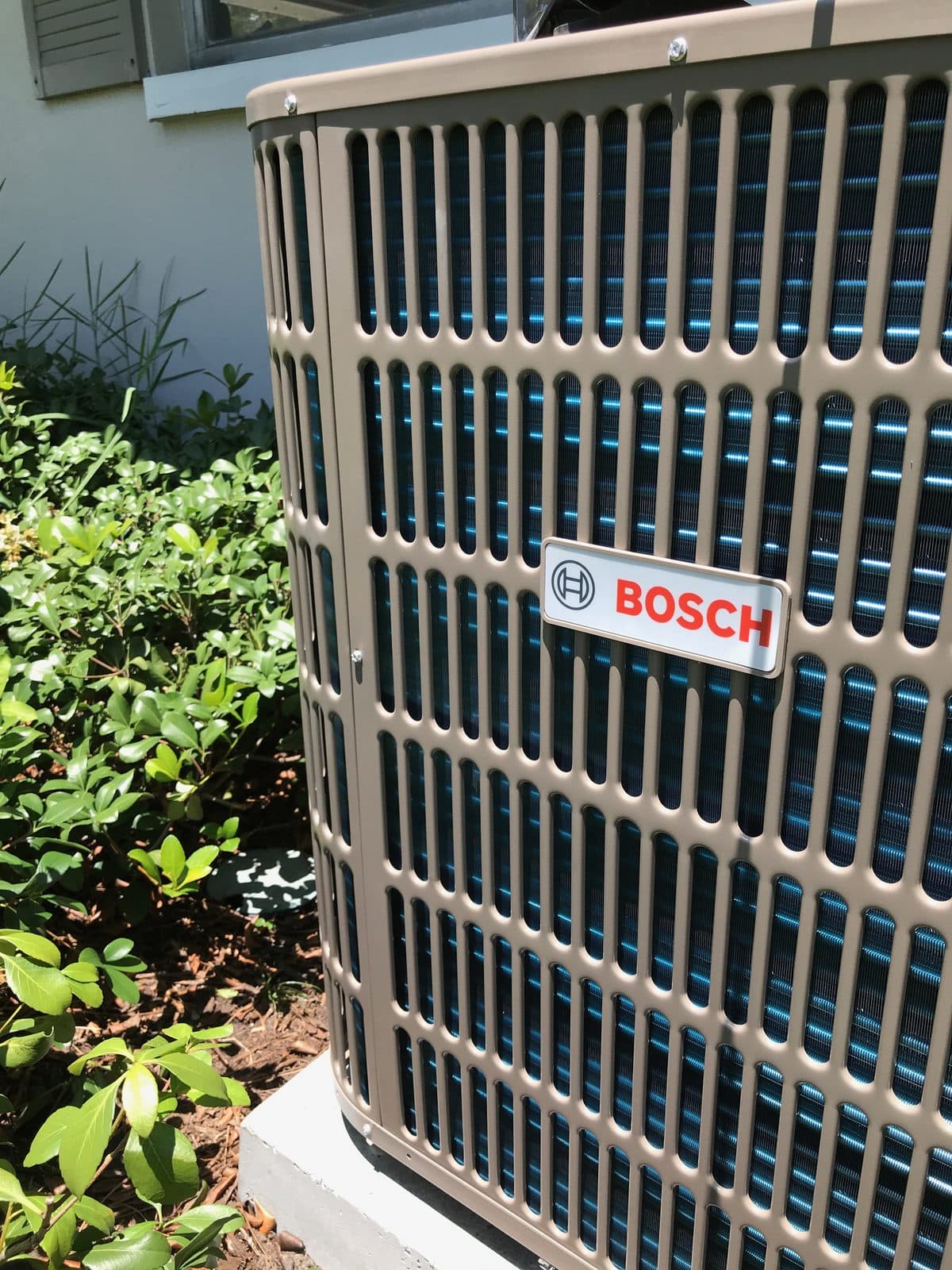
The outdoor unit of a central air conditioner holds the compressor, a large coil and a fan. The compressor is the pump that circulates the refrigerant. The condenser fan pulls outdoor air across the coil so the heat the system collected inside the house can leave.
Many home units are single-phase, and that creates a starting problem for their motors. A University of Utah course note on single-phase motors says a single phase of current cannot produce a rotating magnetic field. A rotating magnetic field is what pushes the motor shaft around. The note adds that the currents in the motor's two windings must differ in timing, or there is no net rotating field and no starting torque. A winding is a coil of wire inside the motor, and starting torque is the twisting force that gets the shaft turning from a stop. The note shows a capacitor wired in series with one winding to make that difference.
In plain terms, a capacitor stores electrical charge and releases it quickly. A motor run capacitor stays in the circuit while the motor runs. One manufacturer's catalog says its motor run capacitors are widely used with permanent split capacitor motors, which it says are used in heating and cooling equipment. Some units also have a separate start capacitor, and Rheem's service chart lists a run or start capacitor among its possible faults.
A dual capacitor puts two sections in one case, so one part can serve two motors. The same catalog's dual-rating tables give one rating in microfarads for the sealed compressor and one for the fan. A microfarad is the unit that measures how much charge a capacitor can store for a given voltage. The label on that maker's capacitors lists the capacitance in microfarads, the tolerance and the voltage rating. Tolerance is the amount a part's real value is allowed to differ from the number printed on it.
The contactor is a different part: the switch that sends power to the outdoor unit when the thermostat calls for cooling. AC noises decoded describes how a failing contactor can sound.
Why this electrical work belongs to a licensed professional
Our reading: none of the documents below gives a homeowner a procedure for working on a capacitor.
The first is a federal workplace rule from the Occupational Safety and Health Administration (OSHA), which covers employees, not homeowners. Its electrical work-practice rule requires the equipment to be disconnected from all electric energy sources. It then lists a separate step: stored electric energy that might endanger personnel must be released, and capacitors must be discharged. It adds that a capacitor handled in doing so counts as energized.
The second is a manufacturer's warning. Trane's installation instructions for a wiring kit on its Voyager units warn that failing to disconnect power and discharge capacitors before servicing could result in death or serious injury. Our reading: that manual covers a combustion blower wiring kit for gas-heat units, not a home condenser. The warning is cited only to show how a manufacturer treats motor start and run capacitors.
The third is who the manuals are written for. Rheem's heat pump installation manual says its instructions are an aid to qualified, licensed service personnel. Daikin Comfort's condensing unit manual says only personnel trained to service the equipment should service it. It adds that where the law requires a license to service the equipment, only licensed personnel should do it.
The fourth is Florida law. Florida Statutes section 489.105 defines the Class A air-conditioning contractor as one whose services are unlimited in the execution of contracts requiring the experience, knowledge and skill to install, maintain and repair central air-conditioning. Our reading: a warning that names stored charge, a rule that treats a handled capacitor as energized and manuals addressed to licensed people all point the same way. This page therefore gives no steps for opening the unit, testing the part or replacing it.
One symptom, many possible causes
A fan that is not turning, a unit that hums or an outdoor unit that never starts can each come from more than one part. Rheem's chart for its heat pump outdoor units lists five possible causes when the outdoor fan runs but the compressor does not. They are a defective run or start capacitor, a defective start relay, a loose connection, a compressor that is stuck, grounded or has an open winding, and a low-voltage condition. A start relay is a switch that helps the compressor start.
Daikin Comfort's analysis guide for condensing units has a column for "condenser fan will not start" and a list of more than 40 possible causes across all its columns. The list includes a shorted or open capacitor, a faulty compressor contactor, a faulty fan relay, a shorted or grounded fan motor and low voltage.
The Department of Energy's Building America guideline describes a measurement for the fan motor itself. It says measured amps significantly higher than nameplate can be used to detect a failing compressor or condenser fan motor, from motor winding or bearing failure. Amps measure the electric current a motor draws, and the nameplate is the label that lists the motor's rated values.
Our reading: a new capacitor can be the right fix, but it will not cure a fan motor that is failing for its own reasons. That is why the questions at the end ask what was measured. To compare the sounds a failing part can make, see AC noises decoded and why your outdoor unit is loud. For the checks a homeowner can safely make on a dead system, see AC not turning on.
A stopped fan: what it does and what to do
Rheem's chart lists "outdoor fan not running" as a possible cause of high head pressure. Its compressor-overheating chart also lists a faulty fan motor and a faulty fan blade among the causes of high head pressure. Head pressure is the pressure on the high side of the refrigerant circuit, which rises when the outdoor coil cannot shed heat. The Department of Energy guideline notes that when a compressor fails, the contractor generally replaces the entire condensing unit, though it says replacing only the compressor should be assessed. Our reading: a unit whose outdoor fan is not turning is working against itself. No document read says how long it can run that way, so this page gives no time limit.
While you wait, set the thermostat to off. Leave the outdoor unit closed: do not remove a panel, reach through the fan guard or try to spin the blade. Then call a licensed HVAC contractor. Our reading: switching the thermostat off does not make the outdoor unit safe to open. Rheem's chart warns that the contactor may break only one side, and that failing to shut off power can cause electrical shock resulting in personal injury or death.
Heat is a risk in itself. The National Weather Service lists young children and infants, older adults and people with chronic medical conditions among those particularly vulnerable to heat. It asks people to check in with friends and relatives in those groups, especially if they do not have air conditioning.
Why these parts fail, and what Tampa Bay adds
No document read for this page counts capacitor or fan failures by cause, region or season. So this page gives no Florida failure rate and no lifespan in years.
First, one manufacturer's catalog for motor run capacitors includes a chart of capacitor life against temperature and another against voltage. The same catalog lists an operating range of minus 40 to plus 70 degrees Celsius, which is 158 degrees Fahrenheit at the top. It also lists a rated operating life of 60,000 hours with 94 of every 100 parts surviving, under an industry test standard. Our reading: the charts show the maker treats heat and voltage as things that change a capacitor's life. Those ratings belong to one product line, not to the part in your yard.
Second, the Department of Energy guideline names capacitors, condenser fan motors, contactors and compressors among the faulty components behind low equipment reliability when maintenance is ignored. ENERGY STAR's maintenance checklist says a contractor's check-up should tighten all electrical connections and measure voltage and current on motors. It adds that faulty electrical connections can cause unsafe operation and reduce the life of major components.
Third, the National Weather Service Tampa Bay office dates the rainy season from May 25 to October 10 for West Central Florida outside the southwest. It describes almost daily showers and thunderstorms, with high temperatures in the upper 80s to middle 90s. Our reading: the outdoor unit works hardest in the same months it faces storm-related electrical events. AC surge protection in Florida covers that side, so this page does not repeat it.
What to ask the technician
These questions turn the sources above into answers a contractor can give on paper. They work for any contractor.
- Which part failed, and how did you confirm it? Ask to see the old part and the reading, next to the value printed on its label.
- What are the old and new ratings? Ask for the capacitance in microfarads and the voltage rating of each part, with model and part numbers, on the invoice.
- Was the fan motor's current draw compared with its nameplate? The Department of Energy guideline describes that check.
- What else did you inspect? Ask about the contactor, the wiring connections and the fan blade.
- What warranty applies to the part and to the labor? ENERGY STAR advises signing a written proposal before work starts that specifies project costs, model numbers, job schedule and warranty information. AC warranty transfer in Florida explains manufacturer warranties.
- What is your Florida license number? The Florida Department of Business and Professional Regulation (DBPR) says that to verify a license you need the license number, the contractor's name or the business name. You can search at MyFloridaLicense.com. ENERGY STAR also advises finding out the license and insurance requirements for contractors in your state.
Taking the readings and replacing the part are technician work. If the answers do not hold together, a second opinion on an AC repair is a normal step. Ask your local building department whether a repair like this needs a permit; HVAC permits in Florida explains why permits exist and who pulls them.
Frequently asked
Can I change an AC capacitor myself if I switch the breaker off?
No. This page gives no steps because the sources above show that disconnecting power is not enough. OSHA treats releasing stored energy as its own step, and Trane warns of death or serious injury if capacitors are not discharged. Call a licensed HVAC contractor.
My outdoor fan is not spinning. Is the capacitor bad?
Maybe. The charts above list a capacitor as one of many possible causes, so only measurements can tell which part failed. Set the thermostat to off and ask the questions above.
Is it safe to run the AC if the outdoor fan is not turning?
Our reading is no. Rheem's chart lists a stopped outdoor fan as a possible cause of high head pressure, and no document read gives a safe running time. Set the thermostat to off and call a licensed contractor.
How long does an AC capacitor last?
No document read gives a lifespan for installed capacitors. One manufacturer's catalog rates a line of motor run capacitors at 60,000 hours with 94 of every 100 surviving, under an industry test standard. That is a product rating, not a promise for a unit in a Tampa Bay yard. The label diagram in that catalog includes a manufacturing date code, so ask whether the old part carried one.
Do I need to call a pro for this?
Yes. A capacitor stores a charge after the power is off, which is what makes this one of the few parts on a home system that can injure someone who treats it like a battery. The part is inexpensive and the swap looks simple in a video; the discharge step is the part the video skips. This is a licensed contractor's job, and it is usually a same-visit repair.
Related
Blume Mechanical Service is a licensed commercial and residential HVAC contractor serving Florida's Tampa Bay region (CAC-1822618). Blume installs and services all major brands as a licensed contractor. Whichever contractor you call, ask the questions above.
Last updated: 2026-11-05
Sources: OSHA, 29 CFR 1910.333, Selection and use of work practices, paragraph (b)(2) (U.S. Department of Labor) · Trane, Combustion Blower Motor Wiring Kit, Gas Heat, installation instructions, RT-SVN17B-EN (04/20/2020) · Daikin Comfort, Condensing Unit Installation and Service Reference, IOD-4048C (12/2024) · Rheem, R-410A Heat Pump Outdoor Units Installation Instructions, RP13, RP14 and RP15, 92-105074-04-03 (8/15) · U.S. Department of Energy, Building America program (prepared for NREL), Measure Guideline: Air Conditioner Diagnostics, Maintenance, and Replacement (March 2013) · Regal-Beloit (Genteq), AC Capacitors for Motor Run Applications, catalog GTC-001 (last updated 02-17-2014) · University of Utah, ECE 3600 course notes, Single-Phase Induction Motors (2020) · Florida Statutes (2025), section 489.105, Definitions (Florida Senate) · Florida Department of Business and Professional Regulation, Construction Industry business information (contractor license verification) · ENERGY STAR, Maintenance Checklist · ENERGY STAR, 10 Tips for Hiring a Heating and Cooling Contractor · National Weather Service Tampa Bay Area, Florida Thunderstorm Season · National Weather Service, Heat Safety Tips and Resources