
Pinellas, Hillsborough and Pasco Counties · Florida CAC-1822618
Warehouse HVAC & Ventilation in Tampa Bay, Florida
Nationally, the federal Commercial Buildings Energy Consumption Survey found packaged air conditioners the most common cooling equipment in warehouse and storage buildings, with residential-type central air conditioners second. Rite-Hite notes that condensation can damage inventory, packaging and racking structures. Blume Mechanical Service services commercial HVAC in Pinellas, Hillsborough and Pasco Counties — Florida license CAC-1822618, fully insured.
Rite-Hite names open dock doors among the biggest sources of dock energy loss, and says that in summer heat and humidity move in.
Start with what the building holds and who works in it
"Warehouse" covers very different buildings. The federal Commercial Buildings Energy Consumption Survey splits the category into nonrefrigerated warehouses, distribution or shipping centers, public rental storage and refrigerated warehouses. It also finds that most warehouses are relatively small, though the idea of a warehouse may bring to mind a large building.
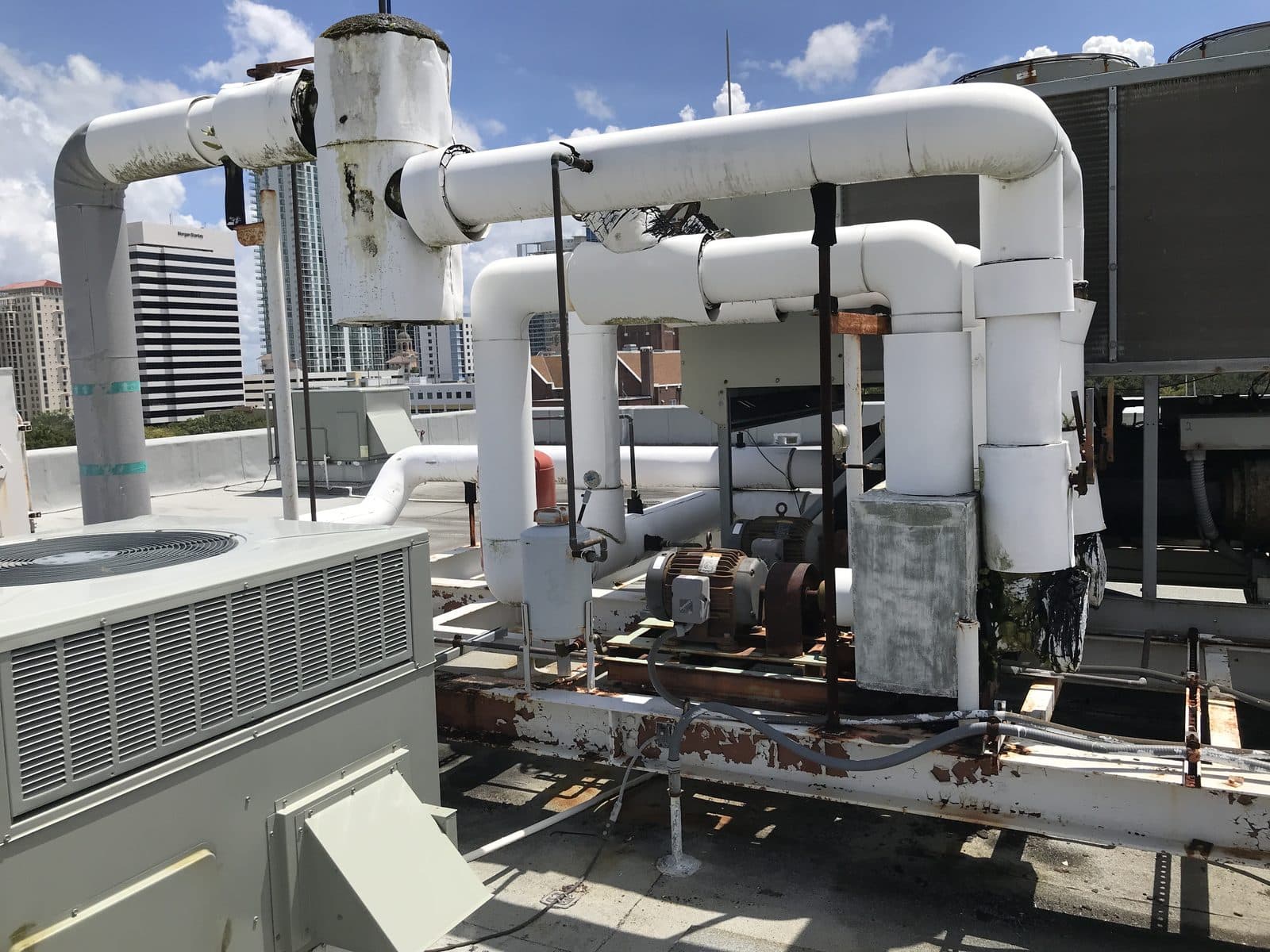
In that survey, packaged air conditioners were the most common cooling equipment in warehouse and storage buildings. Residential-type central air conditioners were the second-most-used cooling equipment. Individual space heaters were the most common heating equipment.
Which areas must be conditioned: the office, a pick-and-pack zone, a temperature-sensitive storage room, or the whole floor? Which areas only need air movement? What do the goods tolerate? Buildings kept well below room temperature for stored goods are their own specialty and are outside the scope of this page. For a tour of the equipment families, see our guide to industrial air conditioners.
In Florida, the dew point is the warehouse load
The Florida Climate Center at Florida State University reports summer dew points typically between 65 and 75 degrees in Florida, and generally in the high 60s or low 70s everywhere in the state. Coastal areas run a little more humid than inland central Florida. Dew point is the temperature air must be cooled to before it is saturated, and once air is saturated the excess moisture condenses out as dew.
The U.S. Environmental Protection Agency (EPA) puts it plainly: when warm, humid air contacts a cold surface, condensation may form.
Rite-Hite, a maker of warehouse fans and dock equipment, calls the floor version Sweating Slab Syndrome: moisture collecting on concrete. It names slipping hazards for workers and says moisture may compromise fork truck braking and turning. It adds that condensation can damage inventory, packaging and racking structures.
EPA notes that molds can grow on virtually any organic substance where moisture and oxygen are present, and that they gradually destroy the things they grow on. EPA says mold growth can be controlled indoors by controlling moisture indoors. Our page on commercial humidity control covers the diagnosis side in more depth.
Why swamp coolers and open doors work against a Tampa Bay warehouse
The Building America Solution Center at Pacific Northwest National Laboratory says evaporative coolers work best in dry climates where outdoor relative humidity during the cooling season is low. It also notes that, unlike standard air conditioning, direct evaporative coolers raise rather than lower the humidity in the air.
Rite-Hite calls the dock often the weakest link for air infiltration in an otherwise efficient building, and says that in summer heat and humidity move in. HVAC systems then run harder and longer. It says the biggest sources of dock energy loss are usually the trailer perimeter, the leveler area and open dock doors.
Rite-Hite says seals and shelters help minimize gaps around the trailer perimeter, and that air curtains can serve as a supplemental solution during active loading. Ontario's electricity system operator, in its warehouse guidance, adds the maintenance side: watch the weather stripping or cushioning around each bay opening so trucks seal up to the bay.
Moving air: fans, stratification and units that fight each other
Rite-Hite says high-volume, low-speed (HVLS) fans circulate trapped hot air from the ceiling down to the cooler air at floor level. It says the added air movement helps dissipate moisture and can reduce sweating slab conditions.
Layout matters. The same manufacturer notes that larger-diameter fans move air further down rack aisles. Smaller-diameter fans can be most effective in specific work areas or where installation space is limited, and each Rite-Hite HVLS fan has minimum overhead clearance requirements based on the fan's diameter. Rite-Hite also advises centering a fan in the light or sprinkler grid where possible.
Controls matter too. Ontario's warehouse guidance warns that HVAC systems are often set up separately with independent thermostats, so one area can be cooling while another is heating.
What service a warehouse HVAC system needs
EPA describes one function of a building's HVAC system as removing moisture from the air before the air is distributed.
EPA lists poorly draining condensate drain pans inside air handling units among the possible locations of hidden moisture, resulting in hidden mold growth. Uninsulated air conditioning duct can sweat, and EPA's fix for that condensation is to insulate the duct on the outside.
EPA links delayed or insufficient maintenance to moisture problems in large buildings. See commercial HVAC service agreement. For aging rooftop units, see rooftop unit replacement planning. If water is already on the floor under a unit, start with commercial AC leaking water.
Frequently asked
Can condensation damage warehouse inventory and racking?
Rite-Hite notes that condensation can damage inventory, packaging and racking structures.
Why is our warehouse floor wet on humid mornings?
EPA explains that when warm, humid air contacts a cold surface, condensation may form. Florida summer dew points typically run between 65 and 75 degrees, according to the Florida Climate Center. Rite-Hite says that at the dock, in summer, heat and humidity move in. Rite-Hite says the movement of air created by an HVLS fan can reduce sweating slab conditions.
Will an evaporative cooler work in a Tampa warehouse?
Pacific Northwest National Laboratory's Building America guidance says evaporative coolers work best in dry climates with low outdoor humidity during the cooling season. Direct evaporative coolers add moisture to the air rather than remove it.
Do HVLS fans replace air conditioning?
Rite-Hite, a fan manufacturer, says larger-diameter fans move air further down rack aisles and that HVLS fans increase air movement and help dissipate moisture. It says each Rite-Hite HVLS fan has minimum overhead clearance requirements based on the fan's diameter.
Do I need a contractor for this?
Maybe. Facility staff can replace filters, read and adjust setpoints and schedules on the thermostat or building automation front end, read and report alarms, and check condensate pans and drain lines for standing water or blockage. Refrigerant, electrical, gas heater and controls work, including sequences and control wiring, needs a licensed contractor.
Unit converter
Showing 1 therm in 4 other units
| Unit | Value |
|---|---|
| Btu | 100,000 |
| kWh | 29.31 |
| MMBtu | 0.1000 |
| Ccf (natural gas) | 0.9653 |
Used only for Ccf and therm conversions. Source: EIA, Heat Content of Natural Gas Consumed (U.S., 2025).
Sources: 1 therm = 100,000 Btu and 1 kWh = 3,412 Btu, from EIA. MMBtu from EIA. MBH from Wikipedia. 1 ton of refrigeration = 12,000 Btu/h from NIST. Ccf = 100 cubic feet from Wikipedia. — means no result for the current input.
Running a warehouse or distribution building in Tampa Bay? Request service from a licensed A/C contractor, and ask for the dock and the slab to be checked, not just the thermostat.
References: US Energy Information Administration — 2018 CBECS: Principal Building Activities, Warehouse and Storage · Florida Climate Center, Florida State University — Humidity in Florida · US Environmental Protection Agency — Mold Remediation in Schools and Commercial Buildings Guide: Chapter 1 · US Environmental Protection Agency — Mold Course Chapter 2 · Building America Solution Center, Pacific Northwest National Laboratory — Evaporative Cooling Systems · Rite-Hite (manufacturer) — How Sustainable Loading Dock Design Lowers Energy Costs · Rite-Hite (manufacturer) — Warehouse Ceiling Fan: HVLS Ceiling Fans · Save on Energy, Independent Electricity System Operator — How to make your warehouse more energy efficient