
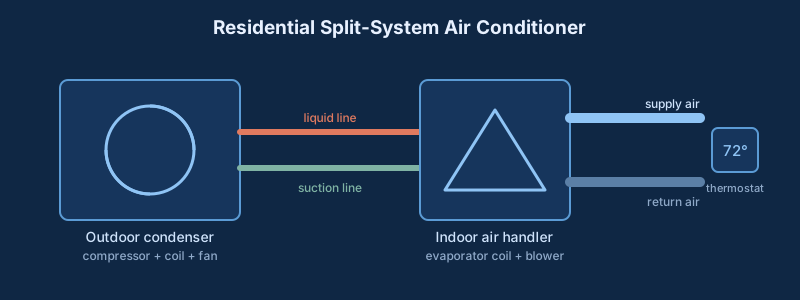
AC Tripping the Breaker: Causes & What's Safe
Tampa Bay, Florida · Blume Mechanical Service · FL CAC-1822618
Understanding ac tripping the breaker
When an air conditioner repeatedly trips its breaker, the breaker is doing its job: it senses a current or fault condition that could be dangerous and cuts power to protect the wiring and equipment. That is why a breaker that keeps tripping should never be wedged, taped, or repeatedly reset. A single reset is reasonable to rule out a one-time nuisance trip, but if it trips again, the system is signaling a real electrical or mechanical fault. Common causes include a dirty condenser coil making the compressor overheat, a failing capacitor, a shorted or grounded compressor, loose or corroded wiring, a weak or aged breaker, and low refrigerant that overloads the compressor. Most of these require a licensed technician, because they involve high voltage or sealed refrigerant components.
Common causes, most likely first
- Dirty condenser coil and overheating compressor — A coil caked with dirt cannot shed heat, so the compressor works harder, draws more current, and overheats until the breaker trips to protect it.
- Failing capacitor — A weak capacitor forces the compressor or fan motor to strain to start, spiking the current draw and tripping the breaker.
- Shorted or grounded compressor — If the compressor's electrical windings short internally or to ground, current surges instantly and the breaker trips to prevent a fire; this typically means major repair or replacement.
- Loose, corroded, or damaged wiring — Loose connections and corroded terminals create resistance, heat, and arcing that can trip the breaker and pose a genuine fire risk.
- Weak or aged breaker — Breakers themselves wear out and can trip below their rating after years of thermal cycling, though this is diagnosed only after real faults are ruled out.
- Low refrigerant overloading the system — Low charge from a leak makes the compressor run inefficiently and can contribute to overheating and higher current draw, which can lead to tripping.
- Restricted airflow from a clogged filter — Severely restricted airflow can make the system overwork and run hot, indirectly stressing the compressor and its electrical draw.
What to check, in order
- Reset the breaker a single time only. If it holds, monitor the system; if it trips again, stop and leave it off.
- Do not repeatedly reset the breaker, and never wedge, tape, or force it closed; a repeated trip is protecting you from a real fault.
- Check and replace a dirty air filter, since restricted airflow can make the system overwork and run hot.
- Make sure supply and return vents are open and unobstructed so the system has adequate airflow.
- Look at the outdoor condenser and gently clear grass, leaves, and dirt from the fins; a hose on a low setting can rinse loose debris.
- Note whether the breaker trips immediately on start or after the unit has run for a while, and share that timing with your technician.
- If you smell burning, see scorching at the panel, or the breaker trips instantly, leave the system off and call a licensed technician right away.
What the numbers should read
| Reading | Normal range |
|---|---|
| Compressor and fan-motor amperage draw | at or below the rated load amps (RLA) and full-load amps (FLA) on the unit nameplate; a draw above RLA indicates an overloaded or failing component |
| Compressor winding resistance and check to ground | measurable, balanced winding resistance with high resistance (effectively open) to the compressor housing; low resistance to ground confirms a shorted or grounded compressor |
| Run capacitor capacitance | within about plus or minus 6 percent of the microfarad value printed on the case; a low reading raises starting current and can trip the breaker |
| Condition of electrical connections and voltage drop across terminals | tight, clean connections with negligible voltage drop; a measurable drop or visible corrosion or arcing indicates loose or resistive wiring |
| Refrigerant charge (superheat and subcooling) | matches the manufacturer's target values for the metering device; a low charge from a leak makes the compressor run hot and overdraw |
Ranges are general and vary by equipment; confirm against the unit’s own documentation before acting on them.
When to stop and call a licensed technician
After a single reset, if the breaker trips again, stop and call a licensed HVAC technician. Repeated tripping points to a high-voltage fault such as a shorted compressor, damaged wiring, or a failing capacitor, or to a refrigerant problem, none of which are safe DIY work. Refrigerant handling in particular requires an EPA Section 608-certified technician. Never repeatedly reset or bypass a breaker to keep the unit running; doing so defeats a safety device and can create a fire hazard.
In Tampa Bay specifically
In the Tampa Bay area, condensers run hard through a long, hot season and their coils collect pollen, grass, and coastal grime, so overheating from a dirty outdoor coil is a frequent contributor to breaker trips here; keeping the coil clean genuinely helps.
How a licensed technician diagnoses it
A technician starts by noting when the breaker trips, because the timing narrows the cause: an instant trip suggests a dead short or grounded compressor, while a trip after minutes of running points toward overheating, high current draw, or a weak component. With power safely managed, they measure compressor and fan amperage against the nameplate to see whether a load is pulling too much current, and they check the compressor windings for resistance and for a short to ground, which would confirm a failed compressor. They test the run capacitor's capacitance, since a weak one spikes starting current, and inspect wiring and terminals for looseness, corrosion, and arcing. If the electrical side looks healthy, they evaluate refrigerant charge and airflow, because low charge or a dirty coil makes the system run hot and overdraw. Only after real faults are excluded do they consider a worn breaker itself.
Preventing it in the first place
- Keep the outdoor condenser coil clear of grass clippings, pollen, and debris so the compressor does not overheat and overdraw.
- Replace air filters on schedule so restricted airflow does not force the system to overwork.
- Schedule seasonal professional maintenance so a technician can measure current draw, test the capacitor, and tighten electrical connections before summer.
- Never repeatedly reset or bypass a tripping breaker; have the fault diagnosed instead.
- Have refrigerant charge verified during maintenance, since a slow leak can quietly push the system toward overload.
Frequently asked
Why does my AC keep tripping the breaker?
A breaker trips when it detects current or a fault that could be unsafe, so repeated tripping means something is wrong, not that the breaker is being fussy. Common causes include a dirty condenser coil making the compressor overheat, a failing capacitor spiking the starting current, a shorted or grounded compressor, loose or corroded wiring, low refrigerant overloading the system, and sometimes a worn breaker. Most of these involve high voltage or sealed refrigerant, so after one reset that trips again, the safe move is to leave the system off and call a licensed technician.
Is it safe to keep resetting the breaker?
No. The breaker is a safety device that cuts power when it senses a dangerous condition, so repeatedly resetting it, or wedging or taping it closed, defeats that protection and can create a real fire risk. A single reset is reasonable to rule out a one-time nuisance trip. But if it trips again, stop, leave it off, and have a licensed technician diagnose the cause. If you notice a burning smell, scorch marks at the panel, or an instant trip, do not reset it again at all and call a professional.
Can a dirty outdoor unit cause the breaker to trip?
Yes. When the condenser coil is caked with dirt, pollen, or grass, it cannot release heat efficiently, so the compressor runs hotter and draws more current to do the same work. Over time that elevated draw and heat can trip the breaker, usually after the unit has been running for a while rather than the instant it starts. Keeping the coil clean and the area around the unit clear genuinely reduces this strain, which is one reason routine maintenance matters in Florida's dusty, high-pollen, hot-running conditions.
Does a tripping breaker mean my compressor is bad?
Not necessarily. A shorted or grounded compressor is one cause and typically produces an instant trip, but many breaker trips come from lesser problems like a failing capacitor, a dirty coil, loose wiring, low refrigerant, or a worn breaker. Because the causes overlap, a technician diagnoses by timing the trip and measuring amperage draw, winding resistance, capacitance, and refrigerant charge to isolate the real fault. That is why guessing is risky: replacing the wrong part wastes money, and only measurement can distinguish a failed compressor from the more common and less serious causes.
Talk to a licensed Blume technician
For federal efficiency ratings and rebate eligibility we point homeowners to ENERGY STAR heating & cooling rather than making those claims ourselves.
Call (727) 330-9131Related HVAC Guides
Browse all HVAC guides · find your city