
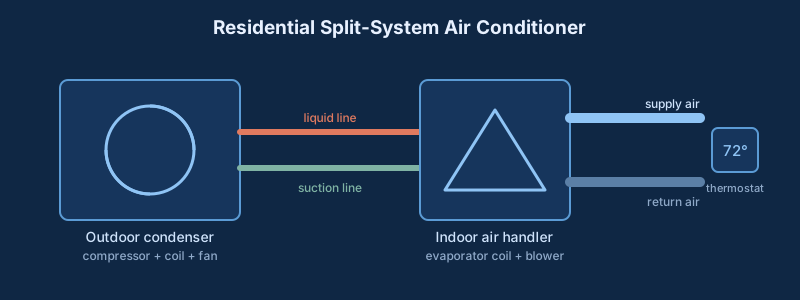
AC Runs Constantly But Never Cools: Why
Tampa Bay, Florida · Blume Mechanical Service · FL CAC-1822618
Understanding ac running constantly
An air conditioner that runs nonstop yet never reaches the setpoint is telling you that its cooling capacity no longer keeps up with the heat entering the house. Constant running is not the system trying harder in a healthy way; it usually means something is limiting how much heat it can move, so it never satisfies the thermostat and simply never shuts off. The common causes fall into three buckets: restricted heat exchange (dirty filter, dirty evaporator or condenser coil), lost capacity (low refrigerant from a leak, an aging or undersized system), and load or control problems (leaky ducts dumping cooled air, a thermostat issue, or an extreme outdoor heat load). Nonstop operation also wears the equipment, because the compressor and blower were never meant to run every minute of the day.
Common causes, most likely first
- Dirty filter or dirty coils restricting heat exchange — A clogged filter or dirt-caked evaporator and condenser coils choke the airflow and insulate the coils, so the system moves far less heat per hour. It keeps running because it can never remove heat fast enough to reach the setpoint.
- Low refrigerant from a leak — Too little refrigerant lowers the system's ability to absorb heat, so cooling output drops and run time climbs. Since refrigerant is not consumed, a low charge means a leak that a certified technician must find and repair.
- Undersized or aging system — A unit that is too small for the space, or an older system that has lost efficiency, may simply lack the capacity to overcome a hot day's heat load, so it runs continuously without ever catching up.
- Leaky or poorly insulated ductwork — Ducts that leak in a hot attic lose cooled air before it reaches the rooms and can pull in hot air, so the system runs constantly while much of its output never arrives where it is needed.
- Dirty outdoor condenser — When the outdoor coil is blocked by grass, leaves, or dirt, the system cannot reject the heat it collected. Run times stretch out because heat has nowhere to go, and cooling stays weak.
- Extreme outdoor heat load — During the hottest, most humid stretches, the heat entering the home can approach or exceed what a correctly sized system removes, so even a healthy unit runs nearly nonstop to hold a comfortable temperature.
- Thermostat problem — A miscalibrated thermostat, a bad sensor, or an unreachable setpoint can keep calling for cooling even when the room is comfortable, driving continuous operation.
What to check, in order
- Check the thermostat: set it to COOL with the fan on AUTO, and confirm the setpoint is realistic for the conditions rather than set far below room temperature.
- Inspect and replace the air filter if it is dirty, since a clogged filter is one of the most common reasons a system runs long and cools poorly.
- Look at the indoor coil and refrigerant lines for ice or frost; if present, turn the system OFF and let it fully thaw before running again.
- Go outside and clear the condenser of grass clippings, leaves, and debris, then gently rinse the fins with a garden hose on a low setting so the coil can shed heat.
- Make sure supply and return vents throughout the house are open and unobstructed by furniture or rugs.
- Feel a few supply vents to judge whether the air is cold but insufficient (a capacity or duct issue) or barely cool (which points toward coils, charge, or airflow).
- Close blinds on sun-facing windows and reduce indoor heat sources during peak heat to see whether the system can finally catch up under a lighter load.
What the numbers should read
| Reading | Normal range |
|---|---|
| Air filter replacement interval | inspect monthly during heavy cooling and change at least every 3 months, more often with constant running or dusty conditions |
| System sizing to the space | cooling capacity should be matched to the home's calculated load; an undersized unit runs continuously and never satisfies the thermostat on a hot day |
| Coil and condenser condition | evaporator and condenser coils should be clean so the system can absorb and reject heat; dirty coils force longer run times and weaker cooling |
Ranges are general and vary by equipment; confirm against the unit’s own documentation before acting on them.
When to stop and call a licensed technician
If the filter is clean, the vents are open, the condenser is clear, and the system still runs nonstop without reaching the setpoint, it is time for a licensed technician. Weak cooling that points to low refrigerant, a suspected leak, or a repeatedly freezing coil must be handled by an EPA Section 608-certified technician, because refrigerant is regulated and a low charge means a leak to locate and repair. A pro is also the right call for evaluating whether the system is undersized or aged out, for testing and sealing leaky ducts, and for a professional coil cleaning, all of which go beyond safe homeowner steps.
In Tampa Bay specifically
Florida's prolonged heat and humidity create one of the heaviest sustained cooling loads in the country, so systems here legitimately run long hours; the concern is a unit that runs every minute and still loses ground, which in this climate usually means dirty coils, a low charge, leaky attic ducts, or a system that has aged past its capacity.
How a licensed technician diagnoses it
The technician works from the easy, high-impact restrictions toward the harder faults. They first confirm airflow by checking the filter and the evaporator coil, since a dirty filter or coil is a leading cause of long run times, then inspect the condenser coil for dirt that would block heat rejection. They measure the temperature split between return and supply air to judge whether the system is removing heat at all, and connect gauges to evaluate the refrigerant charge using superheat and subcooling, which exposes an undercharge from a leak. If the equipment tests healthy, they turn to the load side: checking for duct leakage that wastes cooled air, verifying thermostat operation and sensing, and considering whether the system is undersized or aged for the space and climate. That sequence separates a maintenance issue from a capacity or duct problem.
Preventing it in the first place
- Inspect the filter monthly during heavy cooling and replace it when dirty, so restricted airflow does not force long run times and weak cooling (ENERGY STAR).
- Have a qualified contractor clean the evaporator and condenser coils during maintenance, because clean coils absorb and reject heat far better and shorten run times (ENERGY STAR, DOE).
- Keep the outdoor condenser clear of grass, leaves, and vegetation so the unit can shed the heat it collects (DOE).
- Have refrigerant charge verified during a professional visit so a slow leak is caught before it drags down cooling on the hottest days (ENERGY STAR).
- Have ductwork inspected and sealed where it leaks, and match any replacement system to the home's calculated load so it is neither undersized nor oversized (DOE).
Frequently asked
Why does my AC run constantly but never reach the set temperature?
Constant running with no satisfaction means the system's cooling capacity is not keeping up with the heat entering the house. The usual causes are a restricted or dirty filter and coils, a low refrigerant charge from a leak, leaky ducts that lose cooled air, or a system that is undersized or aged for the space. On the hottest days even a healthy unit runs long, but a unit that runs every minute and still loses ground has a fixable limit. Start with the filter and a clear condenser, then have a technician check charge, ducts, and capacity (DOE).
Is it bad for the AC to run all day?
Continuous operation is hard on the equipment because the compressor and blower were designed to cycle, not run every minute. Nonstop running usually signals that something is limiting cooling, whether dirty coils, low refrigerant, leaky ducts, or an undersized system, and that extra run time adds wear. In Florida's climate some long run times are normal on peak days, but a system that never shuts off and never reaches the setpoint should be checked. Keeping the filter clean and the coils serviced reduces run time and the strain that comes with it (DOE).
Can low refrigerant make the AC run constantly?
Yes. A low charge reduces how much heat the system can absorb, so cooling output falls and the unit runs longer and longer trying to reach the setpoint, sometimes freezing the indoor coil in the process. Because refrigerant is not consumed, a low charge means a leak in the system. Under EPA Section 608, refrigerant must be handled by a certified technician, so this is not a DIY fix; the leak needs to be found and repaired and the charge corrected, rather than simply added to (EPA).
Could my system just be too small for my house?
It is possible, especially in a hot, humid climate where the cooling load is high. An undersized system, or one that has lost capacity with age, may lack the output to overcome a peak heat load, so it runs continuously without ever catching up. Before concluding the unit is undersized, a technician rules out the common capacity thieves first: dirty filter and coils, low refrigerant, and leaky ducts. Matching cooling capacity to the home's calculated load is what keeps a system from running nonstop, which is why proper sizing is emphasized in efficient-equipment guidance (DOE).
Talk to a licensed Blume technician
For federal efficiency ratings and rebate eligibility we point homeowners to ENERGY STAR heating & cooling rather than making those claims ourselves.
Call (727) 330-9131Related HVAC Guides
Browse all HVAC guides · find your city