
HVAC, explained
What Size Mini Split Do I Need? Sizing Room by Room
A mini-split is sized one room or zone at a time, and each indoor unit gets its own capacity in Btu per hour. A ton of air conditioning is 12,000 Btu per hour, so by our arithmetic a 1.5 ton rating means 18,000 and a 2 ton rating means 24,000. Our reading: the number in a model name is a size class, not a measurement. Our reading: two public sizing charts disagree for the same room, so a chart gives a starting range and not a size. Ask for a load calculation for each room, and ask what the unit's lowest output is.
This page is about sizing a ductless system room by room. The whole-house load calculation, the Manual S and Manual D steps and the Florida code limits are in AC tonnage and sizing in Florida, so this page does not repeat them. How a mini-split works, how many heads a floor plan needs and how a Florida field study measured humidity are in ductless mini-split systems. This page reports what public agencies and equipment makers have published, and it reports no Blume field measurement. It gives no refrigerant, electrical or installation steps, because that work is for licensed professionals.
Sizing starts at each head, one room or zone at a time
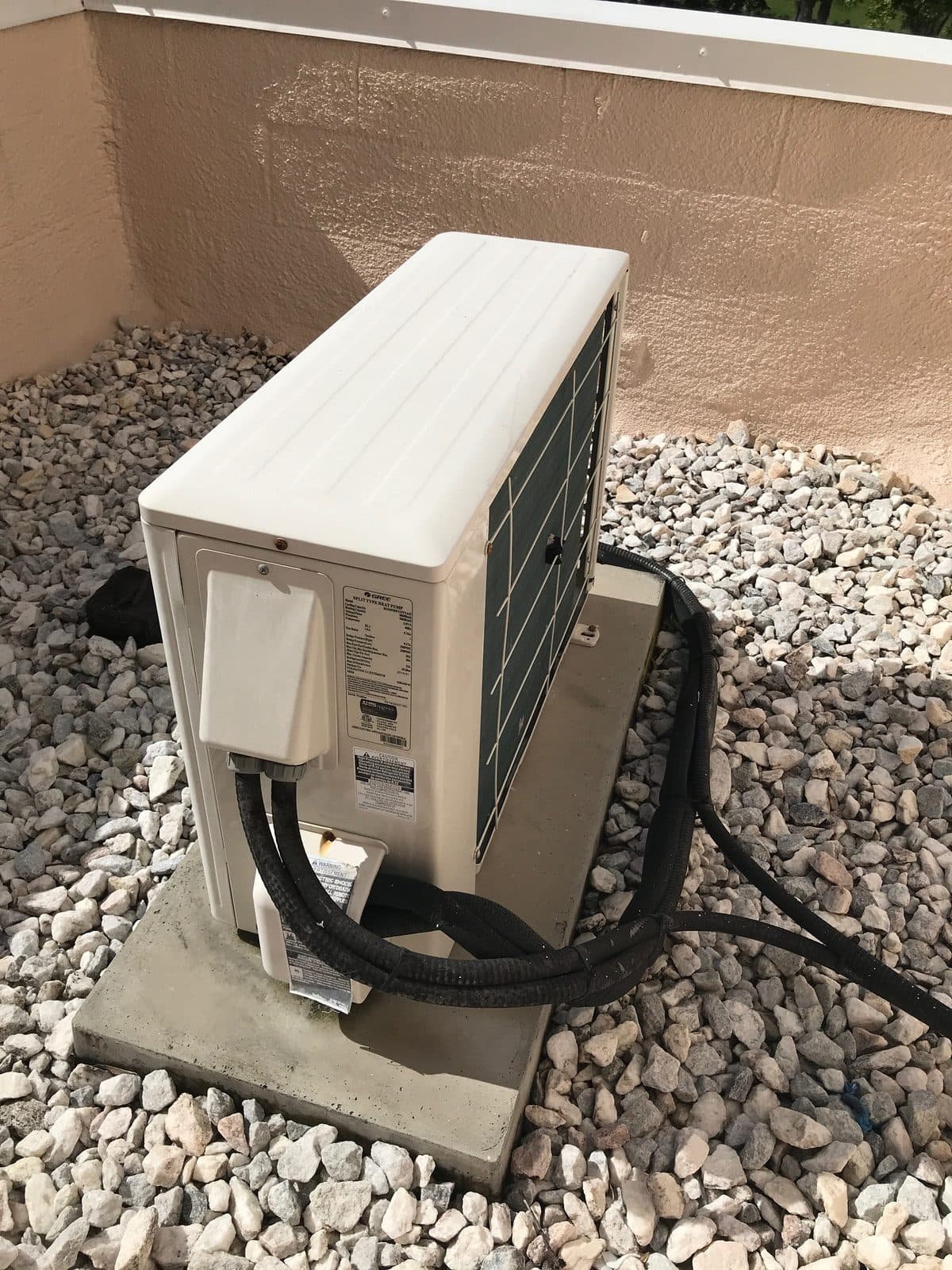
Carrier says a multi-zone mini-split can cool up to six individual rooms from one outdoor unit, with each indoor unit sized independently to match its room. A 2013 review by the Pacific Northwest National Laboratory, written for the Department of Energy, says multi-split systems with up to eight heads are available, but most installations use two to four. A head is an indoor unit, and a zone is one head and the area it serves. The photo at the top of this page shows a mini-split heat pump's outdoor unit.
ACCA, the Air Conditioning Contractors of America, lists a short episode of its Predictable Comfort series on Manual J block loads versus room-by-room loads. A block load is one figure for the whole house, and a room-by-room load gives each room its own figure. Its Manual J contents also list a multi-zone system example. Our reading: a head answers to one room's load, so ask for each room's load and not only one whole-house number.
Tons, Btu per hour and the number in a model name
UF/IFAS Extension, the University of Florida's extension service, says a ton of air conditioning is equal to 12,000 Btu per hour. What BTU means for an air conditioner explains the unit itself. By our arithmetic, 1 ton is 12,000 Btu per hour, 1.5 tons is 18,000, 2 tons is 24,000 and 3 tons is 36,000. The same 2013 review lists one maker's single-head systems with rated cooling capacities from 9,000 to 36,000 Btu per hour. By our arithmetic, that range runs from three quarters of a ton to 3 tons.
GE's multi-zone installation manual lists indoor unit capacities from 07K to 36K in Btu per hour, in its wall bracket table. Our reading: K means thousands of Btu per hour. In Mitsubishi Electric's submittal for its MSZ-FS18NA indoor unit, the title reads 18,000 BTU/H, but the table lists a cooling capacity of 17,200. A 2020 report by the Pacific Northwest National Laboratory also gives 17,200 Btu per hour as the rated cooling capacity of a Mitsubishi MUZ-FH18NA. Our reading: a quote that names only the size in the model name has not told you what the unit is rated to deliver. AC tonnage and sizing in Florida covers why Florida's energy code treats a label rating as a rating-test value and not a sizing number.
Two public charts, one room, three answers
ENERGY STAR calls a mini-split a replacement for window units for cooling, and it publishes a room-size chart for room air conditioners. The chart assumes an 8-foot ceiling. It lists 6,000 Btu per hour for a room of 150 up to 250 square feet and 12,000 for a room of 450 up to 550. ENERGY STAR then says to reduce capacity by 10 percent for a heavily shaded room, increase it by 10 percent for a very sunny one and add 4,000 Btu per hour for a kitchen.
Carrier's page gives an initial estimate of 25 Btu per square foot of room, and a chart that assumes 8-foot ceilings and average insulation. Its chart lists 6,000 to 9,000 Btu per hour for 150 to 250 square feet, and 15,000 to 18,000 for 450 to 600. For a 500 square foot room, that makes three public answers: 12,000 Btu per hour from ENERGY STAR's chart, about 12,500 from Carrier's formula and 15,000 to 18,000 from Carrier's chart. Carrier says the final capacity should come from a professional load calculation. Our reading: floor area is one input, so a chart brackets a room and cannot pick a size. Our reading: ENERGY STAR's chart is for room air conditioners and not mini-splits, so treat it as a rough check on a quote and not a way to choose a size.
Rooms that break the chart: kitchens, sunrooms, garages and tall ceilings
Carrier says cooking appliances can add heat to a kitchen, and that large windows and direct sunlight add heat gain to a sunroom, so the basic estimate may not be enough. It says an unconditioned garage often has less insulation and larger temperature swings than living space, which can affect the capacity it needs. For ceilings higher than 8 feet, Carrier says you will likely need a system with higher capacity. ACCA's Manual J page also lists a home addition with large south glass and solarium heat transfer multipliers among its sections. A solarium is a room with a large share of glass, such as a sunroom. Our reading: an enclosed lanai or Florida room belongs on the sunroom list, so ask for its load on its own line.
The lowest output, and why a humid climate cares
The same 2013 review says one maker's units can go down to about 30 percent of rated capacity, and its 9,000 Btu per hour unit had a minimum cooling capacity of 2,800. A maker's submittal for a 12,000 Btu per hour unit lists cooling at 95°F as a maximum of 13,600, a rated 12,000 and a minimum of 2,500. By our arithmetic, that minimum is about 21 percent of the rated figure. The sheet's rating conditions are 80°F dry-bulb and 67°F wet-bulb indoors, and 95°F dry-bulb and 75°F wet-bulb outdoors. Dry-bulb is the air temperature a thermometer shows, and wet-bulb also reflects the moisture in the air. The same sheet lists moisture removal of 1.9 pints per hour and a sensible heat factor of 0.83. A sensible heat factor is the share of the cooling that lowers air temperature, and the rest removes moisture. By our arithmetic, a factor of 0.83 means about 83 percent of the cooling goes to temperature and about 17 percent to moisture.
ENERGY STAR says a room air conditioner that is too large cools the room before it has a chance to remove the humidity, which can leave the room damp and clammy. The National Weather Service Tampa Bay Area office says the rainy season is typically accompanied by persistent dew point values above 70°F. Dew point is a measure of how much moisture the air holds, and a higher one means wetter air. Our reading: in Tampa Bay, ask for a unit's lowest output and its sensible and total capacity before you accept a size larger than the room's load. Ductless mini-split systems reports a Florida field study on why a multi-split with one outdoor unit can turn down less than two separate units. How to choose AC size in Florida explains why an oversized system leaves a home cool but clammy.
Matching indoor units to an outdoor unit
GE's multi-zone installation manual includes a compatibility matrix that lists which indoor unit sizes may be paired on each outdoor model. In it, the first outdoor model pair lists indoor units up to 12K, the second lists units up to 18K and the third lists units up to 24K. Our reading: indoor unit sizes cannot be mixed freely, so the quote should name the outdoor model and the maker's table that allows the pairing.
Mitsubishi Electric's submittal for its 18,000 Btu per hour indoor unit adds that capacity varies with the number of indoor units operating and the model of the multi-zone outdoor unit. Our reading: in a multi-zone system, the capacity a head delivers can change with how many heads are running. By our arithmetic, two 12K heads add up to 24,000 Btu per hour, the same as a 2 ton label. That sum does not say what the outdoor unit delivers when both heads run.
What to ask for in writing before you accept a size
These questions work for any ductless proposal.
- A load calculation that lists each room or zone in Btu per hour, with any kitchen, sunny room or lanai on its own line.
- Which indoor unit goes in which room, the size of each, and which outdoor unit carries them.
- The maker's table that allows that pairing, and how many heads were running when its capacity was listed.
- For each unit, the rated, minimum and maximum cooling capacity from the maker's submittal, and its sensible and total capacity.
- Why this size and not the next one down, and whether it is larger than the room's load.
- How the system will handle humidity in each room, and what its lowest output is.
- Who does the refrigerant and electrical work, and who pulls the permit.
Mini-split installation has a written checklist for pipe runs, drains, electrical work and the outdoor unit. Put each answer in the written proposal, because a spoken answer is hard to check later. Refrigerant and electrical work is for licensed professionals, so this page gives no steps for it.
Frequently asked
What does a 2 ton mini split mean?
A ton of air conditioning equals 12,000 Btu per hour, so by our arithmetic a 2 ton system is 24,000, a 1.5 ton system 18,000 and a 1 ton system 12,000. Our reading: that is a capacity label and not a house size, and it does not say how many rooms the system serves.
How many square feet will a 1 ton or 1.5 ton mini split cool?
There is no single answer, and two public charts show why. ENERGY STAR's room air conditioner chart puts 12,000 Btu per hour at 450 up to 550 square feet and 18,000 at 700 up to 1,000. Carrier's chart puts 12,000 to 15,000 at 350 to 450 square feet and 15,000 to 18,000 at 450 to 600. By our arithmetic, 12,000 Btu per hour is 1 ton and 18,000 is 1.5 tons. Our reading: ask for each room's load, not a square-foot rule.
Will a 2 ton mini split cool my whole house?
Carrier's page works a 1,000 square foot home and gets about 25,000 Btu per hour from its formula. It adds that an entire home may need several indoor units or a different system configuration. By our arithmetic, a 2 ton system is 24,000 Btu per hour. Our reading: the label alone cannot say whether a home fits it, because room loads and the number of heads decide.
Is it safer to size a mini split up?
ENERGY STAR says a room air conditioner that is too big will be less effective and offer reduced efficiency. A maker's sheet lists a minimum capacity, and it was 2,500 Btu per hour for a 12,000 Btu per hour unit. Our reading: ask for the room's load and the unit's minimum before you size up.
Is the number in the model name the capacity?
Not exactly, because in one maker's submittal the unit titled 18,000 BTU/H lists 17,200 in its cooling capacity row. Our reading: ask for the rated capacity of the exact model, and for how it changes when other heads run.
Do I need to call a pro for this?
Yes, if you want the size to be right. Capacity comes from a room-by-room load calculation - windows, orientation, insulation, ceiling height - and square footage charts are a starting point rather than an answer. A licensed contractor does that calculation. Oversizing is the common error here and it leaves a room cold and humid rather than comfortable.
Related
- AC Tonnage and Sizing: What 3, 4 and 5 Tons
- Ductless Mini-Splits: How They Work and When
- Mini-Split Installation: What Drives the Job
- What size AC you need in Florida
- What BTU means for an AC
- House humid with the AC running
Blume Mechanical Service is a licensed commercial and residential HVAC contractor serving Florida's Tampa Bay region (CAC-1822618). Blume installs and services all major brands as a licensed contractor, and estimates on new systems and retrofits are no-cost.
Last updated: 2026-11-05
Sources: ENERGY STAR, Room Air Conditioners (room-size chart and adjustments; page read November 2026) · ENERGY STAR, Ductless Heating & Cooling (page read November 2026) · Carrier, Calculating What Size Mini Split I Need (page dated October 27, 2026) · Mitsubishi Electric Trane HVAC US, Submittal Data, MSZ-FS12NA indoor unit and MUZ-FS12NA outdoor unit (2021) · Mitsubishi Electric Trane HVAC US, Submittal Data, MSZ-FS18NA indoor unit (2023) · Pacific Northwest National Laboratory for the US Department of Energy, Review of Residential Low-Load HVAC Systems (PNNL-23017, September 2013) · Pacific Northwest National Laboratory for the US Department of Energy, Experiments to Maximize the Use of Ductless Mini-Splits in Homes with Existing Central or Zonal Heating and Cooling Equipment (PNNL-29531, May 2020) · GE Appliances, Ductless Multi Zone with Highwall Indoor Units, Installation Instructions, 31-5000560 Rev. 3 (06-22) · ACCA, Manual J Residential Load Calculation (technical manuals page) · University of Florida, UF/IFAS Extension, Energy Efficient Homes: Air Conditioning (FCS3262/FY1026) · National Weather Service Tampa Bay Area, Rainy Season