
Pinellas, Hillsborough and Pasco Counties · Florida CAC-1822618
Apartment Complex & Multifamily HVAC in Tampa Bay, Florida
This page covers properties where each apartment has its own equipment. It covers condensate in stacked units, humidity in vacant units between leases, air moving between apartments, and refrigerant rules. Blume Mechanical Service is a licensed Florida air conditioning contractor (CAC-1822618), fully insured, serving residential and commercial customers in Pinellas, Hillsborough and Pasco Counties.
This page covers the equipment and building side of multifamily HVAC. For the vendor relationship, records and budgeting, see HVAC for property managers.
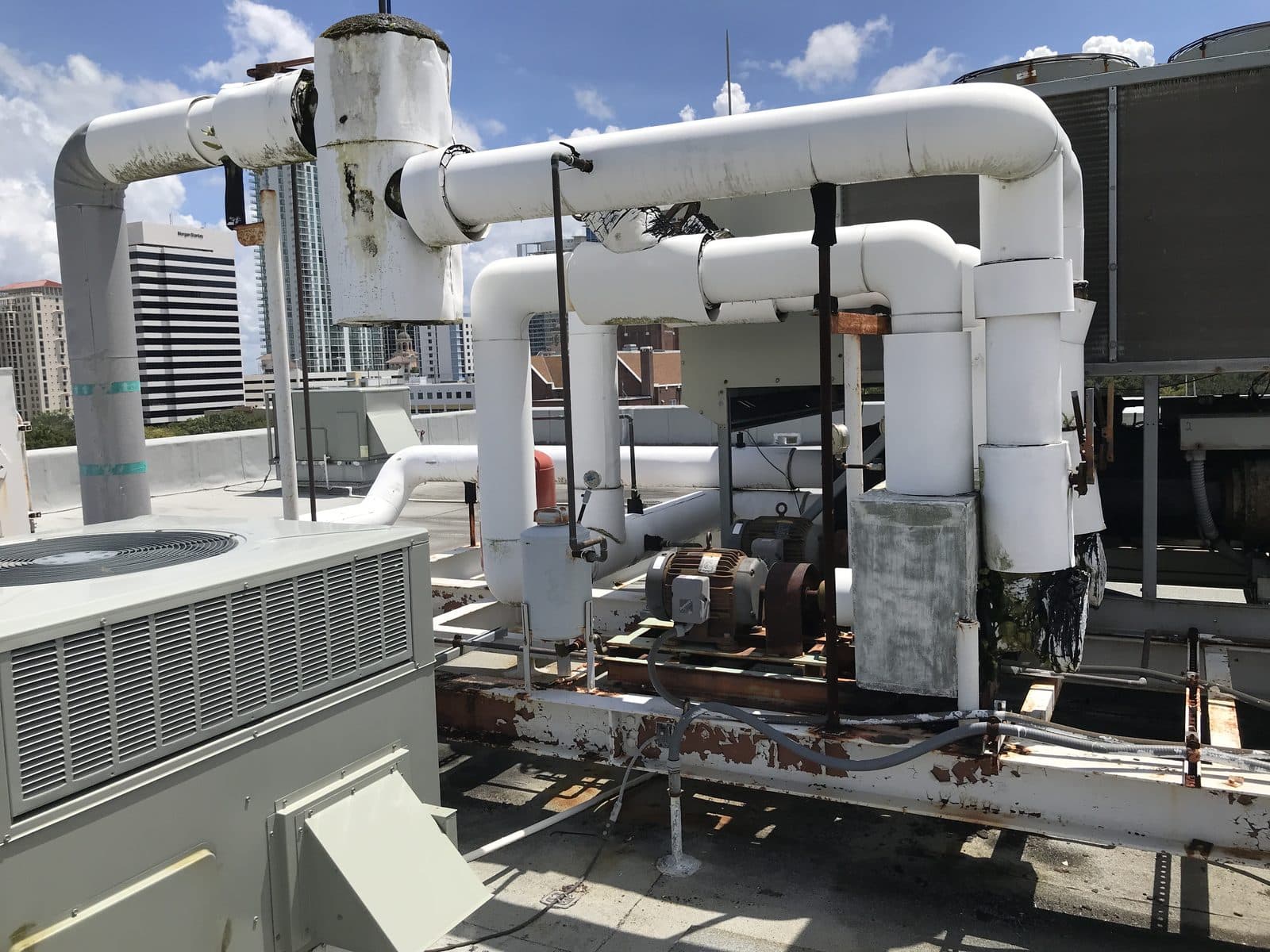
Many small systems, one property
Some buildings use other equipment classes. Through-wall units are covered in through-the-wall AC and PTACs. Buildings with a heat pump in each unit on a shared water loop are covered in condo water-source heat pumps.
ENERGY STAR recommends annual pre-season check-ups by a contractor and lists what a typical check-up should include. The list includes tightening electrical connections, measuring voltage and current on motors, and cleaning evaporator and condenser coils. It also covers checking the refrigerant level and adjusting blower components for proper airflow.
Condensate: the failure that travels downstairs
ENERGY STAR says a plugged condensate drain can cause water damage and affect indoor humidity levels. The Environmental Protection Agency (EPA) moisture guide says to keep air conditioning drip pans clean and the drain lines unobstructed and flowing properly.
EPA says that if wet or damp materials are dried 24 to 48 hours after a leak, in most cases mold will not grow. EPA also tells renters to report plumbing leaks and moisture problems to the building owner, manager or superintendent immediately.
A continuing-education course summary of the 2023 Florida Building Code, Mechanical changes, hosted by the Florida Building Commission, says one identification requirement, in section 307.2.3.3, is that condensate drains for cooling coils and evaporators be marked to show whether the piping is connected to the primary or the secondary drain.
Turnovers: the vacant unit in a Florida summer
The Florida Solar Energy Center (FSEC) studied vacant homes in hot, humid Florida conditions. It found that letting a building float could not reliably keep indoor humidity below 65% most of the time. It also found that setting the air conditioner at 85°F gave generally poor results in most homes, because the system ran too little to remove enough moisture.
The strategies FSEC rated effective included running the air conditioner at 74°F from 3 to 5 AM (which FSEC said yielded promising but mixed results), a dehumidifier on a timer, and heating the house to 88 or 90°F to lower indoor humidity. FSEC noted that in homes with high infiltration rates, the cooling period may need to be extended to four hours. FSEC advised setting the fan to auto in a vacant home. The reasons given were saving energy, avoiding drawing humid air in through duct leaks, and keeping the filter from fouling too quickly. The study tested three Brevard County homes, one of them a mobile home, and no apartments. The building-wide side of moisture is covered in commercial humidity control.
The same study found that air infiltration (the rate at which outside air leaks in) was an important factor, and leakier homes needed more moisture removal.
Stacked units share air whether you want them to or not
The Building America Solution Center describes compartmentalization as isolating each apartment so that air does not flow between units. It says compartmentalization is needed to reduce fire and smoke risk and to help control odors. When units are not compartmentalized, air from one unit can be drawn into adjacent units.
The same guide explains the stack effect in multistory buildings. In a non-compartmentalized multistory building, the stack effect can pull outside air in through leaks at lower floors and push air out through leaks in the upper envelope.
It says air sealing must be done around ductwork where it passes through floors, and that the walls of shafts and chase ways must be air sealed. The guide also shows corridor service chases, which carry ducts, pipes and wiring, sealed off from the apartments.
Refrigerant rules at fleet scale
EPA's Section 608 certification page says technicians who maintain, service, repair or dispose of equipment that could release ozone-depleting refrigerants must be certified. EPA's certification types include Type 1, for small appliances.
EPA's Section 608 leak repair page says owners or operators must take corrective action when an appliance with a full charge of 50 or more pounds is discovered leaking ozone-depleting refrigerant above the applicable trigger rate. That statement concerns ozone-depleting refrigerant only. Whether a given system falls under it depends on its full charge and its refrigerant.
Disposal follows rules too. EPA lists central residential air conditioning among equipment that must have its refrigerant recovered before disposal. Window unit air conditioners fall under separate safe disposal requirements. Replacement planning across mixed equipment ages and refrigerants is covered in the A2L refrigerant transition.
Frequently asked
Do I need a contractor for this?
Maybe. Maintenance staff can change filters, check thermostat setpoints and schedules, read and report equipment alarms, and look for standing water or a blocked condensate line at each unit. Refrigerant work, electrical work and controls work need a licensed contractor. EPA requires Section 608 certification for technicians who service equipment that could release ozone-depleting refrigerant.
What should maintenance staff check on the HVAC during a unit turnover?
Check that the filter is clean, that the thermostat is set to the property's vacancy setpoint with the fan on auto, and that the drip pan and drain line show no standing water. Note any alarm or warning on the thermostat. Coil cleaning, electrical checks, refrigerant level and airflow adjustment are on ENERGY STAR's list of contractor check-up tasks.
How should we set the thermostat in a vacant apartment over the summer?
In a Florida Solar Energy Center study of vacant homes, letting the house float could not reliably keep indoor humidity below 65% most of the time, and setting the air conditioner at 85°F gave generally poor results because it ran too little to remove enough moisture. Strategies the study rated effective included early-morning cooling at 74°F from 3 to 5 AM (which yielded promising but mixed results), a timed dehumidifier, and heating the house to 88 or 90°F. The study noted that leakier homes may need the cooling period extended to four hours. The study tested three Florida homes, not apartments, so confirm the setting your buildings need.
Why do residents smell a neighbour's cooking in their apartment?
Air can move between units that are not compartmentalized. The Building America Solution Center explains that units which are not compartmentalized can draw air from adjacent units, and that in multistory buildings the stack effect can pull outside air in at lower floors and push air out higher up. Sealing penetrations is the remedy the guide describes.
Does EPA's ozone-depleting refrigerant leak repair rule apply to each apartment's air conditioner?
It depends on the system. EPA's Section 608 leak repair page says owners or operators must take corrective action when an appliance with a full charge of 50 or more pounds is discovered leaking ozone-depleting refrigerant above the applicable trigger rate. Separately, Section 608 requires certified technicians for servicing, and EPA's certification types include small appliances. This page does not cover EPA's separate HFC leak repair rules.
Unit converter
Showing 1 therm in 4 other units
| Unit | Value |
|---|---|
| Btu | 100,000 |
| kWh | 29.31 |
| MMBtu | 0.1000 |
| Ccf (natural gas) | 0.9653 |
Used only for Ccf and therm conversions. Source: EIA, Heat Content of Natural Gas Consumed (U.S., 2025).
Sources: 1 therm = 100,000 Btu and 1 kWh = 3,412 Btu, from EIA. MMBtu from EIA. MBH from Wikipedia. 1 ton of refrigeration = 12,000 Btu/h from NIST. Ccf = 100 cubic feet from Wikipedia. — means no result for the current input.
Responsible for a complex with more air handlers than you can count? Talk to a licensed air conditioning contractor about your property.
References: ENERGY STAR — Maintenance Checklist (US EPA) · US EPA — A Brief Guide to Mold, Moisture and Your Home · Florida Solar Energy Center (University of Central Florida) — Executive Summary: Evaluation of the Impact of Vacant Home Space Conditioning Strategies on Summer Relative Humidity, Energy, and Peak Load (FSEC-CR-1487-04) · US DOE Building America Solution Center (PNNL) — Air Sealing and Compartmentalization in Multifamily Buildings · Florida Building Commission course file — 2023 Advanced Building Code 8th Edition, Mechanical: Significant Code Changes (Course #1147.0) · US EPA — Stationary Refrigeration Leak Repair Requirements · US EPA — Stationary Refrigeration Safe Disposal Requirements · US EPA — Section 608 Technician Certification