
Commercial HVAC in St. Petersburg
There is no single “St. Petersburg commercial building.” A 500-foot downtown tower, a converted warehouse in the arts district, a children’s hospital in the Innovation District, and a corporate campus out at Carillon are four completely different mechanical problems, and this city has all four within a few miles of each other. Blume Mechanical Service has worked across Tampa Bay since 2009 as a Class A licensed Florida mechanical contractor, CAC-1822618, fully insured.
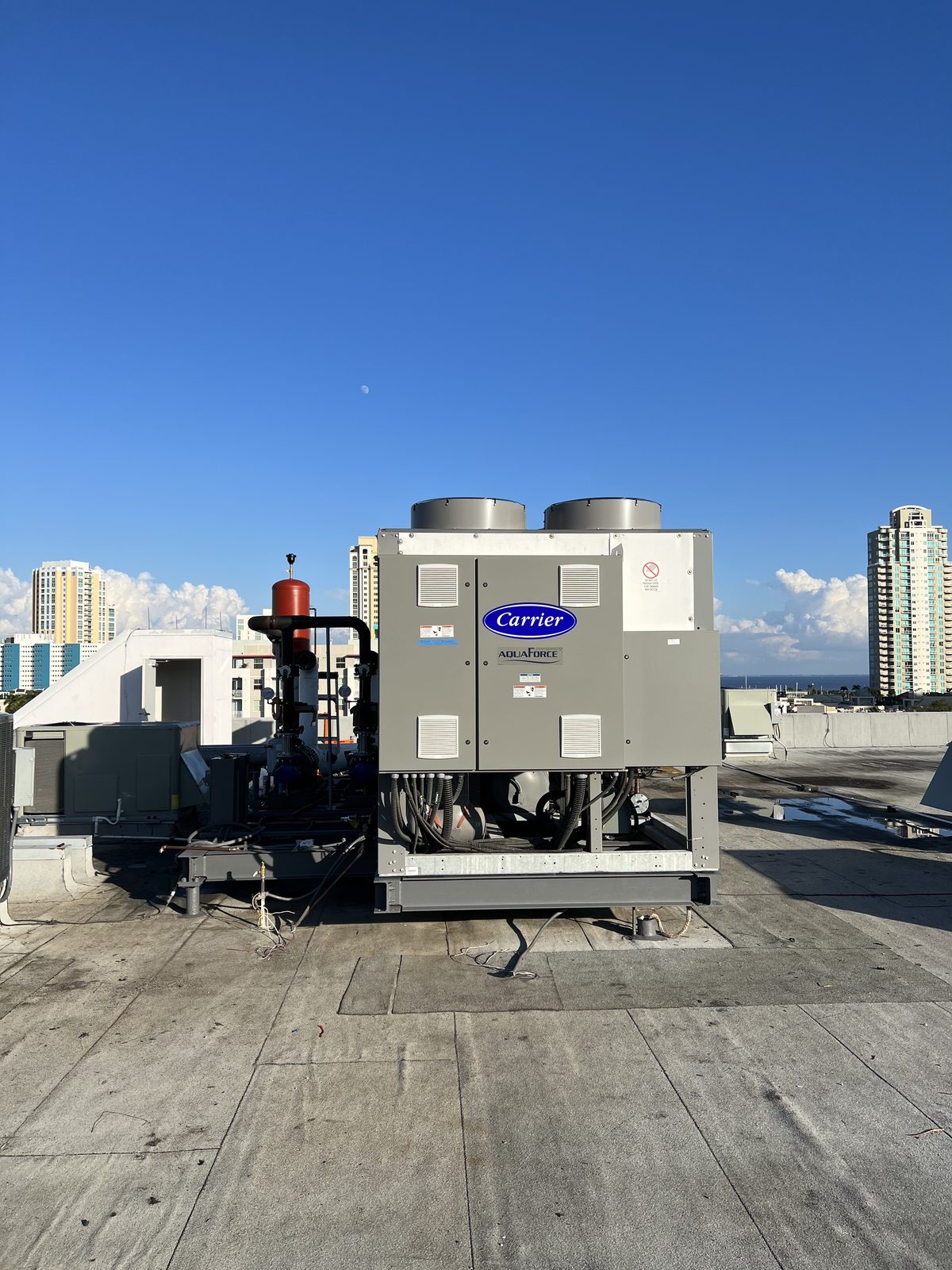
Commercial HVAC in St. Petersburg, specifically
The buildings here
The City's economic development page lists major development areas including Downtown, the Innovation District, Gateway, the Warehouse Arts District, the Grand Central and EDGE Main Street districts, Skyway Marina, and Tyrone.
Districts and what they run
Downtown
A core where revitalization continues with new retail, research, residential-tower, and cultural projects.
Innovation District
A cluster south of Downtown of higher education, marine science, and healthcare institutions, including the University of South Florida St. Petersburg campus.
Gateway
An employment area in north St. Pete, home to the region's top employers; the City counts more than 2,700 businesses and 60,000 employees here.
Warehouse Arts District
An area between 16th and 31st Streets, much of it formerly industrial with warehouses and small manufacturing companies, now home to artists and studios.
Grand Central District
A Florida Main Street district along Central Avenue from 16th Street to 31st Street.
EDGE District
A nationally accredited Florida Main Street district along Central Avenue from Dr. Martin Luther King Jr. Street to 16th Street.
Tyrone
A mostly retail and residential area west of Downtown, with Tyrone Square Mall as a primary retail attractor.
Skyway Marina
A district in south St. Petersburg that the City's district plan envisions as a mixed-use destination for shopping, dining, and employment.
The kind of building stock here
St. Petersburg is anchored by large, mission-critical buildings — the sort whose systems cannot simply be shut off for a repair. Naming a few well-known local landmarks is the clearest way to describe the commercial building stock a contractor works around in this market; it is not a claim that Blume services any specific building below.
- Johns Hopkins All Children's Hospital — hospital and research center, Downtown
- Orlando Health Bayfront Hospital — hospital in downtown St. Petersburg
- University of South Florida St. Petersburg — university campus
- Tropicana Field — domed stadium
- Raymond James Financial — corporate headquarters
- The Vinoy — historic hotel
- 400 Central — 46-story condominium tower
Climate and coastal load
St. Petersburg is a peninsular city with shoreline along Tampa Bay and the Gulf of Mexico.[1] The City cites an average of 361 days of sunshine a year.[1] The National Weather Service's 1991–2020 normals for St. Petersburg put the annual average temperature at 74.7°F and annual rainfall at 46.65 inches.[2] Normal cooling degree days (3,912 a year) outnumber heating degree days (357) by more than ten to one.[2] In those normals, August averages a high of 89.8°F and a low of 78.2°F, and January a high of 69.0°F and a low of 55.3°F.[2] June through September bring 29.33 of the 46.65 inches of normal annual rainfall.[2]
Sources
Local conditions that change the engineering
Equipment does not fail the same way everywhere. These are the conditions specific to St. Petersburg that change how a commercial system is sized, sited, and serviced — each verified against a public source rather than assumed from the region.
The Florida Building Code, Energy Conservation places Pinellas County in climate zone 2A, a moist, warm-humid location.
In Hurricane Helene (September 25–27, 2024), the National Weather Service Tampa Bay office's storm report lists a water level of 6.31 feet above mean higher high water (MHHW) at the St. Petersburg NOAA tide gauge and a 71-knot gust at Albert Whitted Airport.
In Hurricane Milton (October 8–10, 2024), a CoCoRaHS station listed as St. Petersburg 2.5 S recorded 20.40 inches of rain, the highest total in the National Weather Service Tampa Bay office's report, and Albert Whitted Airport recorded 18.88 inches and an 88-knot gust.
The City's Floodplain Management Ordinance defines substantial damage as any combination of repair, reconstruction, or other improvement of a structure whose cumulative cost equals or exceeds 49% of its pre-damaged market value before the improvement or repair is started.
For damage to a structure in the Special Flood Hazard Area, the City says the rule prohibits improvements or repairs exceeding 49% of its market value unless the entire structure is brought into full compliance with current zoning, building, and floodplain management regulations, which may include elevating the structure.
The City says the 49% Rule applies to all buildings in the flood hazard area and to all repairs, even if the damage is not caused by flooding, and it estimates market value from the Pinellas County Property Appraiser's tax assessment value of the structure.
Permits
Commercial mechanical permits for work in St. Petersburg are issued through the City of St. Petersburg's Construction Services and Permitting Division. The City's main permitting office is at the Municipal Services Center, One 4th Street North.[1] Under the City's permit rules, an owner or authorized agent who intends to install, alter, or replace a mechanical system regulated by the Florida Building Code must file an application and obtain the required permit; the Building Official keeps a list of exempt work.[2] The City says that, effective November 1, 2023, all requests for electronic plan review are handled through its online Building & Permitting portal and no longer require a prescreen by staff through email.[1]
What the work covers
Across those different buildings the scope is consistent even when the equipment is not: load calculation and system design for new fit-outs and replacements; scheduled preventive maintenance that keeps a rooftop unit or a chilled-water plant out of the emergency column; diagnostic repair when something fails mid-season; and planned equipment change-outs staged to keep a business open while the work happens. Deferred maintenance does not stay deferred — it resurfaces as an emergency call, and a maintenance agreement moves that spend from unplanned to planned.
Why St. Petersburg buildings call
The recurring failures here track what makes the city distinct. Salt air off the bay and the Gulf corrodes coils and rooftop cabinets faster than inland; the humid, cooling-dominated load leaves a building clammy and complaint-ridden before the thermostat number looks wrong; and the split between old envelopes and new towers means the same week can hold a warehouse retrofit and a high-rise service call.
Serving St. Petersburg
Blume takes commercial calls throughout St. Petersburg and the surrounding area. The line is (727) 330-9131, with a 24/7 answer for genuine emergencies and standard weekday scheduling for planned work, maintenance agreements, and system evaluations.
Commercial HVAC in St. Petersburg
Blume Mechanical Service · Class A licensed · CAC-1822618
Call (727) 330-9131