The Phone Call: What Happens When You Report an Apartment AC Problem
When you call (727) 330-9131 about an apartment ac unit that has quit cooling, a person answers the 24/7 dispatch line. That is true at two in the afternoon and at two in the morning, on weekends and on holidays. Their job is to gather the right details so the technician arrives prepared, and to get you on the schedule — same-day response is available for no-cool calls, based on location and technician availability. Apartment calls take a few more questions than a single-family house does, because both the equipment and the person authorized to approve work can vary from building to building.
The questions dispatch will ask
Expect a short list of practical questions. What does the unit look like — a machine through the wall under a window, a closet with an air handler in it, a wall-mounted head near the ceiling? Is anything leaking water, and is there a neighbor below you? What is the building name, and is there a gate code, assigned parking, or a maintenance office that controls roof or mechanical-room access? None of this is bureaucracy. A technician who knows they are walking into a fourth-floor vertical stack unit with roof access through a locked hatch arrives ready to work instead of ready to reschedule.
Who has to approve the work
Here is the wrinkle unique to apartment ac unit calls: the person sweating in the living room is often not the person who pays for the repair. Blume provides written upfront pricing that must be approved before any work begins, so it matters to establish early who gives that approval. If you rent, check your lease — most put AC repair on the landlord, and calling a contractor directly could leave you holding the bill. Owners of individual condo units usually approve their own work. Property managers can authorize by phone or email while the technician is on site. Dispatch will help you sort out which situation you are in before the visit, not after.
Step One On Site: Identifying What Kind of Apartment AC Unit You Have
The phrase apartment ac unit covers at least four different machines, and the repair path is different for each one. So the first thing the technician does after knocking is identify what is actually installed — not what the listing called it or what the last handyman guessed it was. In Pinellas and Hillsborough apartment buildings we see everything from decades-old through-wall units to brand-new ductless systems, sometimes in the same building.
Self-contained wall units and PTACs
If your apartment ac unit sits in a sleeve through the wall, usually below a window, it is a self-contained machine: compressor, coils, fan, and controls all in one chassis. These are common in older condo and apartment buildings around Clearwater and St Petersburg. The good news is that everything can be serviced from inside your unit, with no roof access needed. The catch is that when a major component fails, the honest conversation is often about replacing the chassis rather than rebuilding it, because these machines are built as sealed packages rather than as repairable systems.
Closet air handlers, vertical stacks, and ductless mini-splits
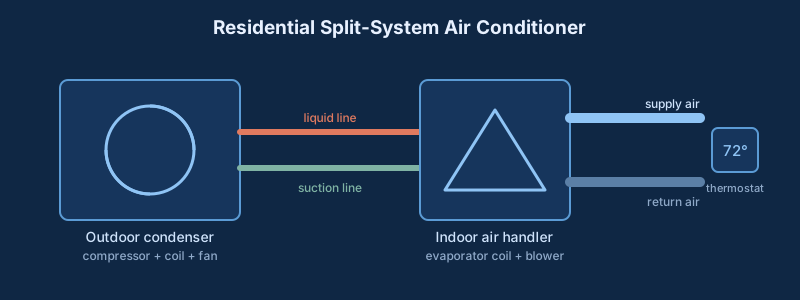
Many Tampa Bay apartments run a small split system: an air handler in a hallway, laundry, or patio closet, connected to a condenser on the roof or a ground pad. Vertical stack units, common in mid-rise buildings, work on the same principle in a tighter footprint. Ductless mini-splits — a wall-mounted head inside, a compact condenser outside — show up in garage apartments and newer conversions. Each design puts key components in different places, which is why the technician traces your specific system before quoting anything. Blume services all major brands across these formats, including Carrier, Trane, Lennox, Rheem, Goodman, Daikin, York, and Bryant.
The Diagnosis: What an experienced Technician Checks, in Order
With the equipment identified, the diagnosis follows a deliberate sequence: thermostat and power first, then airflow, then the refrigerant circuit, then the condensate path. Airflow deserves special mention in apartments, because filters get neglected there more than almost anywhere else — tenants assume the landlord changes them, landlords assume the tenant does, and eventually the coil freezes into a block of ice. A frozen coil looks a lot like a refrigerant leak from the thermostat's point of view, which is why an experienced technician verifies airflow before condemning expensive parts. Skipping that step is how people end up paying for repairs they never needed.
The drain line, and why it matters more on the third floor
Every air conditioner in Florida is also a dehumidifier, and the water it pulls out of the air has to go somewhere. In a single-story house, a clogged condensate drain makes a puddle. In an apartment ac unit two or three floors up, it can stain your ceiling — or your downstairs neighbor's. That is why the technician checks the drain pan, clears the line, and confirms the float switch shuts the system down if water backs up. If you called because the unit quit for no obvious reason, a tripped float switch doing exactly its job is a common answer.
Once the technician knows what is wrong, you get the price in writing before any repair begins — and nothing happens until you, or the owner or manager paying for the work, approve it. This is a firm rule at Blume, not a courtesy. It matters in apartments in particular because the person standing in the room is often not the person paying, and nobody should discover the cost of a compressor after it has already been installed.
When repair stops making sense
Sometimes the honest quote comes with a second conversation. Blume's rule of thumb is simple math: when a repair will cost more than half the price of a new system on aging equipment, replacement usually wins. That comes up often with apartment ac units, because so many are older self-contained machines or systems still running on R-22. R-22 refrigerant has been phased out, so recharging an old leaking system means paying a premium for a refrigerant that is only getting scarcer — money spent propping up equipment already near the end of its run. The technician lays out both paths and lets you decide; the choice belongs to you or your landlord, never to us.
The Repair, and the Proof It Worked
With approval in hand, the repair itself is often the quickest part of the visit. Blume technicians work on all major brands — Carrier, Trane, Lennox, Rheem, Goodman, Daikin, York, and Bryant — and apartment jobs add their own craft to the work: maneuvering in a closet barely wider than the air handler, protecting the floors of an occupied home, coordinating roof access with building staff, and keeping the noise reasonable for the neighbor on the other side of the wall.
Proof before the truck leaves
A repair is not finished when the part is in; it is finished when the system proves itself. The technician runs the apartment ac unit through a full cycle, measures the temperature drop between the return air and the supply air, confirms condensate is actually flowing to the drain, and watches the system reach and hold the thermostat setting. Then you get a plain-language explanation of what failed, what was done, and what to watch for. If the bill is going to a landlord or property manager, the documentation travels with it.
After the Visit: Records, Maintenance, and Multi-Unit Buildings
Every visit ends up in a documented service history tied to that specific unit — which matters more in apartments than almost anywhere else. Tenants move, property managers change, and without records every new technician starts from zero. Blume's maintenance plans build on that history: two tune-ups a year, priority scheduling, and discounted repairs, with per-unit paperwork that owners and managers of multiple apartment ac units need at budget time. In a climate where cooling runs most of the year and coastal air works steadily on outdoor coils, twice-a-year attention is not an upsell; it is how equipment in Pinellas and Hillsborough County reaches old age at all.
Who Shows Up, and Where
The company behind this process is Blume Mechanical Service, LLC, in the climate business since 2009, holding Florida license #CAC-1822618 — verifiable through the Florida DBPR — and fully insured, which matters when a condo association or building management requires proof before letting a contractor on the roof. Our technicians are experienced, and the company measures and balances delivered airflow with instruments, which comes into play on larger multifamily buildings. We are headquartered in Belleair Bluffs and serve Pinellas and Hillsborough County: Tampa, Clearwater, St Petersburg, Largo, Brandon, Dunedin, Palm Harbor, Seminole, and the surrounding communities. When your apartment ac unit gives out, the number is (727) 330-9131, and a person will answer — day, night, or holiday.