Most AC Emergencies Announce Themselves First
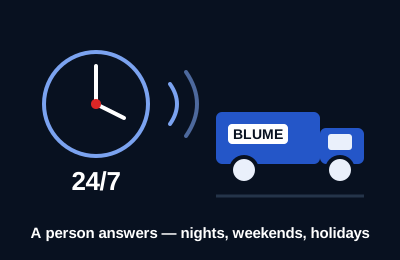
If you are searching for emergency air conditioning service, you are probably standing in a hot house wondering how it came to this. Here is the honest answer from a company that has been in the climate business since 2009: most cooling failures are not sudden at all. A compressor that seizes on a July afternoon usually spent weeks running hot behind a dirty condenser coil or a slow refrigerant leak. A blower motor that quits at midnight often rattled for a month first. The failure feels instant; the causes rarely are. That matters for two reasons. If your system is down right now, a person answers the 24/7 dispatch line at (727) 330-9131, holidays included, and same-day response is available for no-cool calls, based on location and technician availability. And once cooling is restored, the smartest money you will spend is on never needing to search this phrase again.
Early Warning Signs Tampa Bay Homeowners Should Not Ignore
Nearly every emergency air conditioning service call has a prologue. Systems communicate in sounds, smells, and small performance changes long before they quit. Learning to read those signals is the difference between a repair on your calendar and a sweltering wait on a holiday weekend. These are the warnings our experienced technicians most often find were present well before the breakdown.
Sounds and smells that deserve a same-week call
Grinding or screeching noises point to failing motor bearings. A hard buzz at startup can mean a weakening capacitor, one of the most common single points of failure in Florida systems. Repeated clicking while the unit fails to start suggests a control or relay problem. On the smell side, a musty odor usually traces to growth on a wet coil or in the drain pan, while an acrid, burning smell means shut the system off and call immediately. None of these problems fix themselves, and all of them are cheaper the week you first notice them.
Cooling and airflow changes
If the system runs longer than it used to for the same thermostat setting, or vent airflow feels weak or only mildly cool, something upstream is straining. Common culprits are a clogged filter, a coil slowly losing charge through a pinhole leak, or duct problems. Warm air during a cooling call is the classic pre-failure sign. So is a home that cools but never feels dry; in our humid climate, poor moisture removal often means a system that is undercharged or short cycling on its way to a breakdown.
Electrical and cycling clues
An air conditioner that starts and stops every few minutes is short cycling, and every restart overheats the compressor a little more. A breaker that trips repeatedly on the AC circuit is a symptom, not a nuisance, and resetting it over and over can turn a modest repair into a compressor replacement. Ice on the refrigerant lines or the indoor coil means the system needs to be shut off and diagnosed before further running does real damage.
Why Florida Equipment Fails Faster, and What That Means for Prevention
Air conditioners in Pinellas and Hillsborough County work a longer season than almost anywhere in the country. In much of the United States a system rests for half the year; here it runs from spring well into what other states call autumn, in air heavy with moisture and, near the coast, salt. That combination is why prevention is not optional advice in Tampa Bay. It is the only realistic way to stay off the emergency air conditioning service line.
Humidity is a workload, not just a discomfort
Every hour your system runs it removes water as well as heat. Wet coils, damp drain pans, and constantly wet condensate lines invite algae growth and clogs, and a clogged drain line is one of the most preventable causes of a sudden shutdown, because most modern systems carry a float switch that shuts the unit down when the pan backs up. That safety will trip at the worst possible moment unless the line is flushed regularly.
Salt air and outdoor coil corrosion
Homes in Clearwater, St. Petersburg, Dunedin, and other coastal neighborhoods deal with salt-laden air that slowly attacks outdoor coil fins and electrical connections. A corroded coil sheds capacity year after year, forcing the compressor to work harder for the same cooling. Rinsing and inspecting the condenser is simple preventive work, but skipped long enough, corrosion becomes the quiet reason a compressor dies young.
Maintenance Built to Keep You Off the Emergency Line
Our maintenance plans are built on one premise: an air conditioner that is inspected, cleaned, and tested twice a year produces very few surprises. Plan members get two tune-ups per year, priority scheduling when something does go wrong, discounted repairs, and a documented service history for every unit. Each piece exists to keep you off the emergency line.
What a real tune-up catches
A proper tune-up is not a filter swap and a handshake. Our technicians check refrigerant charge, test capacitors and contactors, tighten electrical connections, flush the condensate drain, clean coils, and verify the temperature drop across the system. Weak capacitors, pitted contactors, and clogged drains are among the most common causes of no-cool calls, and all three can be found and corrected in advance. A capacitor reading weak in April is a scheduled part swap. The same capacitor discovered in August is an emergency.
Why documented service history matters
Because we record what we find at every visit, each unit builds a history: readings, parts replaced, trends over time. That record lets a technician notice a compressor drawing more current than it did last year and recommend action before failure. It also keeps the repair-or-replace conversation honest, because the decision rests on your equipment's actual record instead of guesswork made under pressure.
If Your Air Conditioning Is Down Right Now
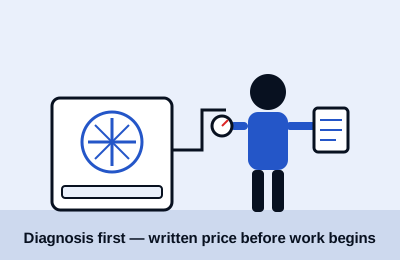
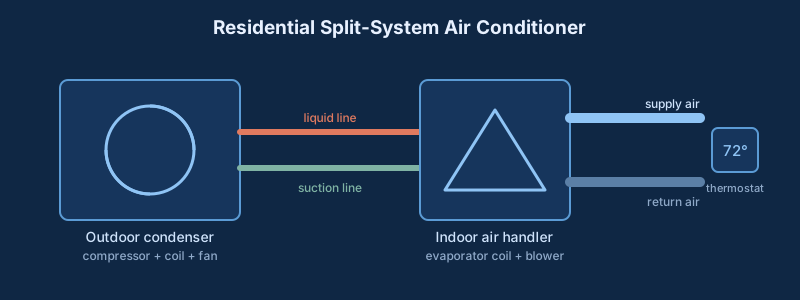
Prevention advice is cold comfort when the house is already hot, so here is the practical sequence. Check the thermostat first: fresh batteries, cooling mode, setpoint below room temperature. Check the breaker panel next; if the AC breaker has tripped you may reset it once, but if it trips again, stop and call, because repeated resets can destroy a compressor. Look at the copper lines at the outdoor unit and at the indoor coil; if you see ice, switch cooling off and run the fan so the system can thaw before a technician arrives. Finally, check the pan under the air handler; standing water usually means a float switch has shut the system down to protect your ceiling. Then call (727) 330-9131. A person answers the 24/7 dispatch line, holidays included, and same-day response is available for no-cool calls, based on location and technician availability across Tampa, Clearwater, St. Petersburg, Largo, Brandon, Dunedin, Palm Harbor, Seminole, and nearby communities. You will see written upfront pricing and approve it before any work begins.
Aging Systems, R-22, and the Honest Math
Some emergencies are best prevented by not repairing at all. If your system still runs on R-22 refrigerant, it belongs to a generation the industry has phased out, which makes every leak repair on those units a conversation worth having carefully. Our rule of thumb is simple: when a repair on aging equipment costs more than half the price of a new system, replacement usually wins the math. An old unit limping through Florida summers is the most predictable source of repeat emergency air conditioning service calls, and a predictable emergency is one you can choose to retire.
Planning replacement on your schedule, not the weather's
Replacing a system in a planned window means you pick the week, compare options calmly, and never spend a night without cooling. Replacing one after a catastrophic failure means deciding in the heat, under pressure. Blume installs and services all major brands as a licensed contractor, including Carrier, Trane, Lennox, Rheem, Goodman, Daikin, York, and Bryant, so the recommendation reflects your home and budget rather than whatever equipment a contractor happens to favor.
Who Shows Up When You Call Blume
Blume Mechanical Service, LLC has been in the climate business since 2009 and holds Florida license CAC-1822618, verifiable through the Florida DBPR, and we are fully insured. Our technicians are experienced, and we measure and balance delivered airflow with instruments, which matters when a comfort complaint turns out to be an airflow problem rather than a broken part. We are headquartered in Belleair Bluffs and work throughout Pinellas and Hillsborough County. Whether tonight's call is a true emergency or the early warning that prevents one, the process is the same: a person answers the 24/7 dispatch line, a technician diagnoses the actual problem, and you approve written pricing before any work begins.