
Hillsborough, Pinellas, Pasco, Manatee, Sarasota, Polk and Hernando Counties · Florida CAC-1822618
Commercial HVAC Tripping Breaker in Tampa Bay, Florida
A breaker that trips is doing its job — it is protecting the circuit from a fault. The most important thing on this call is what NOT to do: resetting a breaker repeatedly into a fault is how electrical fires start. Florida license CAC-1822618.
What is actually happening
This is the one diagnostic on this site where the safety instruction matters more than the diagnostic sequence. A breaker is a protective device. When it opens, it has detected current the circuit cannot safely carry, and the fault that caused it does not go away because the handle was pushed back.
The diagnostic order
Identify which breaker it is and what it protects. Narrowing the circuit narrows the fault.
Look for an obvious fault — burned wiring, a failed capacitor, a seized motor. Some of these are visible before any instrument comes out.
Measure amp draw on the circuit before resetting. This is the step most often skipped and the most informative. If draw is at or above nameplate, the load is the problem, not the breaker — replacing the breaker would simply remove the protection.
Check for a ground fault. A compressor with a grounded winding trips a breaker immediately on reset, and that immediate re-trip is itself diagnostic.
Where an untrained person has to stop
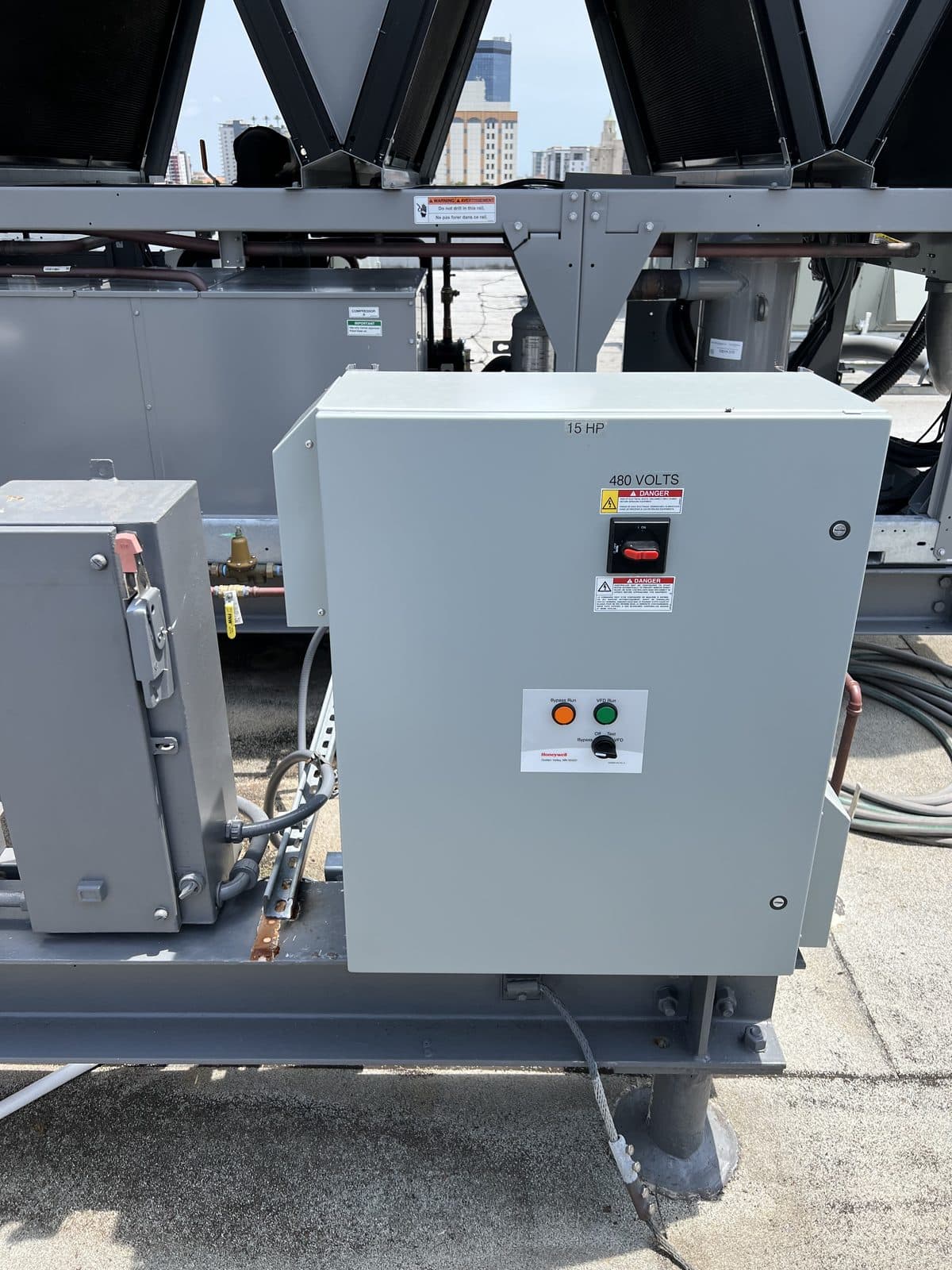
This is the most important hard stop in this series. Do not repeatedly reset a tripping breaker.
A breaker that trips is protecting the circuit from a fault. Resetting it into that fault causes fires. Each reset sends fault current through wiring, connections and equipment that have already demonstrated they cannot carry it safely.
If the breaker trips again after a single reset, the diagnosis requires a licensed electrician or a qualified technician with electrical test equipment. This is not a judgment call and there is no version of it that depends on how urgently the building needs cooling.
Electrical faults in a coastal environment
Coastal exposure gives this diagnosis a specific character. Salt-laden air corrodes electrical connections, and corrosion at a terminal raises resistance, which generates heat, which accelerates the corrosion — a loop that ends in a connection that arcs intermittently before it fails outright. Across the Gulf-facing counties, disconnects, whips and outdoor terminations degrade faster than their inland equivalents, and a nuisance trip in that environment deserves more suspicion rather than less.
There is also a seasonal pattern worth knowing. Commercial equipment here runs long hours through a long cooling season, and a motor drawing slightly high current will do so for far more hours than it would elsewhere. Conditions that would remain marginal in a milder climate reach their limit here — which is one reason breaker trips cluster in the hottest weeks rather than distributing evenly through the year.
None of that changes the hard stop. It is a reason to take the first trip seriously rather than treating it as a one-off.
Ground fault vs overload: what the difference tells a technician
A breaker can open for two very different reasons, and the difference is the first thing a qualified technician tries to establish. An overload is a matter of degree and time: the circuit is carrying more current than it is rated for, but not catastrophically more, so the breaker's thermal element heats up and trips after a delay — sometimes seconds, sometimes minutes, depending on how far over the limit the load is running. A short circuit or ground fault is different in kind. It is a direct, low-resistance path that current was never meant to take, and the breaker's magnetic element reacts to it almost instantly.
That timing signature is diagnostic on its own. A compressor with a winding that has failed to ground effectively hands the current a shortcut to the equipment chassis, and a breaker will trip the moment power is restored — the re-trip is immediate and repeatable. An overloaded but electrically sound circuit behaves the opposite way: it will run for a stretch before the trip, because the fault is thermal accumulation rather than an instantaneous fault path. A technician reading these two patterns is already narrowing the field before any single component is confirmed.
Confirming which one is happening is instrument work, and it belongs to someone trained and equipped for it. A qualified tech isolates the circuit, then uses meters to distinguish a load pulling high current from a conductor path leaking to ground — measurements taken under controlled, de-energized or properly protected conditions. The point here is not to teach a test. It is to explain why the same visible symptom, a tripping breaker, points a professional toward two entirely different repairs.
Why the compressor is the usual suspect, and how a tech confirms it
On most commercial HVAC circuits the compressor is the largest single electrical load, which puts it first on the list whenever a breaker keeps opening. Several of its common failure modes trip breakers directly. A locked rotor — a compressor that cannot start turning — draws a large surge of current the moment it is energized and holds it, which reads to the breaker as an overload it must interrupt. A grounded winding creates a fault path to the chassis and trips the breaker instantly on restoration of power. Failed start components, such as a capacitor that no longer gives the motor the boost it needs to come up to speed, can leave the compressor drawing high current for too long as it struggles to start.
Because the compressor is both the biggest load and the most expensive component, a careful technician does not assume it and swap it. Confirmation is a process of isolation. A tech separates the compressor circuit from the rest of the equipment, evaluates the motor's electrical condition with proper instruments, and checks the supporting components — the start and run devices, the contactor, the wiring feeding it — so that a healthy compressor is not condemned for a fault that lives upstream of it. The re-trip timing described earlier feeds directly into this: an instant trip and a delayed trip point toward different failures inside or around the same motor.
All of this is firmly technician territory, and for reasons beyond expertise. Compressor circuits on commercial equipment carry high voltage and substantial available fault current, and the diagnosis requires energizing and measuring in a controlled way that follows electrical safe-work practice. This is exactly the kind of work the hard stop above is meant to protect — the answer to a repeatedly tripping breaker is a qualified professional with the right instruments, not another push of the handle.
Why this one is different from every other page here
Every other diagnostic on this site is about finding a fault efficiently. This one is about not causing a fire while you look.
A circuit breaker is a protective device with a specific job: interrupt current that the conductors, connections and equipment on that circuit cannot safely carry. When it opens, it has already detected that condition. Pushing the handle back closes the circuit into a fault that has not been removed, and sends that current through the same wiring again. Commercial equipment operates at voltages and available fault currents that make this materially more dangerous than the residential equivalent most people's intuition is built on.
The measurement that most often gets skipped — amp draw taken before resetting — is also the one that answers the question people actually want answered. If draw is at or above nameplate, the load is the problem and the breaker is functioning correctly. Replacing a correctly functioning breaker with a larger one removes the protection and leaves the fault, which is how a nuisance trip becomes an electrical fire.
Frequently asked
My HVAC breaker keeps tripping. Can I just keep resetting it?
No. A breaker that trips has detected a fault the circuit cannot safely carry, and resetting into a fault is how electrical fires start. If it trips again after one reset, stop and get a licensed electrician or a qualified technician with test equipment. This is not a judgment call.
Could it just be a bad breaker?
Sometimes, but that conclusion has to be earned rather than assumed — and the way to earn it is to measure amp draw on the circuit before resetting. If draw is at or above nameplate, the load is the problem, and replacing the breaker would remove the protection while leaving the fault in place.
Why do breaker problems seem to happen in the hottest weeks?
Because that is when marginal conditions reach their limit. A motor drawing slightly high current does so for far more hours in a long cooling season, and in coastal areas corroded connections raise resistance, which generates heat, which accelerates the corrosion. Conditions that stay tolerable in a milder climate reach failure here — which is a reason to take the first trip seriously.
What's the difference between an overload and a short circuit tripping my breaker?
An overload means the circuit is carrying more current than it is rated for, so the breaker's thermal element heats up and trips after a delay. A short circuit or ground fault is a direct low-resistance path the current was never meant to take, and the breaker reacts almost instantly. That timing difference is one of the first things a qualified technician uses to narrow down the fault — but confirming which one it is requires proper instruments, not another reset.
Why does the technician always look at the compressor first?
Because the compressor is usually the largest electrical load on the circuit, and several of its failure modes trip breakers directly — a locked rotor that can't start, a winding that has failed to ground, or worn start components that leave it drawing high current. A good technician doesn't just assume it and swap it, though; they isolate the compressor circuit and check the supporting components with instruments so a healthy compressor isn't condemned for a fault that lives upstream. This is high-voltage work that belongs to a qualified professional.
Do I need a contractor for this?
Yes, and stop resetting it. A breaker that trips repeatedly is a protective device doing exactly its job, and each reset puts the fault back under load. What helps before the call is recording how often it trips and what the unit was doing at the time, and reading any alarm. The fault itself is electrical and belongs to a licensed contractor, without exception.
Unit converter
Showing 1 therm in 4 other units
| Unit | Value |
|---|---|
| Btu | 100,000 |
| kWh | 29.31 |
| MMBtu | 0.1000 |
| Ccf (natural gas) | 0.9653 |
Used only for Ccf and therm conversions. Source: EIA, Heat Content of Natural Gas Consumed (U.S., 2025).
Sources: 1 therm = 100,000 Btu and 1 kWh = 3,412 Btu, from EIA. MMBtu from EIA. MBH from Wikipedia. 1 ton of refrigeration = 12,000 Btu/h from NIST. Ccf = 100 cubic feet from Wikipedia. — means no result for the current input.
Commercial equipment down in Tampa Bay? Talk to a licensed technician.
References: Blume field practice (Tye, via Leverage, 2026-07-24) · US EPA — Section 608 refrigerant handling certification · NFPA 70E / OSHA — electrical safe work practices, lockout/tagout · ASHRAE/ACCA Standard 180 — commercial HVAC inspection and maintenance