
Hillsborough, Pinellas, Pasco, Manatee, Sarasota, Polk and Hernando Counties · Florida CAC-1822618
Commercial HVAC Energy Savings in Tampa Bay, Florida
When a commercial power bill climbs, HVAC is usually the largest single contributor and almost always the most correctable one. Blume finds the waste by measuring how equipment is actually operating — runtime, staging, airflow, outdoor air and control sequences — rather than by recommending equipment before anyone has looked. Florida license CAC-1822618.
Most commercial energy waste is not dramatic. It is a motor running at full speed when it does not need to, a damper stuck open, two systems fighting each other, or equipment running through hours when the building is empty. None of that announces itself on a utility bill — the bill only tells you the total. Finding which part is HVAC, and which part of HVAC, requires measuring the building rather than guessing at it.
Where commercial HVAC waste actually hides
The waste that shows up on a bill is rarely one broken thing. It is usually several conditions that are individually unremarkable and collectively expensive.
Full-speed operation is the most common. Fans and pumps that run at constant full output regardless of demand consume the same power at three in the morning as they do at peak occupancy. On genuinely variable-torque applications, power demand falls much faster than speed does — which is why variable-speed control on the right pump or fan is one of the few changes that produces a large, durable reduction.
Simultaneous heating and cooling is the one that surprises owners most. A reheat system with a failed control, a zone fighting a neighboring zone, or a chilled-water valve leaking through will consume energy to cool air and then consume more energy to warm it again. The building feels fine. The bill does not.
Then there are the quiet ones: economizer dampers stuck open, admitting hot humid outside air the system then has to condition; equipment operating on schedules nobody has revisited since the tenant changed; filters and coils loaded enough to raise static pressure and drive up motor current; and refrigerant charge that is off enough to hurt efficiency without being off enough to produce a comfort complaint.
Why a building can run constantly and still not be comfortable
One of the most common calls behind a high bill is equipment that runs almost continuously. Owners usually read that as the system being too small. Frequently it is the opposite, or it is not a capacity problem at all.
A condenser coil that cannot reject heat — because it is dirty, corroded, or blocked — raises head pressure, which makes the compressor draw more current to deliver less cooling. The system runs longer to hold setpoint and consumes more while doing it. That reads exactly like undersized equipment and is a maintenance condition.
Airflow does the same thing from the other direction. Restricted airflow means the equipment cannot deliver its rated capacity into the space, so runtime extends. Elsewhere, an economizer stuck open in a hot-humid climate adds outside air load continuously, and the system responds by running.
The reason this matters for energy is that adding capacity to a building with any of these conditions increases consumption without fixing anything. The correct sequence is to prove the equipment is operating properly first, then look at how it is being controlled, and only then discuss whether the equipment itself is right for the load.
Trending is what separates a guess from a diagnosis
A utility bill is a monthly total. It cannot tell you which system, which hours, or which condition produced it. That is why the buildings that reduce consumption durably are the ones with data.
Where a control system exists, it can show equipment status, runtime, staging, supply and return temperatures, humidity, drive speeds, valve and damper positions and motor current across hours, days and weeks. That converts a complaint into a finding: the humidity climbs every night after the compressor stages off while the supply fan keeps running; the pump has been at full speed continuously since a control was overridden in March; two zones have been fighting each other since a tenant build-out.
Where no control system exists, the same information has to be gathered by measurement — current draw, static pressure, temperature splits, outdoor air quantities and observed staging behavior over a real operating cycle rather than a single visit. It takes longer and it produces the same kind of answer.
What neither approach does is assume. A recommendation to replace equipment that arrives before anyone has measured runtime, airflow or control behavior is a sales position, not an engineering finding.
The motor math, worked out
On a variable-torque load — most centrifugal fans and pumps — power demand does not fall in proportion to speed. It falls with roughly the cube of speed. Drop to eighty percent speed and the shaft power requirement falls to about half. Drop to seventy percent and it falls to roughly a third. That relationship is physics, not a sales claim, and it is why variable-speed control on the right equipment produces reductions that no amount of maintenance can match.
Here is the arithmetic on motors running continuously, using NEMA Premium efficiency values and including a three percent allowance for drive losses. Annual figures assume 8,760 hours — genuine round-the-clock operation.
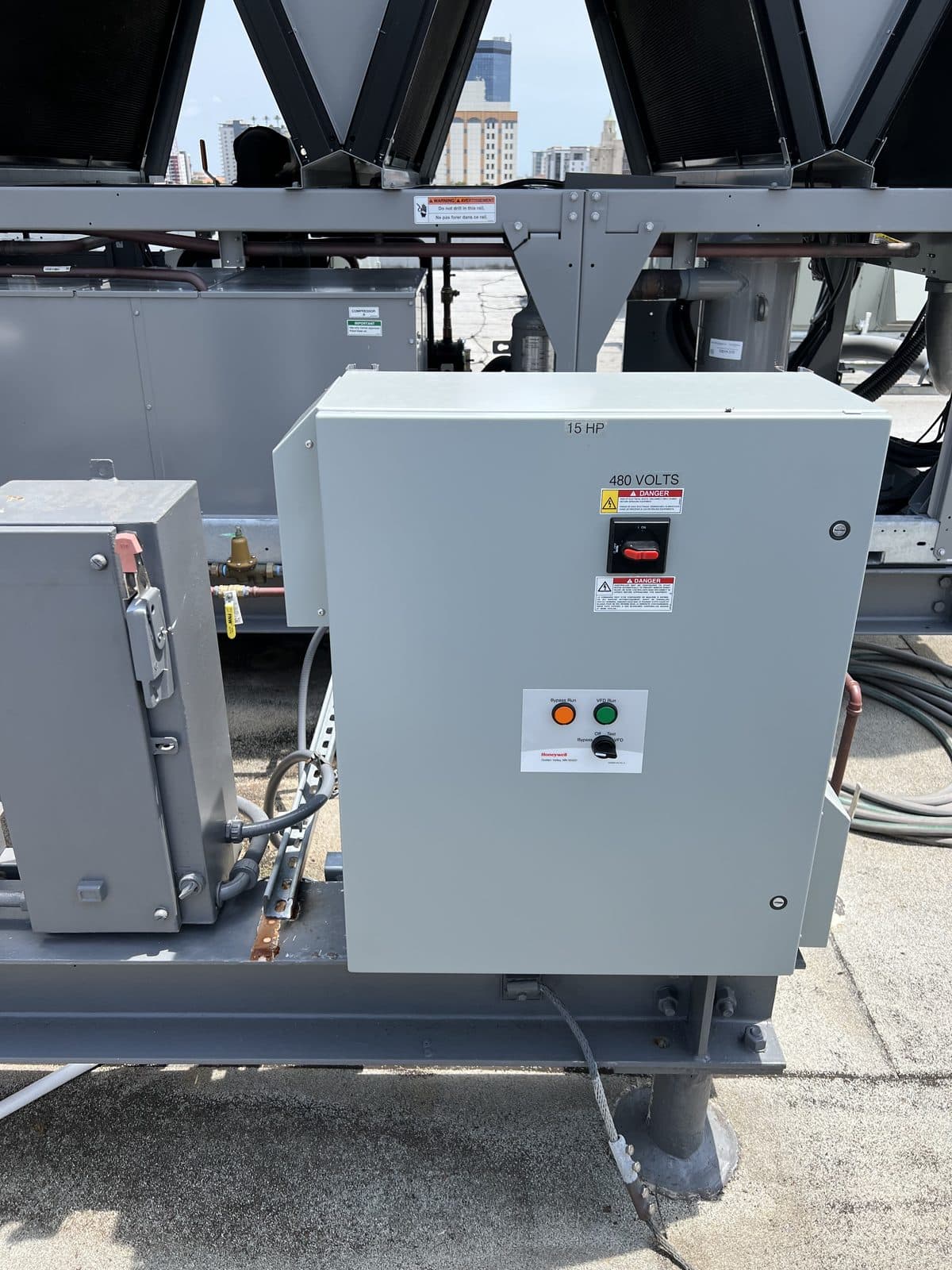
A 5 HP motor draws about 4.2 kW at full speed, roughly 36,400 kWh a year. At eighty percent speed that falls to about 19,200 kWh — a saving near 17,200 kWh annually. A 15 HP motor goes from about 105,400 kWh to 55,600 kWh, saving close to 49,800 kWh. A 25 HP motor goes from roughly 174,500 kWh to 92,000 kWh, saving about 82,500 kWh a year. A 40 HP motor saves in the region of 131,300 kWh.
Converting that to money requires your own utility rate, so multiply the kilowatt-hours saved by the energy rate on your bill, leaving demand charges aside. The annual figure grows quickly with motor size, from the 5 HP motor up to the 40 HP, and at seventy percent speed it rises substantially again.
Two honest qualifications. First, these are calculations for motors that genuinely run continuously on variable-torque loads and can actually be slowed; a motor already cycling, or one on a load with significant static head, will not follow the curve. The Department of Energy is explicit that the affinity relationships do not apply equally to every pump, fan or compressor. Second, demand charges are excluded here and can be a large part of a commercial bill, which generally makes the real saving larger rather than smaller. What we do in your building is run this same arithmetic against your measured load, your actual operating hours and your own utility rate — including demand.
The order we work in
Prove the equipment first. Refrigerant performance, airflow, coil condition, staging and runtime, so that nothing downstream is being blamed for a mechanical fault.
Then the controls and sequences. What is the equipment being told to do, when, and does the schedule still match how the building is actually occupied? A great deal of commercial waste is equipment faithfully executing instructions that stopped making sense two tenants ago.
Then the air. Outdoor air quantities verified physically rather than by what a controller reports, exhaust and return measured, and building pressure evaluated — because a building running negative pulls in unconditioned air continuously through every opening, and no equipment change fixes that.
Then, and only then, the equipment itself. If a system is genuinely oversized, mismatched to its load, or at the end of its service life, replacement is the right answer — and by that point it is a decision supported by measurements rather than an opening pitch.
What we see in the field
On a high-bill call the first thing we find is almost always something the owner assumed was fine and had not looked at in years. The single most common finding is equipment running around the clock that should be on a schedule — exhaust fans, pumps, air handlers serving space nobody occupies at night. The owner assumed the building automation system was handling it. Either the schedule was never commissioned correctly in the first place, or somebody set a manual override during a problem and the override was never cleared.
The case that surprises owners most is simultaneous heating and cooling, and it is far more common than people expect. Picture a variable air volume system with reheat. The air handler is cooling supply air down to satisfy the zones that need cooling. Meanwhile the reheat coils in the other zones are firing to warm that same air back up before it reaches the space. The chiller and the boiler are running at the same time, working directly against each other, and the meters record both.
What the owner sees is a high electric bill and a high gas bill, and they reasonably conclude they have two separate problems. They have one problem. The system is heating and cooling the same air because the controls are not managing the dead band correctly.
The correction is usually a controls adjustment rather than an equipment change — widening the dead band, raising the cooling setpoint, or implementing supply air temperature reset. Nothing gets replaced, and the reduction shows up on the next bill where it can be measured.
Frequently asked
My commercial power bill jumped and nothing changed. What should I look at first?
Start by proving the equipment is operating correctly — coil condition, airflow, refrigerant performance and staging — because a system working harder to deliver less shows up on a bill before it shows up as a comfort complaint. Then look at controls and schedules, which are the most common source of a sudden change: an override left in place, a schedule that no longer matches occupancy, or a damper that stopped moving.
Why does my rooftop unit run constantly?
Often because it cannot reject heat properly or cannot move enough air, so it runs longer to reach setpoint. A dirty or corroded condenser coil raises head pressure and increases current draw while reducing capacity. Restricted airflow does the same from the other side. Both read like undersized equipment and neither is fixed by adding tonnage.
How much will I save with variable frequency drives?
It depends on measurable properties of your building, not on the drive. Savings track motor load, existing control method, average speed after conversion, operating hours, efficiency, utility rate and demand charges — and DOE is explicit that the affinity relationships do not apply equally to every application. We calculate it from your measured load and your rate rather than quoting a number in advance.
Is an energy audit worth it for a mid-sized building?
It is worth it when it produces measurements you can act on rather than a report of general recommendations. The useful version establishes how your equipment is actually operating, how it is being controlled, and where consumption is going — so that any recommendation that follows can be traced back to something that was measured in your building.
Unit converter
Showing 1 therm in 4 other units
| Unit | Value |
|---|---|
| Btu | 100,000 |
| kWh | 29.31 |
| MMBtu | 0.1000 |
| Ccf (natural gas) | 0.9653 |
Used only for Ccf and therm conversions. Source: EIA, Heat Content of Natural Gas Consumed (U.S., 2025).
Sources: 1 therm = 100,000 Btu and 1 kWh = 3,412 Btu, from EIA. MMBtu from EIA. MBH from Wikipedia. 1 ton of refrigeration = 12,000 Btu/h from NIST. Ccf = 100 cubic feet from Wikipedia. — means no result for the current input.
High commercial power bill? Have the building measured before anyone recommends equipment.
References: US Department of Energy — variable frequency drive evaluation guidance and affinity law caveats · NIST — automated fault detection and diagnostics in commercial buildings · PNNL — sensor, damper and persistent-override faults that waste energy when uncorrected · ASHRAE — humidity control, ventilation and building pressure